

In June 2025, during the 12-day war between Israel and Iran, the state-owned Iranian media repeatedly claimed that the Iranian air defenses had downed two Israel Air Force (IAF) F-35I Adir stealth fighter jets.
The claims were dismissed by Israel as Fake News. Now, the Iranian state media has admitted that the claims were false.
Israel launched ‘Operation Rising Lion’ on June 13, 2025, deploying hundreds of Israeli fighter jets that struck Iranian targets, killed Revolutionary Guard commanders, and damaged military facilities. On the same day, Iran retaliated with hundreds of ballistic missiles and drones, leading to what came to be known as the ’12-Day War.’
Iran’s state media claimed the downing of two Israeli Air Force (IAF) F-35I Adir jets in the initial days of the conflict, right after the jets flew nearly 2,000 kilometers to carry out the precision strikes.
The claims, presented without providing any credible evidence, sparked interest as they were billed by the Iranian media as the first-ever instance of the F-35’s shootdown anywhere in the world.
“Iran has earned the distinction of being the first country in the world to successfully shoot down fifth-generation fighter jets by targeting two stealth F-35 fighters belonging to the Zionist regime,” Iran’s state-owned Press TV said at the time. These claims were reportedly amplified by other popular media outlets in the country, as well as popular social media handles that were widely reporting war-related developments at the time.
On June 14, an image of what is claimed to be the wreckage of an F-35I Adir shot down by the Islamic regime was being circulated on social media. However, it was dismissed as an AI-generated image, as reported by the EurAsian Times at the time.
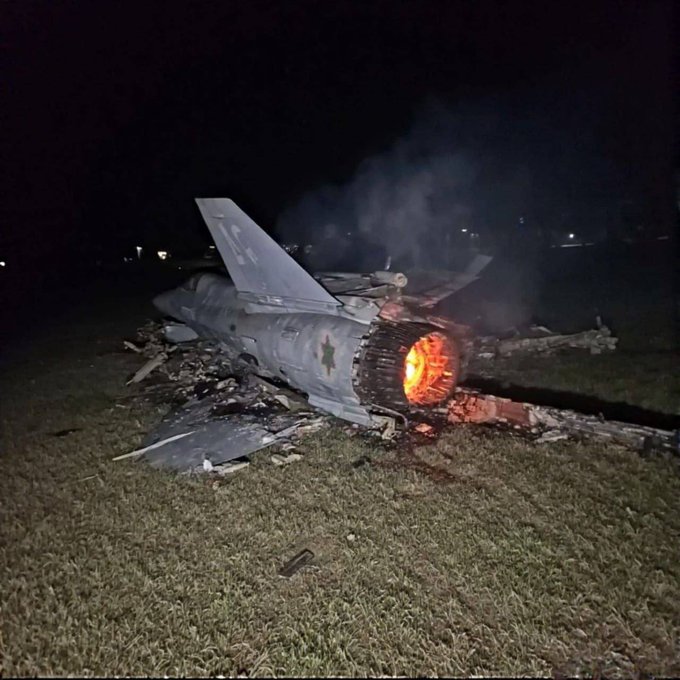
Meanwhile, the Israel Defense Forces (IDF) vehemently rejected the claims. “Fake Iranian media,” said Col. Avichay Adraee, the IDF’s spokesman. “This news being spread by Iranian media is completely baseless.”
Nearly six months after the incident, Iran’s state media has finally acknowledged that it made those claims incorrectly, noting they were based on unreliable information from a military official.
U.S.-China War: Leaked Pentagon Report Says USA Would Lose “Every Time” Without Major Reforms
During a speech at Beheshti University in Tehran, Peyman Jabali, the head of the Iranian Broadcasting Corporation, stated that his organization committed a professional blunder by airing the false reports.
“Were we in the sky to witness the fighter jet crash? Were we behind the defense system? Someone from the military officials informed us, and then they eventually realized…that the information was not credible and gave us another piece of news,” he was recently quoted as saying.
Jabali expressed regret, saying that the false reporting undermined the broadcaster’s credibility, and prophesied that media outlets shouldn’t rely on sources unless there are explicit government announcements.
U.S. Beats China To The Punch: Pulls Out F/A-18 Super Hornet & MH-60R Sea Hawk From South China Sea
He also denounced what he called a “rhetoric of weakness” coming from Iran.
“He thought that, in his opinion, the end of the Islamic Republic would be on June 16 with the bombing of the Iranian Broadcasting Corporation,” Jabali said, referring to Israeli Prime Minister Benjamin Netanyahu.
“We were proud in the war, we were proud, we resisted, we stunned the world, we pushed the regime back for years. They may not say it, but the losses that the Zionist regime suffered were not just these buildings, and the Weizmann Institute and the missile bases, but its entire computing system collapsed.”
The F-35 aircraft in question—the ‘Adir’— is a variant of Lockheed Martin’s F-35 Lightning II, custom-built for Israel. The aircraft are modified in these main areas: command, control, communications, computers, and intelligence (C4I), electronic warfare, and weapons integration. It has sensors, data-processing capabilities, Israel-developed countermeasures, and cutting-edge electronic warfare systems.
The aircraft seamlessly integrates with and shares data with the IAF’s F-15s and F-16s, ensuring the effective execution of precision-guided strikes in contested environments, such as the one carried out against Iran.
“The aircraft flew deep into Iranian territory, encountered little resistance, and returned without a single recorded loss,” as noted by Israeli officials at the time.
Additionally, the F-35I’s ability to detect, geolocate, and neutralize radar-emitting threats, such as Russian-supplied air defense systems, enabled Israel to dismantle Iran’s command-and-control networks and helped blind its defenses for subsequent strikes.
However, the F-35, like any other sophisticated stealth platform, is not invincible. For instance, during the US bombing operation against the Houthis undertaken in early 2025, a Houthi missile almost struck an American F-35 Lightning II aircraft, forcing the pilot to take evasive action.

F-35s Fly Freely Over Iran
The Lockheed Martin F-35, the world’s most popular and widely used fifth-generation aircraft, is not used to being eclipsed by any other aircraft. But, when the United States launched ‘Operation Midnight Hammer’ on June 22, the F-35s were tasked with escorting the B-2 bombers that dropped bunker buster bombs on Iran’s nuclear facilities.
Speaking at the second-quarter earnings call in July 2025, Lockheed Martin CEO Jim Taiclet said the mission was led by the F-35 and F-22, adding that these fighters provided the air dominance and defense suppression required for the bombers to reach Iran’s hardened nuclear sites.
“Our platforms operated essentially undetected in highly defended and contested airspace, underscoring the value of advanced stealth, superior electronic warfare, and broadband communications capability,” he asserted.
While the role of F-35s as escorts had already been praised, the US Air Force (USAF) revealed in November that the aircraft conducted both suppression of enemy air defences (SEAD) and provided fighter cover for the strike force as it departed Iran.
The 388th Fighter Wing, which is based at Hill Air Force Base in Utah, said that the fighters “paved the way” for the flight of seven B-2s that delivered 14 GBU-57 bunker busters, penetrating the hardened, deeply buried targets in Iran. The aircraft reportedly used the Agile Combat Employment (ACE) strategy and flew from multiple sites.
The Pentagon had previously disclosed that 125 aircraft participated in Midnight Hammer. The fighter escorts fired about thirty rounds at Iranian surface-to-air systems.
The latest info from the USAF suggests that the 388th Fighter Wing’s F-35s “were the first aircraft to penetrate Iranian airspace, suppressing enemy air defenses and escorting the B-2s to target areas.”
According to one release, “the SEAD mission calls for ‘kicking down the door,'” utilizing sensors, electronic warfare, stealth, and targeting systems to eliminate possible ground threats to the strike package.
“The effectiveness of this strike validated all of the capabilities of the F-35 we’ve been talking about for years,” Col. Charles Fallon, 388th Fighter Wing commander, said in a statement. The strike package “depended on our pilots and this aircraft to perform, and both proved more than capable.” He said the operation demonstrated the F-35 is “necessary…for today’s fight and tomorrow’s fight, wherever that may be.”
- Contact the author at sakshi.tiwari13 (at) outlook.com
- Follow EurAsian Times on Google News


