

Ukraine has carried out several historical naval attacks against Russia in the ongoing war, changing the rules of warfare forever. In one such breakthrough, the Ukrainian forces have claimed achieving the unthinkable: attacking and damaging a Russian submarine using an unmanned underwater vessel (UUV).
However, Moscow rejected that claim!
What Did Ukraine Say?
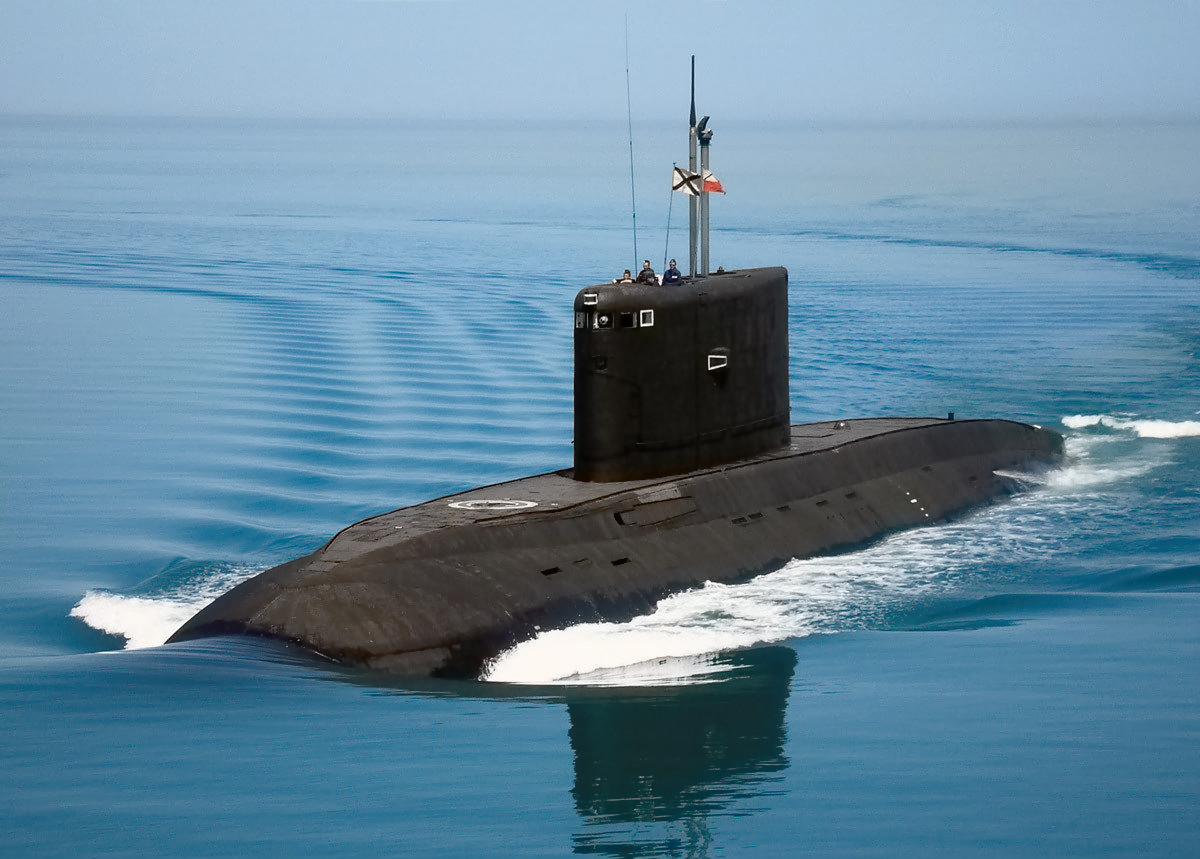
Earlier, Ukraine’s national security service (SBU) carried out what has been described as the world’s first-ever underwater drone attack on a Project 636 Varshavyanka class, or Improved Kilo class diesel-electric submarine in the Black Sea port of Novorossiysk, using the “Sub Sea Baby” drone.
Ukraine published a video of the attack as evidence. The footage begins with the said submarine in the frame, along with other vessels docked at Novorossiysk.
At approximately 16 seconds in, the submarine explodes as the footage pans from right to left, suggesting that the Ukrainian UUV may have manoeuvred through a crowded harbour to reach the target. However, the Sub Sea Baby is not seen in the video.
The Russian Ministry of Defence (MoD) said there was no damage.
“The information disseminated by special services of Ukraine about the alleged ‘destruction’ of one of the Russian submarines in the bay of the Black Sea Fleet’s Novorossiysk naval base does not correspond to reality,” the MoD wrote on Telegram.
“Not a single ship or submarine, as well as the crews of the Black Sea Fleet stationed in the bay of the Novorossiysk naval base, were damaged as a result of the sabotage. The watercraft serves normally.”
The use of the Sub Sea Baby or the exact amount of damage caused to the Russian submarine could not be independently verified. However, we do know that this is the second instance of an attack on a Russian submarine– the first being the September 2023 missile and uncrewed surface vessel (USV) attack on the Rostov-on-Don in Sevastopol.
СБУ вразила підводний човен рф у Новоросійську
Деталі за посиланням ➡️ https://t.co/2PjfguPVnM pic.twitter.com/pU2LIr7DP0
— СБ України (@ServiceSsu) December 15, 2025
There is no information on the Sub Sea Baby UUV at this point. However, Ukraine’s efforts to develop unmanned surface and underwater vessels are well documented.
For instance, it unveiled the ‘Marichka’, a kamikaze underwater drone, in September 2023, as reported by the EurAsian Times at the time. Another UUV, called Toloka, was introduced by Kyiv in February 2025.
Alexander Kamyshin, advisor to President Volodymyr Zelenskiy, announced on X that it was the first time in history that an underwater drone had neutralised a submarine. Kamyshin’s claims were echoed by several naval analysts who emphasised that Ukraine took on the mighty Russian Navy despite lacking a conventional naval force comprising destroyers, warships, and submarines.
Notably, Ukraine introduced sea drones early in the ongoing conflict to counter the dominance of the Russian Black Sea Fleet (BSF).
These unmanned systems have repeatedly dealt painful blows to Russian assets in Crimea and the Black Sea, consistently keeping the fleet on the defensive. Ukrainian sea drone strikes have sunk or damaged multiple vessels, compelling Russia to withdraw much of its fleet from the Crimean waters.
The Sea Baby unmanned surface vessels (USVs) and the Magura-class of sea drones have wreaked havoc on Russian ships. These USVs, which cost a fraction of traditional warships, enable Ukraine to continue mounting effective strikes without the risks and expense associated with manned vessels.
Ukrainian forces have innovated and launched several ‘firsts’ in the last three years. This includes downing a Su-30 and Mi-8 using surface-to-air missiles fired from its unmanned surface vessels, or releasing First Person View (FPV) drones from these sea drones.
These attacks heralded a new era of drone warfare where sea drones would act as motherships for aerial drones, a template that is likely to be used by militaries globally.
Ukraine’s Naval War On Russia As A Global Template
While Russia has been playing catch-up in the unmanned naval warfare, adapting and reverse-engineering Ukrainian designs to create its own offensive and defensive USVs, the United States has launched a massive effort to develop unmanned sea capabilities.
The United States is also actively developing sea drones, driven by the Pentagon’s Replicator program and other Navy initiatives. It aims to field thousands of autonomous naval vessels for missions such as ISR, logistics, and combat, to challenge China in the Indo-Pacific in the event of a conflict, as previously explained in detail by EurAsian Times.
Meanwhile, countries like Taiwan, which face a numerically and technologically superior force like China, are developing sea drones on a war footing as a crucial component of defence against invasion.
It is not going to be much different in the underwater domain.
Ukraine’s historic UUV attack on a manned submarine, considered the ultimate war machine, has essentially rewritten the rules of combat and opened a new chapter in asymmetric warfare.
Advanced militaries around the world, including the US and China, are expected to take inspiration and follow suit.
“A Ukrainian UUV navigated for hours and destroyed/damaged a Russian submarine. Exactly what I said about the exposition and positioning of large naval targets. If Ukraine can do this, imagine the immense damage a major power could inflict using hundreds of these, combined with aerial drones and hypersonic missiles. It is almost impossible to avoid these near-war zones. Cheap and decentralised fleet can attenuate loss if it stays in safer areas,” said Patricia Marins, a defence and security analyst specialising in Europe, Eurasia, and military affairs. “A larger UUV could even target a nuclear submarine. This will be a routine in modern ways,” she added.
For missions similar to the one that hit the Improved Kilo-class submarines, the United States, China, and numerous other countries are building their own UUVs, which are significantly more dangerous because they can be launched from motherships and submarines, increasing their range. They can strike ships and other targets at great distances. They can be used for mine-laying and reconnaissance, among other things.
For one, this could throw a spanner in the works for the United States’ projection of naval power against adversaries like China. In fact, it somewhat validates the recently leaked Pentagon report that strongly recommends developing unmanned systems rather than investing in complex technology like aircraft carriers.
China could further strengthen its Anti-Access/Area Denial (A2/AD) strategy by deploying surface and unmanned sea drones, forcing the US Navy to steer clear of waters near China.
In a Taiwan contingency or broader Pacific conflict, these UUVs could degrade US advantages in submarine warfare and carrier operations, forcing a distributed, risk-averse posture while allowing China to impose asymmetric costs.
Beijing is already pursuing a very extensive UUV and USV program, commensurate with its plans to occupy Taiwan while simultaneously checking any potential external interference from the US or its regional allies.
American submarines, traditionally hard to detect when submerged, would now face threats from autonomous UUVs in contested waters. In fact, submarines may need to avoid ports altogether or conduct brief, risky sorties to launch missiles.
Experts have noted that the UUVs’ advantages in range, stealth, and roles such as reconnaissance, mine-laying, and strikes could accelerate a shift toward unmanned or hybrid systems. This would essentially force countries like the US to invest in multi-layered underwater protections, sonar networks, and anti-UUV measures. Therefore, it reflects a shift toward unmanned systems reshaping the naval balance.
The introduction of these systems has taken the asymmetric threat Russia had been facing from Ukraine to a new level. And it may be safe to say that the era of unmanned naval warfare is here.
- Contact the author at sakshi.tiwari13 (at) outlook.com
- Follow EurAsian Times on Google News


