

Japan is reportedly planning to deploy an electronic warfare (EW) air defense unit near Taiwan that could further ignite tensions between Beijing and Tokyo.
The Japanese Ministry of Defense (MoD) is advancing plans to station an anti-aircraft electronic warfare unit on Yonaguni Island, Japan’s westernmost point, located just 110 kilometers from Taiwan, to strengthen island defenses amid rising regional tensions. The deployment is scheduled for 2026, Sankei Shimbun reported.
On December 4, 2025, the ministry co-hosted an explanation meeting with local authorities in Yonaguni Town, attended by 100 residents. At the briefing, Okinawa Defense Bureau’s director of planning, Shimo Kozo, stated that it is critical to reinforce the defense posture in the southwest and that EW units will improve the security of isolated islands.
The official emphasized that the move was not intended to attack other countries but to showcase Japan’s self-defense capabilities.
The unit would be managed by the electronic warfare unit headquarters at the Asaka Garrison located in Tokyo’s Nerima Ward, and it was clarified that the electromagnetic waves posed no health dangers, since they use the same frequency as cell phones.
Notably, the development comes just weeks after the Japanese Defense Minister Shinjiro Koizumi, during his first visit to the Yonaguni base, announced the deployment of Type 03 medium-range surface-to-air missiles to the frontline island. The Minister linked the move to Tokyo’s broader efforts to fortify its southwestern islands.
These weapons, designed to counter incoming aircraft and air-to-ground threats, underscore Japan’s deepening concerns over China’s military expansion in the East China Sea and potential contingencies around Taiwan.
“The deployment can reduce the possibility of an armed attack on Japan,” Koizumi earlier said with conviction, dismissing criticisms that the move would inflame regional instability.
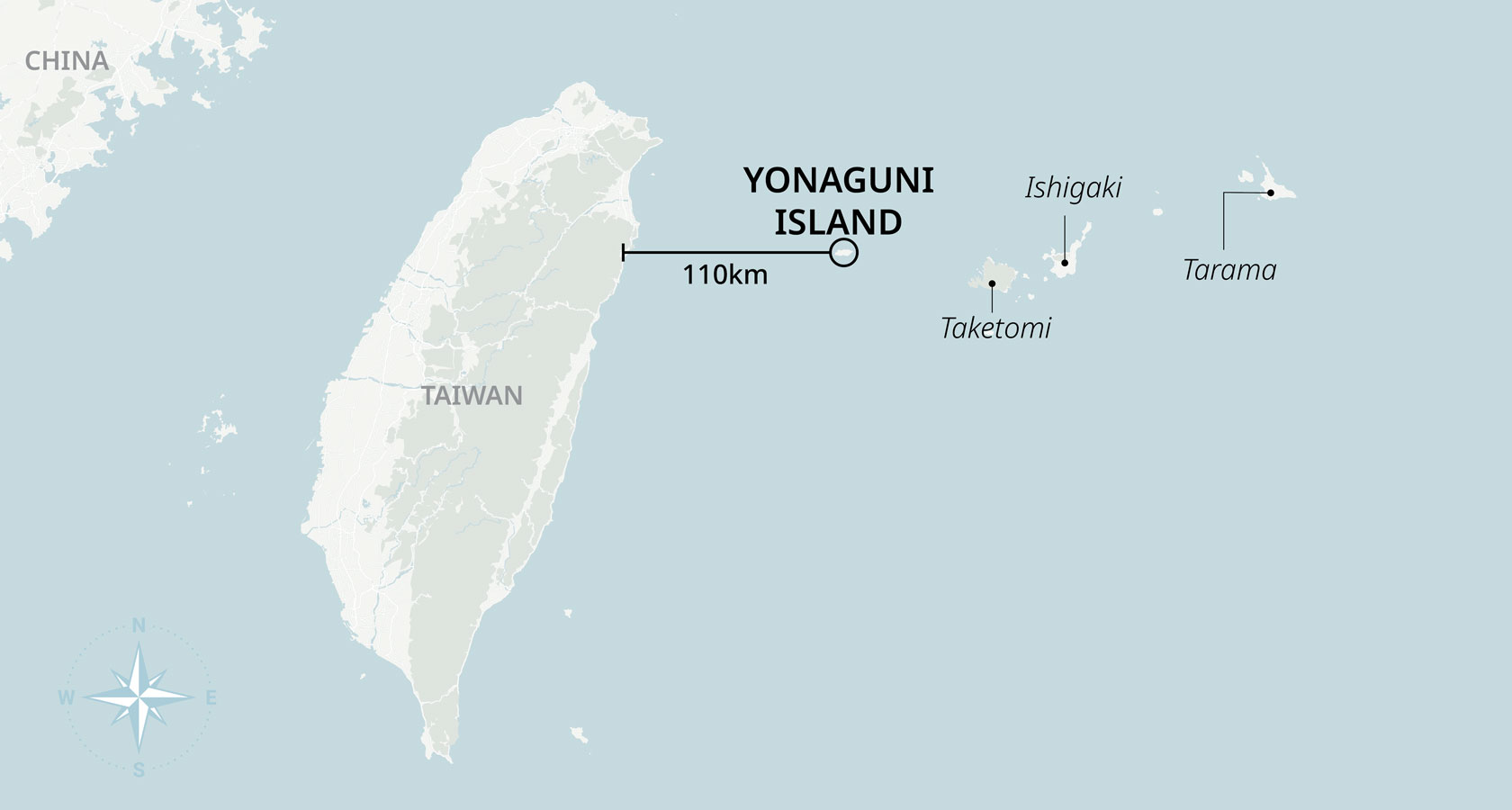
Yonaguni, Japan’s westernmost inhabited island and a popular scuba-diving spot, has hosted a Ground Self-Defense Force camp since at least 2016 and a radar unit since 2022. The base already features surveillance radars and electronic warfare units, positioning it as a frontline sentinel in any potential Taiwan Strait crisis.
This deployment left China fuming, particularly as it came days after the Japanese Prime Minister Sanae Takaichi insinuated that Tokyo would go to war with Beijing in the event of a Taiwan invasion.
Takaichi told a parliamentary session on November 7 that a hypothetical Chinese naval blockade or invasion of Taiwan was a “survival-threatening situation.”
The phrasing invoked the right to collective self-defense according to the 2015 security legislation, as previously explained in detail by the EurAsian Times.
China considers Taiwan a renegade province and has vowed to unite it with the Chinese mainland, with force if necessary.
The remarks triggered a tense diplomatic standoff between the two countries—the worst since the 2012 standoff over the Senkaku/Diaoyu Islands.
China interpreted the missile deployment announcement as a direct response to Prime Minister Takaichi’s remarks and reacted strongly. Beijing condemned the move as a deliberate provocation aimed at heightening regional tensions and risking military confrontation.
At a regular press briefing, Foreign Ministry spokesperson Mao Ning accused “right-wing forces in Japan” of “leading Japan and the region toward disaster” and reiterated that China is “firmly determined and fully capable of safeguarding its national sovereignty and territorial integrity.”
However, it must be noted that Japan has been steadily building military infrastructure in the southwestern region, mainly to counter threats posed by China’s military expansion, North Korea’s missile tests, and tensions over Taiwan and the Senkaku/Diaoyu Islands.
China’s People’s Liberation Army (PLA) has increased incursions near the islands, including carrier groups like the Shandong operating near Miyakojima in June 2025 and unmanned aerial vehicles (UAVs) between Yonaguni and Taiwan in November 2025.
In an annual report, Japan described China as the biggest strategic challenge, stating that the frequency of Chinese warships passing off the southwestern coast of Japan has tripled over the last three years, including in waters between Taiwan and Yonaguni.
Every week for the past three years, Chinese ships and planes passing through the first island chain have encountered Japanese forces stationed in this area, USNI noted.
In essence, Japan has been fortifying its southwestern region, encompassing the Ryukyu Islands, including Okinawa Prefecture and outlying islands like Yonaguni, Ishigaki, Miyako, and Mageshima, into a “southwestern wall” of bases, radars, and missile systems.
More importantly, the islands are within 110-200 kilometers of Taiwan, positioning them as potential first-strike targets or staging grounds in a US-China conflict.
Japan believes that China’s missiles or naval blockades targeting Taiwan could easily strike Japanese territory or disrupt vital sea lanes. In a similar vein, Taiwan is only 170 kilometers from the Japanese-controlled Senkaku/Diaoyu Islands. Beijing actively claims this region, and Chinese forces frequently survey the waters around it.
It is believed that any large-scale attack on Taiwan would almost certainly cross this narrow maritime buffer, risking direct clashes with Japanese patrol vessels and air defenses, or deliberate Chinese strikes to neutralize Japan’s nearby bases that could be used by the US. This may explain the militarization of Yonaguni.

Military Build-Up At Mageshima
Citing satellite imagery, the state-owned Global Times reported that Japan is rapidly advancing military development on Mageshima Island, a crucial strategic position in Japan’s southwest. It stated that several military facilities have been constructed on this remote island in just one year, with the outline of a full-scale base already emerging.
Mageshima Island is located near the mouth of the strategically significant Osumi Strait and controls a vital marine route. Japan reportedly purchased the island for 16 billion yen to train US aircraft carrier-based planes (FCLP, Field Carrier Landing Practice).
A runway is currently being built on the island, and China believes the island could host a facility for both US training and Japan’s “military ambitions.”
According to state media, Tokyo purchased the island with the primary objective of turning it into an “unsinkable aircraft carrier.”
“Two high-resolution satellite images obtained by the Global Times—captured by Chinese commercial satellites—show that Mageshima Island, Japan’s second-largest uninhabited island, has effectively transformed into a massive construction site. The two images were taken in May 2024 and September 2025. In the May 2024 image, large main structures were barely visible, whereas by September 2025, the outline of an airstrip under construction could be clearly seen. The number of support vessels surrounding the island had also increased significantly,” the report stated.

Chinese military affairs expert Zhang Junshe said: “Turning Mageshima into a military base can be seen as Japan’s preparation for military involvement in the Taiwan question — and it is a crucial step.”
He went on to say that one purpose of the Mageshima facility is to strengthen Japan’s authority over the Osumi Strait, and reckoned that Japan could leverage the base to block the strait in the event of a potential war.
Furthermore, the expert said that Japan intends to regularly train F-35B carrier-based aircraft on Mageshima Island. He claimed that during a war, the island may act as a “springboard,” allowing F-35Bs to launch straight from Mageshima Island to threaten Chinese aircraft and ships operating in the East China Sea or even targets near China’s eastern shore.
While Japan has been bolstering its military for more than a year, these deployments and military activity are now being seen with enhanced suspicion in China due to heightened tensions triggered by the Japanese Prime Minister’s remarks.
- Contact the author at sakshi.tiwari13 (at) outlook.com
- Follow EurAsian Times on Google News


