

Israel is ramping up the production of the Arrow interceptor missiles that have been extensively deployed by the Israel Defense Forces (IDF) to counter Iranian ballistic missiles.
The Israeli Defense Ministry announced the decision to increase production, stating that the “agreement with Israel Aerospace Industries will enable a substantial increase in the production rate and quantity of Arrow interceptors.”
The Arrow system forms the top layer of Israel’s layered air defense network: the Arrow 2 operates both within Earth’s atmosphere and in space, and Arrow 3 intercepts above Earth’s atmosphere. Meanwhile, David’s Sling, in the next layer, was created to target medium-range threats, including drones, short-range ballistic missiles, and cruise missiles, and the third layer consists of Iron Dome for intercepting short-range rockets.
The decision to bolster Arrow production comes amid reports that Israel has depleted its stockpile of these prized interceptors. For instance, Israeli news outlet Semafor, citing unidentified US officials, reported that Israel was “running critically low on ballistic missile interceptors” just two weeks after the conflict began on February 28.
Later, the London-based RUSI defense think tank stated that the US, Israel, and their regional allies have burned through vast quantities of missiles and interceptors since the end of February, adding that 81.33% of Israel’s pre-war Arrow interceptor stocks had already been depleted.
Further, the think tank predicted that the remaining stockpiles would likely “be completely expended by the end of March”.
The reports, however, were put to rest by Israeli Defense Minister Israel Katz. “Israel has sufficient interceptors to protect its citizens, and the current move is intended to ensure continued operational freedom and the necessary endurance,” he stated. “The Ayatollah regime should know: Israel is strong and resilient, prepared to continue the campaign as long as necessary, and continues to enhance its defensive and offensive capabilities during combat.”
Each Arrow 2 interceptor costs an estimated $1.5 million, and the Arrow 3s cost around $2 million each. Moreover, the production timelines are very long, and an empty arsenal of Arrow interceptors would probably leave a gaping hole in Tel Aviv’s air defense network and embolden Israel’s adversaries.
According to reports, the Ministry of Defense and IAI had signed a separate agreement in December 2025 valued at billions of shekels to increase the military company’s production of Arrow 3 interceptor missiles. In fact, Israel is known to have accelerated its interceptor production after Hamas’s October 7, 2023, attack.
In the ongoing war with Iran, the Arrow 3 has proved particularly effective against high-altitude and cluster-warhead missiles by destroying them before submunitions could spread. Although the successful strikes on Israeli territory suggest that even the most formidable air defenses deployed can be bypassed, the Arrow-3 is nonetheless regarded as a highly effective system.
What Do We Know About The Arrow-3?
Arrow 3 is designed to intercept incoming ballistic missiles far above Earth’s atmosphere during the spaceflight portion of their trajectories, including those with conventional, nuclear, chemical, or biological warheads.
The development of the Arrow series has been significantly supported by the United States since the 1980s, with Boeing playing a direct role in the development of the Arrow 3 system.
It has been designed primarily to counter a variety of ballistic missiles, including the most lethal long-range weapons, such as intercontinental ballistic missiles (ICBMs).
The interceptor is smaller, lighter, and more agile than the Arrow-2. It features a two-stage solid-fuel booster and a highly maneuverable kinetic-kill vehicle equipped with divert motors, enabling dramatic course corrections in space.
Notably, the interceptor uses hit-to-kill technology, destroying targets through direct high-speed collision rather than an explosive warhead.
The kill vehicle includes a gimbaled electro-optical seeker with significant pivot capability for hemispheric coverage and precise target discrimination, even against sophisticated threats like maneuvering re-entry vehicles that are harder to intercept.
The Arrow-3 has a range of about 2,400 kilometers and can engage targets at an altitude of 100 kilometers. It achieves hypersonic speeds, reportedly in the range of Mach 9 to Mach 17, depending on the profile, which enables it to cover a vast defended footprint.
The Arrow-3 integrates with long-range radars such as the Super Green Pine or the upgraded EL/M-2080 family for detection and tracking.
A single battery of Arrow-3 can reportedly launch salvos of five or more missiles in about 30 seconds. The Arrow-3 features mobile, truck-mounted launchers with vertical-launch canisters, making the system highly mobile and survivable.
While Arrow 2 operates in the endo- or upper-atmospheric layer with a fragmentation warhead and a shorter range, Arrow 3 focuses on true space-based intercepts using pure kinetic energy. This leads to increased speed, altitude reach, and maneuverability.
Further, it is lighter and possibly less expensive per interceptor—roughly $2 to $3.5 million, depending on the source and configuration. The two systems, nonetheless, complement each other in layered defense, with Arrow 3 handling longer-range and higher-threat ballistic missiles.
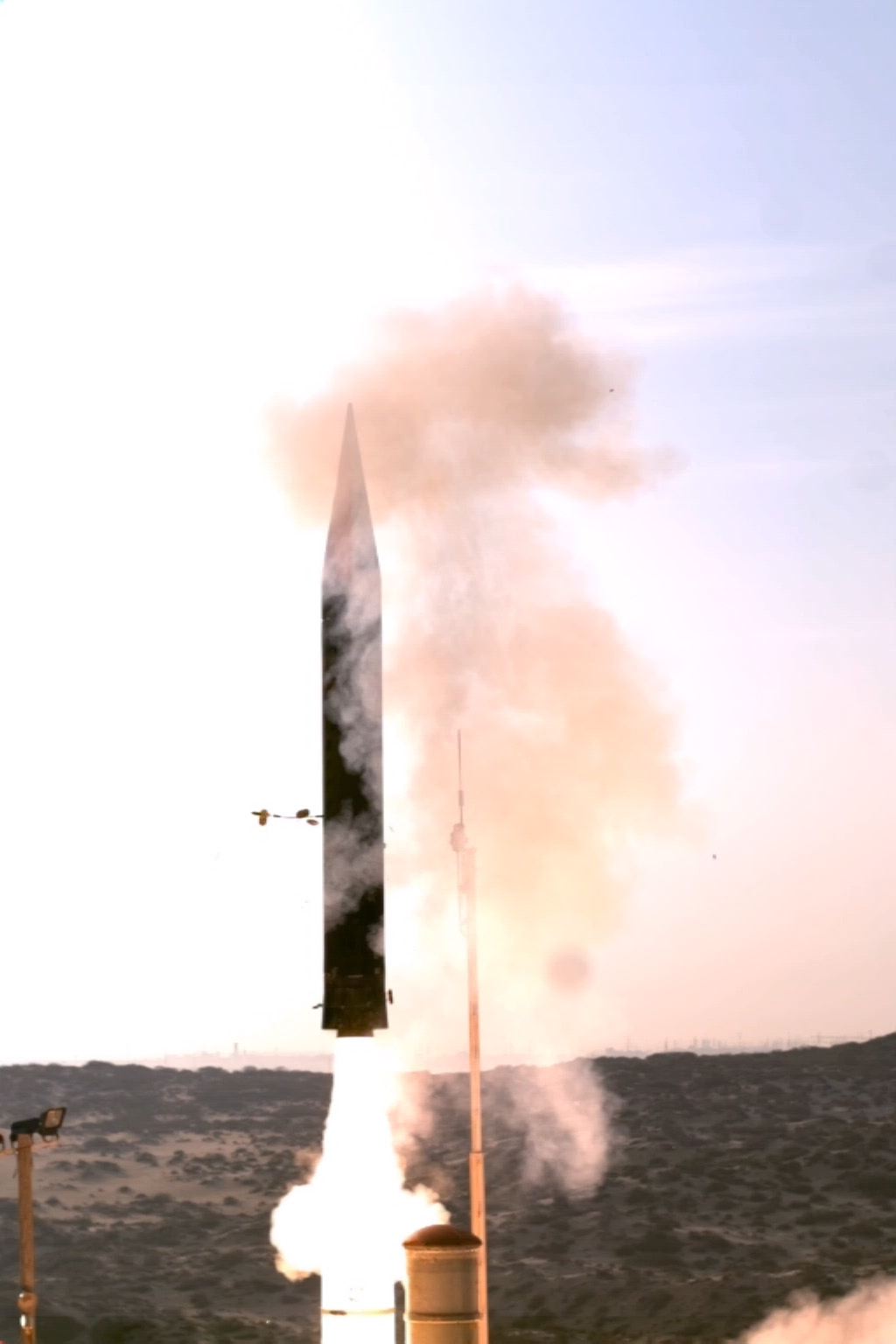
Israel also claims it has robust electronic defenses against jamming and that its systems are built to operate in contested environments. It can also easily distinguish real targets from decoys with its advanced sensors.
The system made its combat debut in November 2023 when it intercepted a Ghadr-110 ballistic missile launched by Houthis. It has since been deployed to defend against two Iranian attacks on Israel in April and October 2024, respectively, as well as the “12-Day War” of June 2025. More recently, the system has been defending Israeli skies since the US and Israel launched joint attacks on Iran on February 28, 2026.
Israeli officials have so far reported high success rates across hundreds of intercepts when combined with other layers, such as David’s Sling and Arrow 2, though exact figures are often classified.
The system has caused quite a stir in the export market with its combat-worthiness, but that has not translated into export sales.
The only known customer of the Arrow-3 system is Germany, which signed a major deal worth approximately $3.5 billion for the system in 2023.
While describing the Arrow as “one of the best systems, if not the best,” German Defense Minister Boris Pistorius said at the time of signing the deal. “It is, without exaggerating, a historic day for both our countries.”
The acquisition was made to bolster Germany’s air and missile defense as part of its European Sky Shield Initiative, which was prompted by heightened concerns over Russian missile threats, as previously reported by the EurAsian Times.
The Arrow-3 is expected to complement Germany’s existing air defense network consisting of the IRIS-T and Patriot systems, providing high-altitude, exo-atmospheric interception capability.

The first system was reportedly delivered to the German Armed Forces and activated at Holzdorf Air Base in December 2025. The German military declared initial operational capability shortly afterward.
The German Bundestag approved an expansion of the Arrow 3 contract with Israel, including significantly more Arrow 3 interceptors and launchers, along with a commitment to ramp up production rates to meet the increased demand. This follow-on deal was formally signed on January 11, 2026, bringing the total value to approximately $6.5 billion.
The Arrow-3 will likely be integrated into the European Sky Shield Initiative, which aims to build a multi-layered European air and missile defense network against long-range ballistic threats. In fact, Germany has also been eyeing the Arrow-4, a more advanced successor of the Arrow-3 system.
When asked by The Jerusalem Post if additional European countries would also purchase the Arrow from Israel, German Air Defense Commander Col. Dennis Kruger said, “I believe so. Germany has closed the capability gap. But there are threats all over Europe. Germany is moving in first and setting a good example. We believe other nations will follow.”
In addition to Germany, other European countries, including Azerbaijan, Poland, Romania, and Scandinavian states, also showed interest in the system.
- Contact the author at sakshi.tiwari13 (at) outlook.com
- Follow EurAsian Times on Google News


