

The Indian Air Force (IAF) MiG-21, which flew into the sunset to an emotional farewell in September 2025, is set to receive another lease of life.
The MiG-21 is being ‘revived’ as part of the IAF’s “Heritage Flight” program, Indian newspaper, The Tribune reported.
The Indian Air Force Heritage Flight is India’s official vintage aircraft flying program, established to preserve and showcase the rich history, legacy, and prowess of the Indian Air Force.
Originally known as the “Vintage Aircraft Flight,” the IAF’s vintage wing was established at the Air Force Station in Palam in April 1988 but was disbanded the following year.
After being brought back to life in 2012, it was christened the “Heritage Flight.” Its inventory of vintage aircraft currently includes the British-origin de Havilland DH-82 Tiger Moth, the US-origin T-6G Harvard, and the Douglas C-47 Dakota.
Last month, the restored Hindustan Trainer-2 (HT-2) was displayed for the first time during the 93rd Indian Air Force Day celebrations. HT-2, the first indigenously developed aircraft, flew alongside the Tiger Moth to mark the occasion.
The IAF praised the flight, saying that “it was the flight of history itself.” Similarly, reports last year suggested plans to restore the MiG-23 and integrate it into the Heritage Flight program.
While the MiG-23 never made it, the IAF is currently evaluating the MiG-21 aircraft in Nashik for inclusion in the program. There is no clarity about the number of aircraft that will be added to the heritage fleet, the reports noted.
The restoration of legacy aircraft could be a herculean task due to challenges related to aircraft and engine maintenance and the sourcing of spare parts. However, since the MiG-21 was license-produced by Hindustan Aeronautics Limited (HAL) in the country, an inventory of spare parts already exists. Moreover, with decades of experience, the IAF also has a thorough plan for sub-unit replacement.

In the eventide of its service life, the MiG-21 took some very memorable sorties. For instance, at the Aero India 2019, Group Captain Nirmalya Dasgupta executed a breathtaking vertical Charlie maneuver with his MiG-21. The photographs of the maneuver went on to become the most iconic images of the fighter ever shared.
The same year, on the 20th anniversary of the Kargil War, the then Chief of Air Staff, Air Chief Marshal BS Dhanoa, led a solemn 3-aircraft “missing man” formation over Bhatinda, the home base of the 17 Squadron during the Kargil War. This flight was a tribute to the bravehearts of the Kargil War.
On the occasion of the 91st Air Force Day in 2023, the MiG-21s conducted their last aerial display at the Sangam area of Prayagraj, Uttar Pradesh. This was the last iconic flight as the MiG-21s shared the skies with the Rafales — showcasing the past and future of the IAF.
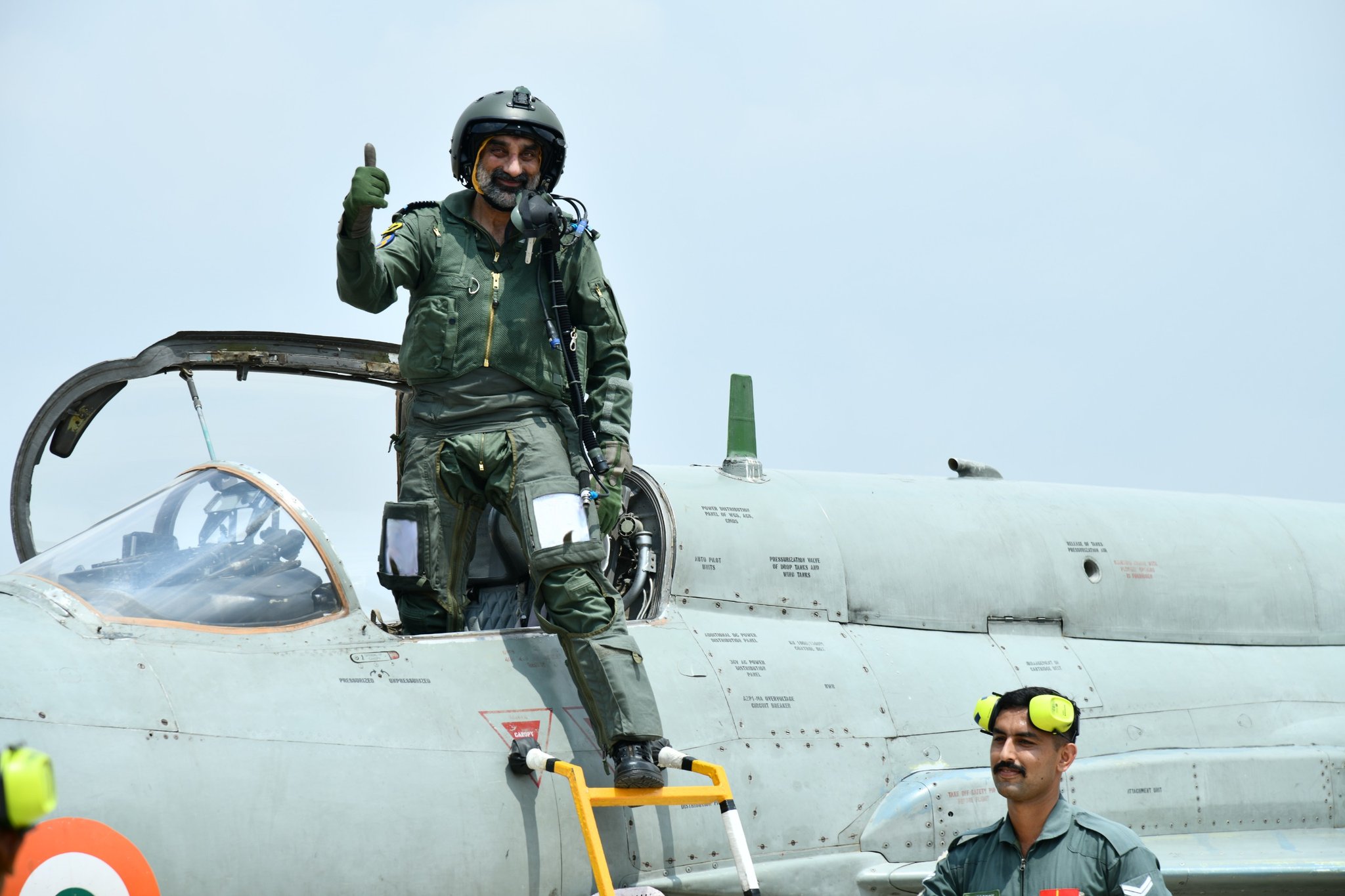
Ahead of the MiG-21’s official retirement on September 25, the Indian Air Force (IAF) chief, Air Chief Marshal Amar Preet Singh, flew solo sorties on the legacy aircraft.
Speaking fondly of the aircraft, the Chief of the Air Staff said, “The MIG-21 has been the workhorse of the Indian Air Force. It was inducted in 1964 and has continued in service ever since. My first flight in a MiG-21 was in 1985. It was a simple yet remarkable aircraft to fly, though it demanded rigorous training.”
The Indian Air Force’s MiG-21, the country’s first supersonic fighter-interceptor, was retired on September 26, 2025, in Chandigarh after 62 years of service. The aircraft stood down with a ceremonial flypast over Chandigarh (where it was first inducted into service), which concluded with a water cannon salute.
The images and videos of the last sortie flown by this legendary aircraft were widely shared, as emotional tributes poured in from IAF veterans and aviation enthusiasts alike.
For everyone who bade an adieu to the MiG-21, this was the last time they saw the aircraft flying fearlessly into the skies.
The MiG-21s, however, aren’t done yet.
The aircraft will soon enter an all-new chapter and soar into the skies, becoming a lasting tribute to their illustrious career in the Indian Air Force.
The MiG-21—An IAF Workhorse
Bought from the Soviet Union, the MiG-21 catapulted the Indian Air Force into the jet age in 1963. It was India’s first non-Western fighter jet, and relatively inexpensive because India was able to license and produce the aircraft domestically, reducing its reliance on imports and keeping costs low, making it practical to maintain a large fleet.
The MiG-21 quickly became a cornerstone of the IAF, serving as a frontline interceptor, fighter-bomber, and trainer for about six decades.
It faced off against Pakistan Air Force (PAF) aircraft like the F-86 Sabre, F-104 Starfighter, and Mirage III. It was credited with several air-to-air victories during the 1971 war, scoring 4–5 kills, primarily on the Western Front, where most dogfights occurred.
The bombing of the Governor’s House in Dhaka on December 14, 1971, conducted by the MiG-21, is considered a crucial event that accelerated the collapse of the Pakistani forces in the region during the Indo-Pakistani War of 1971.
It was a devastating precision strike that targeted a high-level meeting of East Pakistan government officials. So, while the MiG-21 played a limited role during the 1965 Indo-Pakistan war due to its recent induction, it was undoubtedly the tip of the spear during the 1971 War.
During the Kargil War, it was used in combat for close air support (CAS) and interdiction, focusing on Pakistani supply routes, bunkers, and positions atop peaks like Tiger Hill. Although the Mirage 2000s emerged as the war heroes of this conflict, the MiG-21s proved to be instrumental by delivering unguided munitions to enemy positions.
At the time, the MiG-21’s high speed and ability to operate at altitude made it suitable for quick reconnaissance runs, and the data from MiG-21s helped the IAF target key positions.
Interestingly, the MiG-21 also shot down a Pakistan-operated Atlantique aircraft (called flight Atlantic-91) that entered the Indian airspace less than a month after the end of the Kargil War.
The aircraft had breached Indian airspace, and despite being told by a MiG-21 pilot to land, it carried out threatening maneuvers, turning toward one of the MiG-21s that had been scrambled to chase it that day.
An R-60 air-to-air missile was fired by a MiG-21 at the Atlantic-91 when the aircraft was merely five kilometers away from the International Border.
Several years later, in 2004, the MiG-21 had the opportunity to demonstrate its prowess against an ace American fighter. The MiG-21 and the US F-15 competed in the inaugural Cope India 2004 military drill, where the Indian jets crushed the American Eagles, who had the enviable record of 100 kills and no losses.

Low radar visibility, instantaneous turn rate, and “jackrabbit acceleration” were critical factors during Cope India. Plus, its new helmet-mounted sight and high-off-boresight R-73 air-to-air missiles turned the MiG-21 into a “Great Equaliser” in the WVR (within visual range) combat scenario.
The MiG-21 has seen action in various wars, but its most notable combat performance in recent memory is undoubtedly against the F-16.
After India launched an airstrike on a Jaish-e-Mohammed (JeM) terrorist compound in Balakot, Pakistan, on February 26, 2019, a large-scale aerial battle erupted with a Pakistani response on February 27, 2019. According to publicly available information, the IAF deployed a mix of combat aircraft, including MiG-21 Bisons, Mirage 2000s, and Su-30MKIs, while the PAF reportedly utilized F-16s, JF-17s, and other aircraft.
In the ensuing combat between the two sides, Wing Commander Abhinandan Varthaman (now Group Captain), flying a MiG-21 Bison, got into a duel with a PAF F-16 during the fierce air combat. The IAF claimed that Wing Commander Varthaman managed to down a PAF F-16 using an R-73 air-to-air missile before his own aircraft was hit, which forced him to eject behind enemy lines, in Pakistan-occupied Kashmir.
While the downing was repeatedly denied by Pakistan, the IAF released AWACS radar images that showed the paths of Pakistani and Indian aircraft, with one of the Pakistani jets disappearing in the second image, indicating it was shot down. Additionally, the wreckage of an F-16 AIM-120C AMRAAM air-to-air missile, which was widely known to be only compatible with the F-16, was displayed before the media as proof.
Over the years of its service, the MiG-21 was upgraded into many variants, notably the MiG-21 Bison, which featured improved avionics, radar, and weaponry, extending the aircraft’s operational relevance into the 2000s and allowing it to remain effective in air defense and ground attack roles despite its age.
India was expected to have a replacement for the MiG-21 ready by the 1990s. However, delays in the LCA Tejas program and the lack of alternatives, coupled with plummeting squadron strength, forced the IAF to upgrade the jets and keep them in the skies. Amid persistent threats from Pakistan and China, the MiG-21 filled critical gaps in numbers and roles, especially for short-range air defense and tactical missions.
The MiG-21 eventually earned the infamous moniker “Flying Coffin” due to a high number of crashes, which were mainly attributed to its aging airframe, demanding maintenance, and pilot errors in a challenging flight envelope. However, several IAF veterans have criticised the name-calling, dismissing it as inappropriate and exaggerated.
“The media has coined these phrases (Widowmaker and Flying Coffin). These are derogatory. I have been flying that aircraft for a long time,” Air Commodore Nayani earlier told the EurAsian Times, expressing disdain at the ignorance.
The MiG-21 fought valiantly for India whenever it was called upon to do so. Now, it will fly in the Indian skies to honour the legacy it has left behind.
- Contact the author at sakshi.tiwari13 (at) outlook.com
- Follow EurAsian Times on Google News


