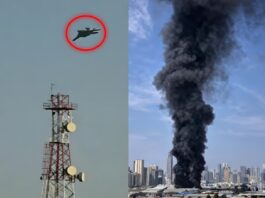
Qatar has shot down two of Iran’s Soviet-era Su-24 jets, Doha’s defence ministry said in a statement.
If true, the downing of two Iranian Su-24 fighter-bombers approaching Qatari airspace marks the first reported instance of Qatar downing a manned aircraft.
“Qatar Emiri Air Force successfully shot down two (SU24) aircraft coming from the Islamic Republic of Iran. They also successfully intercepted seven ballistic missiles through air defences, and intercepted five drones by Qatar Emiri Air Force and Qatar Emiri Navy Forces, which targeted several areas in the state today,” the defence ministry said.
It did not elaborate on the fate of the Sukhoi Su-24 bombers’ pilots. It was the first time Qatar Air Force engaged a manned Iranian warplane after three days of bombardment.
Iranian officials have not commented on the loss of the aircraft.
The Su-24, a variable-sweep wing aircraft acquired by Iran in the 1990s from Iraq during the Gulf War. The fighter-bomber remains a mainstay of the Iranian Air Force, despite being almost obsolete when compared to US and Israeli warplanes.
U.S. Central Command (CENTCOM) has not issued a statement on the Qatari shootout, but the Pentagon has emphasized ongoing efforts to degrade Iran’s ability to project power amid the conflict, which has seen hundreds of fatalities in Iran and regional spillover.

Iran Strikes Qatar
Qatar’s state-run energy firm said on Monday it had halted liquefied natural gas production following Iranian attacks on facilities at two of its main gas processing bases.
“Due to military attacks on QatarEnergy’s operating facilities in Ras Laffan Industrial City and Mesaieed Industrial City in the State of Qatar, QatarEnergy has ceased production of liquefied natural gas (LNG) and associated products,” the company said in a statement.
Earlier, Qatar’s defence ministry said one Iranian drone “targeted an energy facility in Ras Laffan Industrial City, belonging to QatarEnergy”, referring to the firm’s onshore gas processing base 80 kilometres (50 miles) north of Doha.
Another “targeted a water tank belonging to a power plant in Mesaieed”, the statement said, referring to an area 40 kilometres (25 miles) south of the Qatari capital, which is also a key site for Qatar’s natural gas production.
There were no reports of casualties, the defence ministry added.
The Dutch TTF natural gas contract, considered the European benchmark for LNG prices, jumped almost 45 percent to more than 46 euros ($54).
The Gulf state is one of the world’s top liquefied natural gas producers, alongside the United States, Australia, and Russia.
Jamie Ingram, managing editor of Middle East Economic Survey (MEES), said the halt was “an unprecedented development, with Ras Laffan the largest single LNG facility on the planet,” warning there was “scope for prices to rise significantly”.
He said the move was “made from an abundance of caution rather than one forced by the scale of the drone attack earlier today”.
“It’s possibly also intended to drum up international support,” Ingram added.
Justin Alexander, an economic expert on Gulf issues and director of Khalij Economics, said it was “clearly a precautionary move” given strikes on Ras Laffan and risks to “extremely flammable gas facilities”, adding the main market impact was “the closure of Hormuz”, blocking nearly a quarter of global supply.
He added that the QatarEnergy suspension “could increase the delay to the resumption of normal supplies once Hormuz reopens”.
While Iran has not officially closed the Strait of Hormuz, through which around 20 percent of global seaborne oil passes, its Revolutionary Guards have warned against transiting the waterway, leaving it effectively shut.
Qatar shares the world’s largest natural gas reservoir with Iran.
QatarEnergy estimates the Gulf state’s portion of the reservoir, the North Field, holds about 10 percent of the world’s known natural gas reserves.
In recent years, Qatar has inked a series of long-term LNG deals with France’s Total, Britain’s Shell, India’s Petronet, China’s Sinopec, and Italy’s Eni, among others.
Agence France-Presse