

Beset with delays and technical troubles, the US Army’s Dark Eagle hypersonic missile is expected to feature a longer range and a more lethal warhead than previously anticipated.
This was disclosed on December 12, 2025, when the US Secretary of Defence Pete Hegseth visited Redstone Arsenal in Huntsville, Alabama, to preside over the official designation ceremony for the new permanent headquarters of the US Space Command (SPACECOM).
It was a controlled media event recorded by C-SPAN and other local media outlets.
Hegseth’s tour of Army facilities offered a chance for informal briefings by senior Army commanders from the Rapid Capabilities and Critical Technologies Office (RCCTO) on ongoing programs, such as the long-awaited Long-Range Hypersonic Weapon (LRHW), which was named ‘Dark Eagle’ in April 2025.
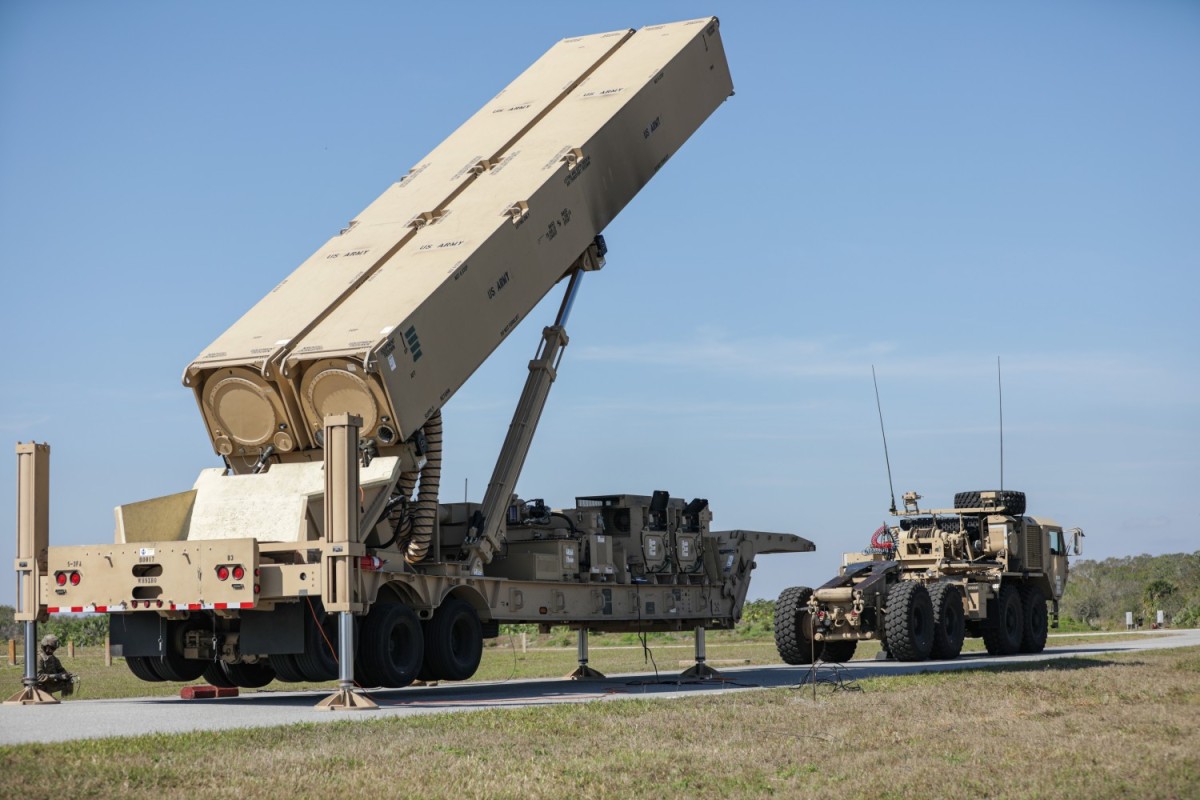
Dark Eagle is a trailer-launched hypersonic boost-glide vehicle system with a stated speed of Mach 17, as already widely known. The weapon system, poised to become the first American hypersonic weapon to achieve operational capability, also has a naval variant known as the Intermediate Range Conventional Prompt Strike (IRCPS), which is planned for deployment aboard the Zumwalt-class warships.
Lt. Gen. Francisco Lozano, Director of Hypersonic, Directed Energy, Space, and Rapid Acquisition, informed Hegseth that Dark Eagle’s range is 3,500 kilometres.
This represents a significant increase over the previously reported range of 2,776 kilometres and would likely enable the US Army to launch hypersonic strikes on high-value targets inside China from forward US bases, such as those in Okinawa, Japan, in the event of a potential Taiwan contingency.
Currently, there is no information on whether the range has been extended as the weapon has matured, or whether the Pentagon deliberately withheld the actual figures for security reasons in the past. Additionally, there is no clarity on whether the Navy’s variant has a similar range.
Another major disclosure was made by an unidentified Army officer who said the Dark Eagle has a warhead “under 30 pounds.”
This took many by surprise, given that the size is relatively modest for a long-range weapon. The officer further explained that the warhead’s sole purpose was to release its “projectiles,” which would then impact an area the size of the parking lot they were standing in.
The design of this missile system essentially relies on the hypersonic glide vehicle’s extreme speed and precision manoeuvring to deliver a destructive impact through kinetic force rather than a large explosive payload, reducing size and weight for better booster compatibility. However, the officer also noted that a blast fragmentation warhead would aid in rendering softer targets, such as radar installations and air defence batteries, inoperable.
The system can cover its full range in under 20 minutes, the officer added. This would allow rapid response in contested environments.
Notably, the kinetic energy warhead likely addresses longstanding Pentagon skepticism about Dark Eagle’s battlefield effectiveness, particularly its lethality against hardened or defended targets. The FY2024 Annual Report from the Director of Operational Test and Evaluation (DOT&E), released in early 2025, stated there was “insufficient data” to assess the system’s operational effectiveness, lethality, suitability, and survivability.
The Army has faced several technical challenges that have delayed the missile’s development. In fact, early flight tests, including the end-to-end December 2024 testing, demonstrated glide and range but not integrated kill-chain performance against “threat-representative” scenarios.
These concerns were echoed in multiple congressional briefings and GAO (General Accountability Office) audits.
However, the program has been accelerating. A battery of Dark Eagle is currently based with the 1st MDTF in Washington and the 3rd MDTF in Hawaii, with plans to forward-base in the Indo-Pacific or Europe.
Additionally, the weapon system was deployed in Australia during the Talisman Sabre military drills, marking the first overseas deployment of the sophisticated system.
However, the system has not yet achieved full operational capability (FOC).
The Army hoped to have the weapon system operational by the end of this financial year. It’s unclear where that schedule stands at the moment, but the release of this new information suggests the Pentagon is poised to declare the system operational soon.
The Dark Eagle Is Coming
The operationalization of the Dark Eagle weapon system would be a big milestone for the United States, which has been playing catch-up with its rivals and adversaries in the hypersonic race.
The primary US adversary in the world, China, has arguably emerged as the world leader in hypersonic capabilities. At least two additional hypersonic weapons emerged in the last year—the DF-27 and an air-launched variant of the YJ-21, respectively.
U.S.-China War: Leaked Pentagon Report Says USA Would Lose “Every Time” Without Major Reforms
Meanwhile, Russia has already used two of its hypersonic weapons—the Kinzhal and Zircon—in combat against the Ukrainian forces. Incidentally, even countries that are considered rogue, like Iran and North Korea, are alleged to have operational hypersonic weapons.
The Dark Eagle will be crucial in the event of a conflict with China, which is (theoretically) always a possibility due to the impending invasion of Taiwan.
China has been pursuing an anti-access, area-denial strategy with missiles directed at ships and aircraft in the South China Sea and near Taiwan.
The Dark Eagle will give the US Army a long-range, strategic attack capacity to engage time-sensitive targets, reduce enemy air defences, and defeat Chinese anti-access/area denial (A2/AD) systems.
The weapon system has become far more deadly due to the upgraded warhead and extended range.
A Dark Eagle battery comprises four trailer-based launchers, each of which accommodates two canister missiles. These launchers are transported on M870 trailers, towed by eight-wheeled M983A4 HEMTT tractor-trailer trucks.
In addition, a six-wheeled command vehicle serves as the Battery Operations Center, supervising the Dark Eagle system’s operations.

The unpowered hypersonic boost-glide vehicle perched on a rocket booster is one of Dark Eagle’s unique design elements. The rocket booster elevates the conical hypersonic vehicle to the desired height and speed before release. After that, it drops along a short, atmospheric flight path at hypersonic speeds—that is, any speed greater than Mach 5.
This truck-launched, land-based weapon can launch hypersonic missiles at speeds over 3,800 miles per hour. These missiles swiftly land on their targets, giving adversaries little time to react, by rising to the high reaches of the Earth’s atmosphere and staying just out of range of conventional air and missile defence systems.
The missile is optimized for precise strikes and is built to carry a conventional warhead. The missile is designed to be road-mobile for quick deployment and resistance to hostile targeting. It can be quickly transported aboard the C-17 for global reach.
With sophisticated thermal protection mechanisms, it can endure intense heat (thousands of degrees) during hypersonic flight.
The weapon system can operate within the Army’s Integrated Air and Missile Defence Battle Command System (IBCS), which means it can integrate with the Army, Navy, and Air Force, as well as with allied partners, for synchronized strikes across domains.
U.S. Abrams Tanks Get “Kamikaze Punch”; GDLS Unveils Switchblade Drone Launcher For BLOS Strikes
- Contact the author at sakshi.tiwari13 (at) outlook.com
- Follow EurAsian Times on Google News


