

China is evaluating its J-16 multirole fighter, touted as the most advanced Flanker, against the French Rafale jets in a simulation exercise. The move comes after Pakistan’s Chinese-origin J-10C fighters clashed with Indian Rafales during the May 2025 Indo-Pak conflict.
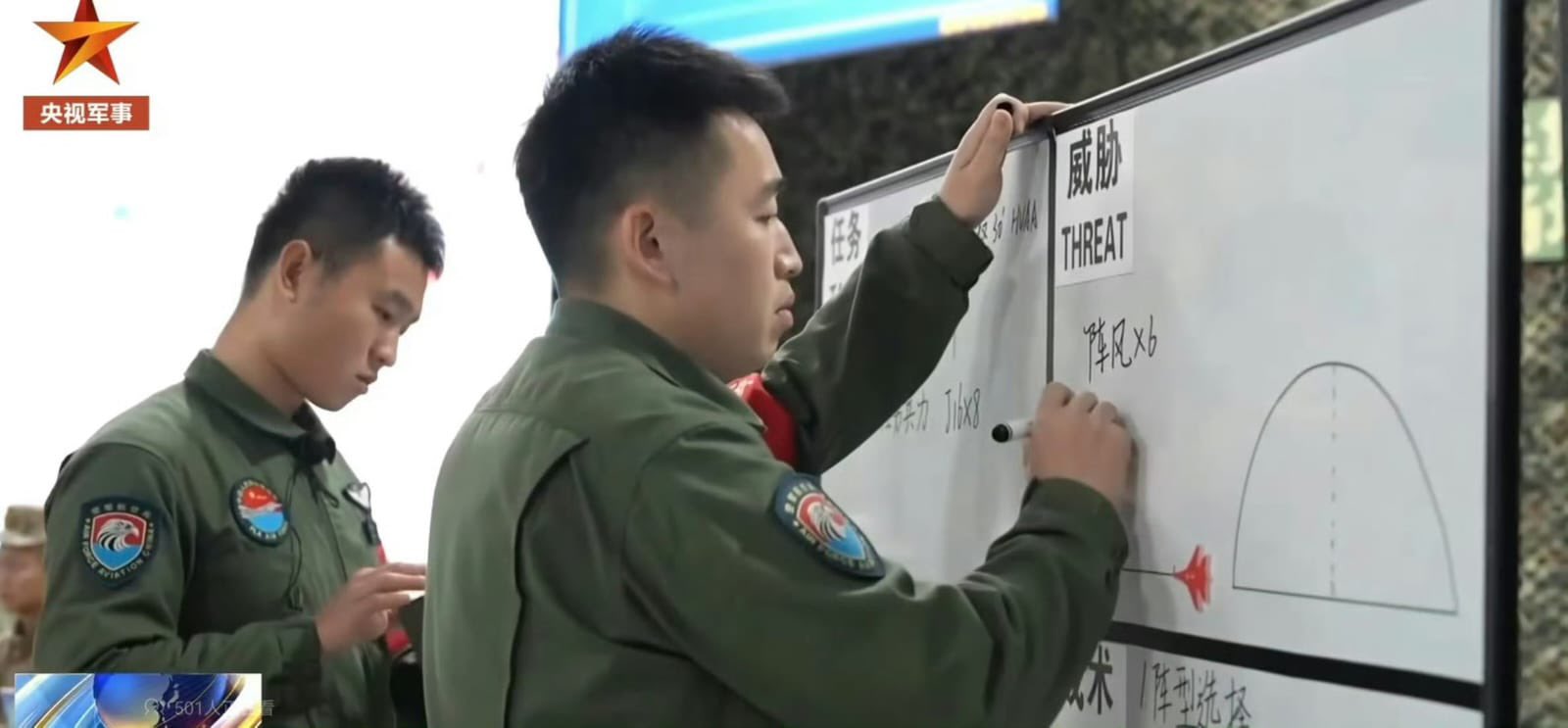
China’s People’s Liberation Army Air Force (PLAAF) simulated a high-stakes air battle pitting eight of its advanced J-16 multirole fighters against six French-built Rafale jets, as reported by state-owned broadcaster CCTV, which surprisingly aired footage of the simulated encounter between the cutting-edge Chinese and French fighter jets.
The broadcast has been described as “rare” because Beijing usually keeps its war games classified, and any information that comes out of them typically comes through leaked videos circulating on the Chinese internet.
According to the state media, the exercise was held in Xuchang, Henan province, and is part of a broader PLA effort to promote large-scale war-gaming—the first of its kind at this scale this year.
In the CCTV footage aired last week and quoted by SCMP, two PLA Air Force commanders were seen standing in front of a board depicting an air battle between Chinese and foreign forces. On the left side of the board was the label “task” along with “forces” including “J16 x8”, which referred to eight 4.5-generation fighters. Meanwhile, “Rafales x6,” which denotes six French-made Rafales, was written under “threat” on the right side of the board.
CCTV 7 (国防军事) features rare scenes of a PLA war game. This game featured tabletop exercise between Chinese J-16 fighters against a foreign military using French Rafales.
War gamers, what do you notice? https://t.co/wgRdc2LIJM pic.twitter.com/YWsFhtV251
— Lyle Morris (@LyleJMorris) December 22, 2025
An officer seemed to be noting additional “threats,” implying that the simulation included a variety of other international risks or dangers.
While no outcomes were disclosed, the public airing of the simulation has sparked interest, especially as it comes directly on the heels of the intense J-10C vs. Rafale debate, ignited by the May 2025 Indo-Pakistan aerial clashes.
Pakistan claimed its Chinese-supplied J-10C fighters armed with PL-15 missiles downed multiple Indian Rafales, stating that it was responsible for the first-ever combat loss of the celebrated French-origin fighter.
French authorities, including Dassault Aviation, acknowledged the loss of one Rafale jet but attributed it to a high-altitude technical failure, rejecting any role of the Chinese jet.
Some analysts interpret the PLAAF’s choice of the Rafale rather than the more similar Su-30MKI, which is more closely related to the J-16, as a deliberate signal of interest in countering India’s most advanced Western fighter, amid ongoing tensions along the Line of Actual Control (LAC). India currently fields 36 Rafales, has ordered 26 Rafale-Marine variants for the navy, and proposed acquiring up to 114 additional Rafales under the Multirole Fighter Aircraft (MRFA) program in September 2025.
India and China have endured repeated military standoffs along their disputed Himalayan border. Even though a fragile calm prevails following recent disengagement agreements in eastern Ladakh, underlying tensions persist, keeping the risk of future confrontation ever-present.
J-16 vs Rafale
Derived from the Su-27 family, the Chinese J-16 is a heavy twin-engine fighter designed for long-range operations, big payloads, and robust integration with air and ground-based support systems. It can deploy long-range air-to-air and strike weapons, has a powerful radar, and is ideal for missions prioritising firepower and range.
Typically, the J-16 is envisioned as a component of a larger network that includes ground sensors, electronic warfare capabilities, and airborne early-warning aircraft, enabling it to fight as a part of a vast, coordinated system rather than in isolation.
Notably, it is often described as a Chinese equivalent to the Su-30 or even F-15E. It excels in payload and range and has a dedicated electronic warfare variant known as the J-16D

The J-16 has advanced radar and fire control systems. It is equipped with an indigenous Active Electronically Scanned Array (AESA) radar. It has a reported range of 150-200 kilometers for fighter-sized targets (RCS 1 m²), and it can track up to 15–20 air targets simultaneously. Furthermore, the J-16 is equipped with an Infrared Search and Track (IRST) system for passive detection with a range of 50–80 kilometres.
It is capable of air-to-air combat, precision strikes, electronic warfare (EW), and suppression of enemy air defenses (SEAD). The Chinese J-16 also features a modernized cockpit with a helmet-mounted display (HMD) for improved pilot situational awareness and a glass cockpit design inspired by the J-20 stealth fighter.
Interestingly, the aircraft also utilizes radar-absorbent materials (RAM) and a dark grey stealth coating to reduce its radar cross-section, thereby enhancing its survivability.
Additionally, the J-16 features electronic countermeasures (ECM), missile approach warning systems (MAWS), and chaff/flare dispensers to enhance defensive capabilities. There have been instances in which the aircraft has been deployed to intercept Western reconnaissance aircraft flying over the South China Sea, resulting in a series of dangerous encounters.
The introduction of new datalinks, improved EW systems, and the increased use of carbon composites by the Chinese on this aircraft give it a superior combat capability.
Previous reports in Chinese state media claimed that the J-16 simultaneously locked two foreign stealth fighter jets and forced them to withdraw.
While the report did not disclose which foreign stealth aircraft it was referring to, the only two aircraft that fit the description were the F-22 Raptor and the F-35 Lightning II. However, these reports remain unverified and lack independent confirmation.
The Dassault Rafale is a medium-weight twin-engine fighter built for adaptability and self-sufficiency on a variety of missions. It is renowned for its powerful electronic warfare system, which improves survivability in contested areas, as well as its great agility and superior sensor fusion.
Rafale can swiftly transition between air-to-air combat, ground attack, reconnaissance, and maritime strike, and it frequently performs well even with little outside assistance.
The design of this French fighter jet reflects the needs of expeditionary operations, rapid deployment, and carrier deployment in the naval variant. This aircraft is attractive to air forces that need a single aircraft to perform many roles efficiently.

The Rafale’s aerodynamic design features a close-coupled canard-delta configuration that provides excellent maneuverability, high-angle-of-attack performance, and low-speed handling.
The airframe incorporates a significant degree of composite materials and radar-absorbent materials (RAM), giving it a reduced radar cross-section (RCS) compared to previous-generation fighters, though it is not a stealth aircraft like the F-35 or J-20.
A pilot flying the Rafale can swiftly switch between attacking and defensive positions because the entire airframe was built for energy maneuverability. The Rafale’s high angle-of-attack stability and accurate fly-by-wire controls make it responsive and forgiving—a desirable combination that promotes aggressive handling while allowing for errors.
The Rafale is equipped with the RBE2-AA active electronically scanned array (AESA) radar, developed by Thales. This radar can track up to 40 targets simultaneously, engage up to 8 targets at once, and perform ground mapping and terrain avoidance.
The aircraft also features the OSF (Optronique Secteur Frontal) infrared search and track system with a passive long-range target detection capability, and the SPECTRA electronic warfare suite that combines radar warning receivers, laser warning receivers, missile approach warning, jamming, decoy dispensing, and active cancellation techniques to reduce the aircraft’s detectability and enhance survivability.
Though a direct comparison between the two jets seems infeasible, we know that the J-16 features superior range, can carry a heavier payload, and is potentially better suited for saturation strikes or long-endurance patrols. Meanwhile, the Rafale has better avionics integration, better dogfighting agility attributed to its canard-delta design, and superior situational awareness.
While both J-16 and Rafale are competent aircraft, the French-origin aircraft has been combat-proven in Afghanistan, Libya, Mali, Iraq, and Syria, demonstrating high availability rates and effectiveness in real-world operations. The J-16, on the other hand, has been responsible for key intercepts in the highly contested airspace over the South China Sea.
- Contact the author at sakshi.tiwari13 (at) outlook.com
- Follow EurAsian Times on Google News


