

China is rapidly expanding its nuclear submarine fleet, even outpacing the United States Navy.
China has increased its production of nuclear-powered submarines over the last five years to the point where it is deploying them faster than the United States, threatening Washington’s long-standing sea-power superiority, according to a recent analysis published by the UK-based think tank, the International Institute for Strategic Studies (IISS).
“China has rapidly expanded its nuclear-powered-submarine production, surpassing US launch numbers and tonnage in the period 2021–25. Although qualitative differences compared with US and European designs persist, the increasing number of Chinese submarines presents a growing challenge for Western countries struggling to expand their own production,” the think tank states in the report.
Notably, the expansion of the Chinese People’s Liberation Army Navy (PLAN) nuclear-powered submarine fleet includes both attack and ballistic-missile submarines.
The IISS report states that between 2021 and 2025, China launched 10 nuclear-powered submarines, including both ballistic-missile SSBNs like the Type 094 or Jin-class, as well as the attack or guided-missile SSNs like the Type 093B Shang-class variants, with a total displacement of 79,000 tons.
On the contrary, the United States launched just seven submarines with a total displacement of 55,000 tons during the same period.
This is a major turnaround over the 2016 to 2020 period, when the Chinese PLAN launched only three submarines with a displacement of 23,000 tons, whereas the United States launched seven submarines with a displacement of about 55,500 tons.
Bohai Shipbuilding Heavy Industry Co. (BSHIC) builds China’s nuclear submarines at its shipyard in Huludao, northern China. The IISS report, titled “Boomtime in Bohai,” states that the company’s annual output pace was lower than that of its US counterparts until recently, but it has registered a significant increase between 2019 and 2022 with the addition of a second hall and other facilities.

The “Military Balance 2025” report cited by the IISS analysis states that, as of early 2025, China possessed 12 operational nuclear-powered submarines, six ballistic-missile submarines, and six guided-missile or attack submarines.
Meanwhile, the United States Navy (USN) has a mammoth fleet of 65 submarines, of which 14 are ballistic missile vessels designed for attacks, and 51 are attack or guided-missile submarines.
The Military Balance 2025 report also emphasises that while China has a sizeable fleet of 46 conventionally powered submarines, the United States is entirely composed of nuclear-powered submarines that remain submerged for longer periods without refuelling.
China Zooms Ahead
Satellite photos and open-source assessments cited by IISS show that the Bohai Shipyard is building multiple hulls simultaneously, a sign of improvements in modular construction and industrial productivity. This expansion is in line with President Xi Jinping’s policy of prioritising the PLAN as part of a larger effort to project power farther from the mainland.
In both 2024 and 2025, China achieved a rate of 1 SSBN + 2 SSGNs per year. It launched its seventh Type 094 (Jin-class) SSBNs in 2024 and eight vessels of the type in 2025. Similarly, it launched the first Type 093B (Shang III-class) SSGNs in 2022, five more by the end of 2024, and at least two more in 2025.
China has essentially matched the US Navy’s planned “1+2” target.
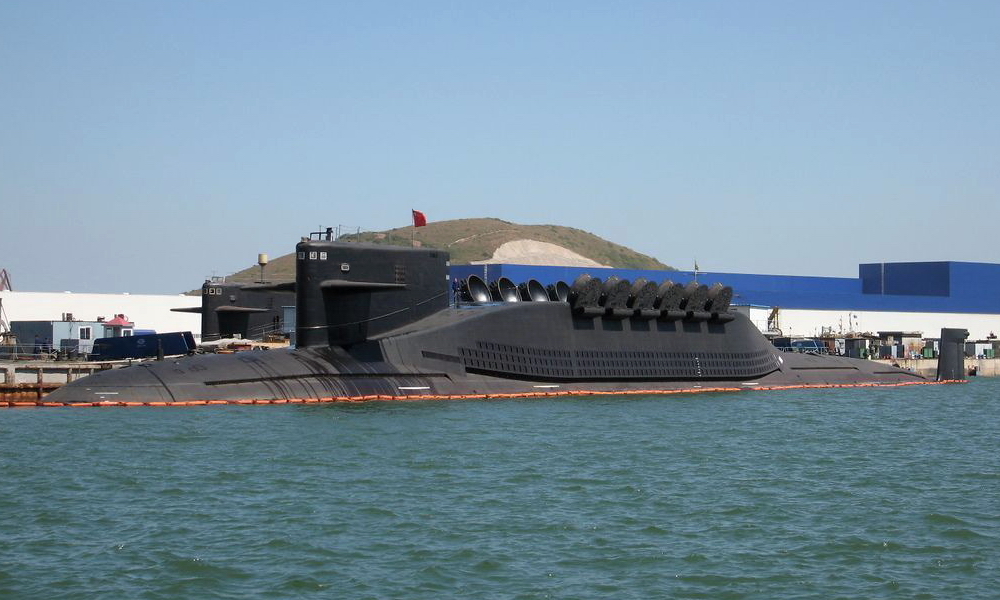
“In 2023, the US Navy published a shipbuilding plan that proposed achieving a ‘1+2’ output, wherein one Columbia-class SSBN and two Virginia-class SSGNs would be delivered each year by 2028. If, as suggested by available imagery, China launched a Type-094 SSBN and two Type-093B SSGNs in each of 2024 and 2025, Beijing has now achieved a 1+2 production output,” the think tank report states.
The report states that the Type 094s augment Beijing’s expanding nuclear triad of land-based intercontinental ballistic missiles and bombers with the capability of firing nuclear-armed ballistic missiles. “The Type-096 is still expected to begin production at Bohai this decade, entering service either in the late 2020s or early 2030s.”
The report specifically highlights two major enhancements in PLAN’s submarine capability: the type 093B getting vertical launch systems (VLS) for guided missiles, initially likely for high-speed anti-ship missiles, and the Type 094 upgrades including the JL-3 SLBMs, which means China could launch strikes on the continental US from safer waters like the South China Sea despite ongoing stealth limitations compared to Western designs.
Additionally, new models under development include the Type 095, which analysts expect to feature vertical launch tubes capable of accommodating cruise missiles.
On February 9, 2026, satellite images showed what appears to be the first instance of China’s new-generation Type 095 nuclear-powered attack submarine (SSN) being fitted out at the Huludao shipyard.

According to the Institute for National Defence and Security Research, the capabilities of China’s two new nuclear submarines — the Type 095 and Type 096 — match those used by the US and Russia.
The US is building new ballistic-missile submarines of the Columbia class, but the program is at least a year behind schedule. For instance, the first-in-class USS District of Columbia is not anticipated to be handed to the Navy until 2028.
“It is important to note, however, that US submarines are significantly larger and more sophisticated than Chinese designs, making them more challenging to build,” the IISS reports state. “Moreover, while it is possible to observe the output of Chinese shipbuilding, the inputs – both financial and personal – remain opaque and are almost certainly substantial. Nor is there visibility on the dates and costs by which Beijing initially expected to achieve certain objectives, which are almost certainly earlier than has been realised.”
Moreover, the IISS report declares rather categorically that, “Chinese designs almost certainly lag behind US and European boats in terms of quality.”
The US Navy is said to have the stealth advantage because the newest Chinese submarines are not as silent as the US ones.
However, experts believe that in naval conflict, the greater force typically wins. Furthermore, China already has the biggest fleet of surface combatants, frigates, and destroyers in the world.
China’s rapid strides in submarine technology could alter the balance of power in the Indo-Pacific. Any conflict over Taiwan, the self-ruling democratic island, will necessarily involve a larger role for the Navy, with the underwater fleet of submarines and undersea drones playing a critical role, as previously noted by the EurAsian Times.
According to the Centre for Strategic and International Studies (CSIS), China now possesses the world’s largest maritime fighting force, operating 234 warships to the U.S. Navy’s 219. This was supported by the US Congress research paper, China Naval Modernisation: Implications for U.S. Navy Capabilities, published in April 2025. “China’s navy is, by far, the largest of any country in East Asia, and sometime between 2015 and 2020 it surpassed the U.S. Navy in numbers of battle force ships, meaning the types of ships that count toward the quoted size of the U.S. Navy,” the paper stated.

It has been anticipated that China’s Navy will have 435 ships by 2030, up from 395 by 2025. The US Department of Defence (DOD) states that China’s navy “is the largest navy in the world with a battle force of over 370 platforms [i.e., ships], including major surface combatants, submarines, ocean-going amphibious ships, mine warfare ships, aircraft carriers, and fleet auxiliaries”.
Last summer, Navy Secretary John Phelan stated that US naval shipbuilding was in terrible shape during a hearing before the US House of Representatives. “I think our best one is six months late and 57% over budget … That is the best one,” he testified. Meanwhile, a Congressional Research Service (CRS) assessment states that as older Los Angeles-class attack boats are retired, the number of US attack submarines is predicted to drop to 47 in 2030, the “bottom of the valley” in terms of submarine numbers over the next five years.
It appears that by 2035, PLAN will surpass the US Navy in submarine numbers. However, the US Navy has more combat experience and time at sea than the PLAN.
Not just that, the US has more alliances in the Indo-Pacific than China. In any potential conflict with China, the US could get assistance from Japan, South Korea, Australia, Taiwan, India, and even the Philippines.
Whether China’s numerical advantage turns into a combat advantage or the US’s capability superiority remains unchallenged remains to be seen.
- Contact the author at sakshi.tiwari13 (at) outlook.com
- Follow EurAsian Times on Google News


