

China’s People’s Liberation Army (PLA) appears be ending the year with a dramatic surge of aviation milestones. This week, China’s new Y-30 medium transport aircraft was captured on its maiden flight, shortly after the emergence of the CH-7 stealth unmanned aerial vehicle.
Interestingly, in December 2024, the PLA shocked the world with the maiden flights of two distinct sixth-generation fighter prototypes—later dubbed the Chengdu J-36 and Shenyang J-50.
These sightings were widely interpreted as an unofficial public unveiling, as they were shared via leaked visuals on Chinese social media. As experts scrambled to decipher the radical new designs, the PLA delivered yet another surprise: the inaugural flight of the advanced KJ-3000 Airborne Early Warning and Control (AEW&C) aircraft.
Adding to the flurry, the first clear visuals of the distinctive WZ-9 twin-fuselage high-altitude drone emerged online, further highlighting Beijing’s relentless push towards cutting-edge military tech.
With three new Chinese platforms taking their maiden flights in the past week, is Beijing pulling the December 2024 “trick” in 2025?
Y-30 Tactical Transport Aircraft
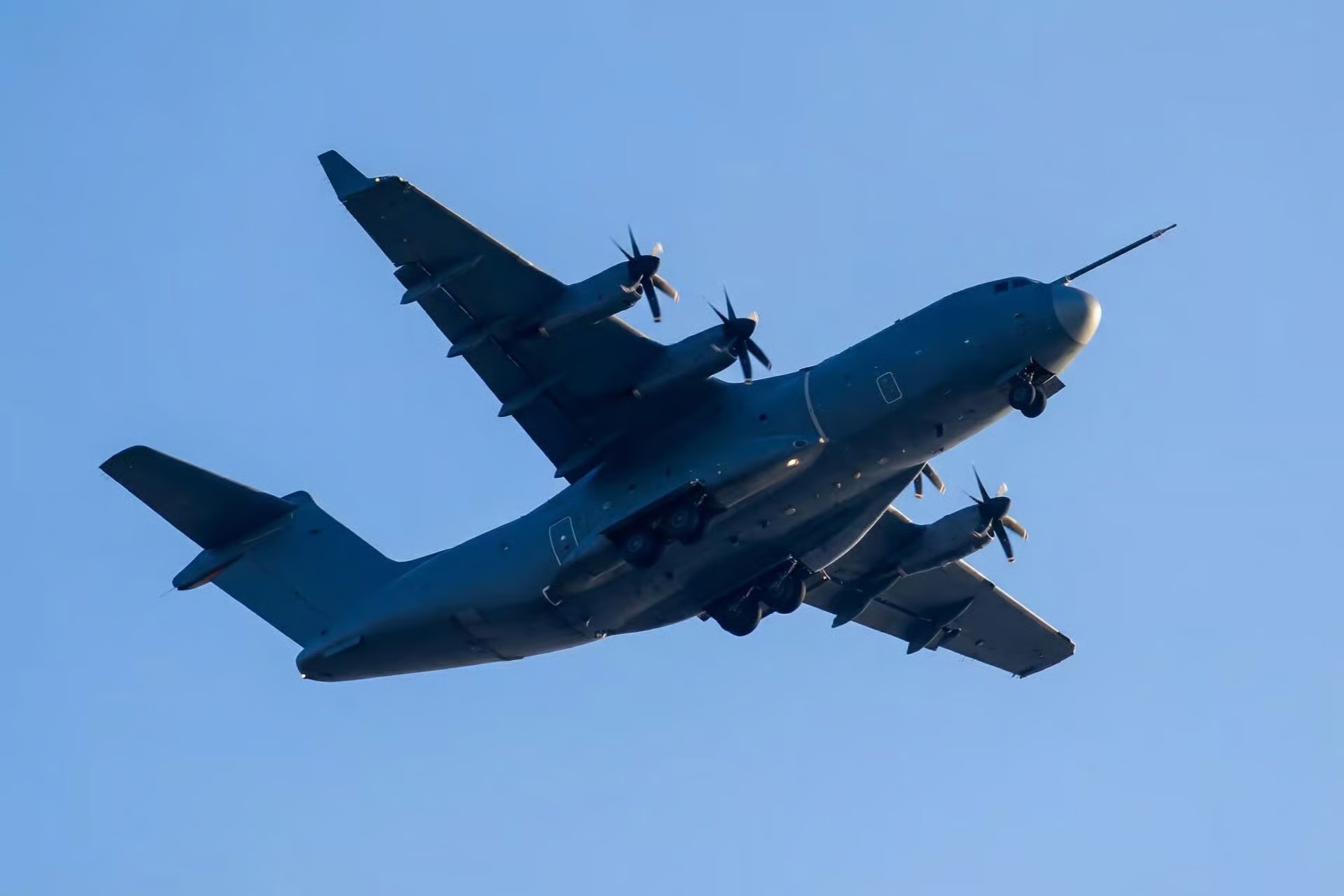
A PLA Air Force (PLAAF) tactical transport aircraft, unofficially referred to as the Y-30, was spotted on its maiden flight on December 15, 2025.
Developed by Shaanxi Aircraft Corporation, the Y-30 is expected to replace the existing Y-8/Y-9 transport aircraft four-turboprop transport aircraft and address the need for a modern air lifter to bridge the gap between the smaller Y-9, which can transport a payload of 20 tons, and the larger strategic Y-20 that can carry a payload of 66 tons.
A scaled model of a medium-sized transport aircraft with four turboprop engines made its debut at the Aviation Industry Corporation of China’s exhibition area at the Airshow China 2014 in Zhuhai, Guangdong Province, South China, according to state-owned Chinese media at the time. These reports stated that the aircraft was designated “Y-30” and “new-type medium transport aircraft.”
The new aircraft features a high-wing design with a T-tail, straight wing, and winglets, a rear loading ramp, and four turboprop engines driving six-bladed propellers. Observers noted that its fuselage appears to be larger than that of the Y-9, likely to accommodate modern wheeled armoured vehicles.
The prototype features test instrumentation, such as an air data probe. PLA aviation analyst Rick Joe said, “Looks like an air data probe out front, I doubt it’s IFR probe.”
Although an aerial refuelling probe was not visible, it might be installed in the future, as with certain Y-9 models. The landing gear seen in the pixelated photos appears to be a tricycle arrangement with tandem wheels on main legs, which is ideally suited for operations from austere or short runways.
Although it is hard to estimate the payload capacity, some experts conjecture that it could have a maximum takeoff weight of around 80-100 tons, with a payload capacity of 25-30 tons, which exceeds the 15-ton capacity of the Y-9.
The Y-30 is purportedly powered by WJ-10 or WJ-16 turboprops, which are purportedly capable of producing 6,800 horsepower or 5,140 horsepower, respectively.
The Y-30 is intended as a tactical/medium air lifter for rapid troop deployment, equipment transport, airdrops, and logistics support. It would help enhance China’s ability to project power in regions like the Indo-Pacific, support island operations in a potential Taiwan contingency, or conduct humanitarian/disaster relief missions.
The aircraft could eventually be modified for specific missions in addition to its primary transport role, as has been the case with the Y-8 and Y-9, which have been used to construct dozens of electronic warfare, maritime patrol, and airborne early warning and control (AEW&C) aircraft for the PLA in a variety of sub-variants.
Some observers drew comparisons between the newly seen Chinese medium transport aircraft and the European Airbus A400M, based on common features like a wide fuselage, rear loading ramps, and four turboprops.
A popular PLA observer, Hurin, called the aircraft “A400M esque.”
Meanwhile, another observer argued that “The reasoning for Y-30 is the same as A400M. Wheeled combat vehicles aren’t just heavier; they are much larger in volume. So, transport aircraft need a larger volume of cargo space to move them compared to legacy aircraft.”
However, seasoned experts noted that the Y-30 has a T-tail empennage similar to that of the Airbus transport, but its high-lift wing is not swept. The Chinese design’s wingtips also feature winglets, which increase lift and reduce drag, improving fuel efficiency.
Notably, the maiden flight of this aircraft comes right after the CH-7, a popular Chinese UAV, took its first flight.
CH-7 Stealth UAV
China’s CH-7 stealthy flying-wing drone also took off for its maiden flight, as seen in footage published by Chinese state media.
The CH-7 is a high-altitude, long-endurance (HALE) platform with a tailless flying-wing design, optimized for low observability (stealth). This configuration enhances endurance and reduces radar/infrared signatures but introduces challenges in stability and control, requiring advanced fly-by-wire systems. It has been tailored for intelligence, reconnaissance, and surveillance (ISR), as well as possibly a secondary strike role.
The first flight comes a year after the CH-7 made appearence at the Zhuhai Air Show in November 2024. At the time, experts noted the drone’s unique configuration, with the air intake located on top of the fuselage and the engine exhaust nozzle featuring a semi-concealed design.
The UAV has a clean, streamlined overall appearance and a sleek shape.
China's CH-7 high-altitude, high-speed drone recently conducted its maiden flight in a northwestern province, according to the China Academy of Aerospace Aerodynamics, which designed and built the pilotless plane.
According to the academy, a subsidiary of China Aerospace Science… pic.twitter.com/tnPu4efdyc
— China Daily (@ChinaDaily) December 15, 2025
The drone adds stealth coatings to the aircraft’s surface, incorporates radar-wave-absorbent designs at high-reflectivity locations along the leading edges, and employs stealth measures on all access panels, landing gear bay covers, and armament bays, among other components.
The stealth characteristics would allow the drone to operate unnoticed in crowded, air-defence-radar-laden, survival-challenging symmetric warfare settings, as well as to operate with ease in asymmetric battlefield environments where threats are relatively low.
Developed by the China Academy of Aerospace Aerodynamics, a subsidiary of the China Aerospace Science and Technology Corporation (CASC), the CH-7 can transport a range of high-performance mission payloads, such as visible light and infrared sensors, thanks to its high-aspect-ratio flying-wing aerodynamic shape. It is an autonomous platform that features autonomous taxiing, takeoff, landing, and flight control.
This drone meets the high-end ground observation and data support needs in complex situations, thanks to its extended endurance, high flight ceiling, high cruise speed, and robust mission capabilities, according to its manufacturer.
It was formerly believed that the CH-7 had an internal payload compartment.
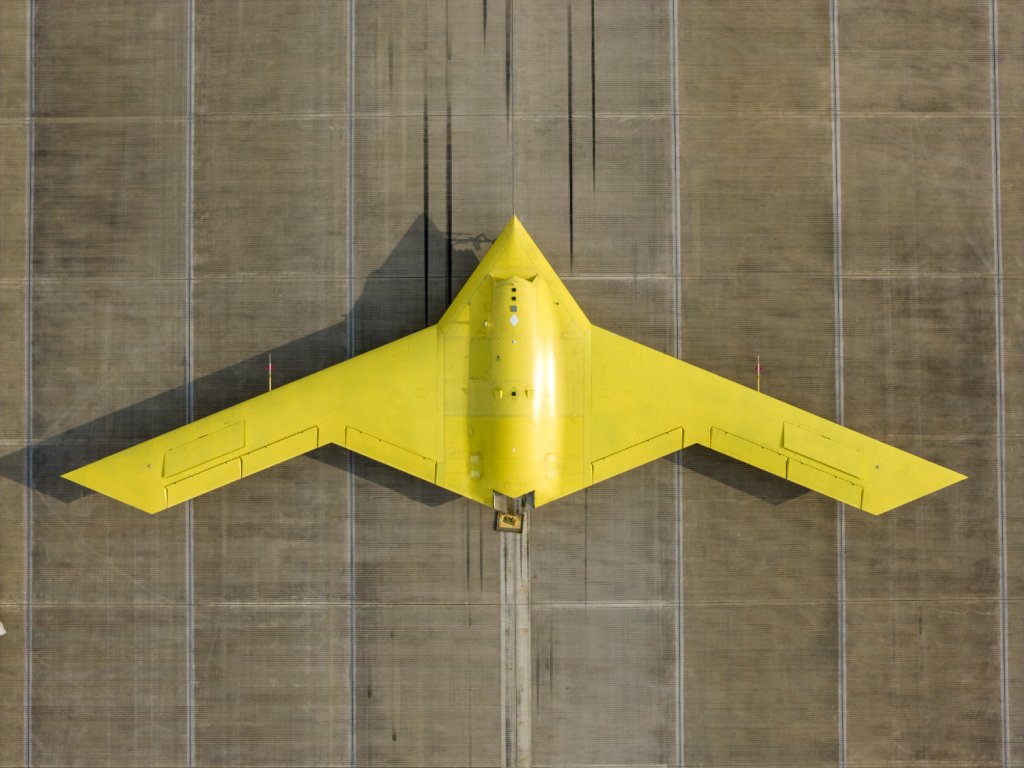
There appears to be a noticeably long and thin bay directly in front of the main landing gear on the right side. Presumably, there is a comparable bay on the left side as well. If these are for weapons, then only smaller stores would be allowed to use them. This might indicate a secondary strike role.
The main goal of CH-7’s first flight was to verify the design scheme’s logic and demonstrate the advancement of its major technological innovations.
CASC’s Li Jianhua told the Global Times that the CH-7 is more difficult to test than other drones because it requires testing more critical technologies.
He pointed out that the CH-7’s high aspect ratio, tailless flying-wing aerodynamic layout, and directional stability make the system more complex.
“These factors collectively increase the difficulty and, consequently, elevate the risks associated with its maiden flight to a relatively higher level,” Li Jianhua said.
It has been primarily designed for high-speed, long-range reconnaissance in contested environments. It can penetrate defended airspace to collect data, provide early warning, conduct electronic warfare, relay communications, and support targeting. The official descriptions currently emphasise reconnaissance over strike, but earlier concepts had also indicated combat capabilities.
This milestone marks the CH-7’s entry into formal flight testing after years of development, highlighting China’s advancing capabilities in stealth UAVs for potential use in high-threat scenarios, such as maritime surveillance in the Indo-Pacific.
In addition to the transport aircraft and the stealthy drone, China recently conducted the maiden flight of a high-flying unmanned aircraft capable of unleashing a mid-air swarm of unmanned aerial vehicles (UAVs).
A large unmanned aerial vehicle (#UAV), named "Jiutian," completed its maiden flight on December 11, 2025, according to the Aviation Industry Corporation of China (#AVIC).
The domestically developed general-purpose drone, measuring 16.35 meters in length and 25 meters in… pic.twitter.com/LwUHyNaEp6
— China Military Bugle (@ChinaMilBugle) December 11, 2025
Dubbed the world’s first “drone mothership,” the Jiutian completed its first flight on December 11, 2025.
The Jiutian uses a “universal platform with modular mission payload” design philosophy and is based on independently developed, integrated technological breakthroughs. It has a large cargo capacity, a high service ceiling, a broad speed range, and a short takeoff and landing capacity, as you can read in this EurAsian Times report.
These flights are noteworthy and demonstrate the technological advancement in PLA aviation and the scale at which China is churning out new aircraft. However, with nearly two weeks left until the year ends, will there be more surprises?
- Contact the author at sakshi.tiwari13 (at) outlook.com
- Follow EurAsian Times on Google News


