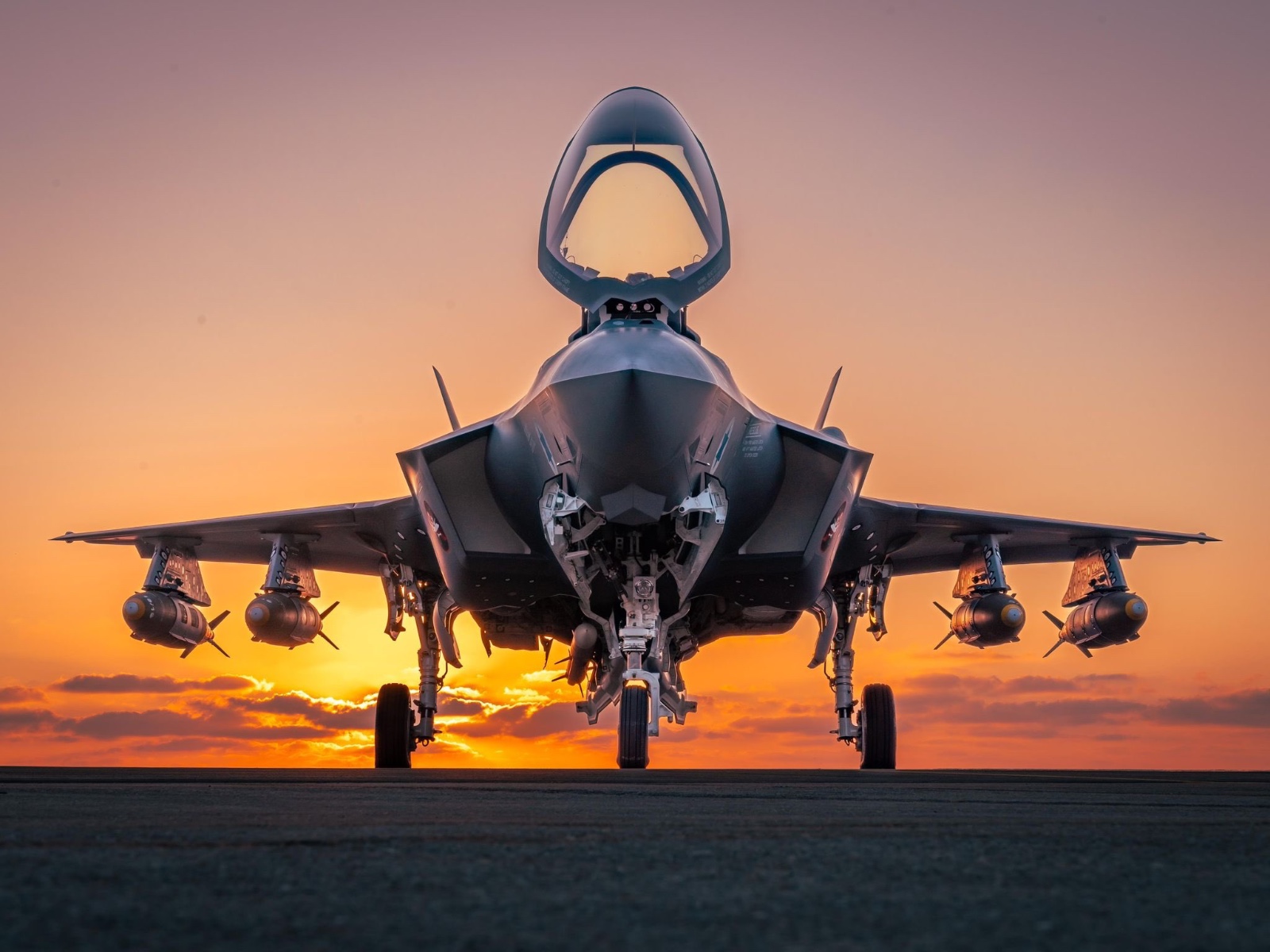
Despite escalating trade tensions with the Trump administration, including annexation threats, tariffs on key Canadian exports, and a full review of F-35 procurements, Canada appears to be quietly moving ahead with the acquisition of more F-35A stealth fighters.
Canadian Prime Minister Mark Carney put the acquisition of 88 F-35 fighters under review in March 2025 amid escalating tensions with the Trump administration, as previously explained in detail by the EurAsian Times.
The government has since clarified that the Royal Canadian Air Force (RCAF) will induct the 16 jets that have already been paid for, while reviewing the remaining 72.
The review was expected to be published by the end of summer 2025, but it has been pushed indefinitely.
However, despite the pause, Canada has begun making payments for key components for 14 additional F-35s, as CBC News recently reported, citing informed sources. The payment for these jets is in addition to the contract for a first order of 16 F-35s, which are slated to arrive in the country by the end of 2026.
The sources cited by the publication claimed that the additional costs are associated with the acquisition of “long-lead items,” or critical parts such as structural assemblies, avionics, and other components that must be ordered years in advance due to the complex, global production queue managed by the manufacturer Lockheed Martin. These components need to be bought well in advance of the delivery of a fully completed aircraft.
The expenditures were reportedly part of additional spending on the CF-18 replacement program in late 2025. And although the payments have not been officially notified, it seems the Canadian government is quietly ensuring it is next in line to receive the jet, should the government decide to complete the purchase.
The Department of National Defence declined to confirm details on these specific payments, reiterating only that the review is ongoing.
Notably, the latest reports come days after Lt.-Gen. Jamie Speiser-Blanchet, the commander of the Royal Canadian Air Force (RCAF), travelled to Lockheed Martin’s Fort Worth production facility to sign the fuselage bulkhead for the first Canadian F-35.
Later this year, the RCAF pilots will be trained to fly the stealth aircraft at Luke Air Force Base in a mixed squadron amongst their American counterparts.
All these developments have sparked speculation that Canada may be on course to complete the purchase, even though the review has yet to be concluded.
It could be another setback for SAAB, which has made an enticing offer to Canada for 72 Gripen-E/F fighters. In fact, SAAB officials recently told reporters at the Singapore Air Show that they expected the RCAF to operate a mixed fleet of F-35s and Gripens.
Canada’s Controversial F-35 Purchase
Some experts believe that the indefinite F-35 review in Canada, coupled with payments for additional components, suggests that it has reached a point of “no return.” However, some others believe that Ottawa is just being prudent.
Justin Massie, a political scientist, professor at Université du Québec à Montréal, and defence specialist, noted that these expenses are “expected” given that the government hasn’t officially changed its F-35 policy despite the review. He added that the situation “puts the Carney administration in a difficult position,” highlighting the tension between logistical necessities and the ongoing political or trade-related review.

However, it is also likely that Canada is bowing out to the incessant pressure from the United States. Last month, for instance, US Ambassador to Canada Pete Hoekstra said there would be “significant consequences” for the continental defence alliance, NORAD (North American Air Defence), if Canada doesn’t complete its F-35 purchase.
Further, the envoy made a subtle warning saying that the US would likely have to buy more of these jets for the US Air Force (USAF) and fly them into Canadian airspace more frequently to address the prevailing threats to Washington.
“If Canada is no longer going to provide that [capability], then we have to fill those gaps,” Hoekstra said.
Carney paused the purchase amid tensions with the United States over trade disputes, tariffs, and repeated attacks by US President Trump on Canada’s sovereignty. However, these tensions have only increased, further complicating the matters.
Earlier this week, President Donald Trump threatened to block the opening of a 1.5-mile-long Gordie Howe Bridge between Detroit, U.S., and Windsor, Ontario, in Canada.
The bridge, constructed at a cost of more than $4 billion, has been fully paid for by Canada and is supposed to provide continuous freeway traffic flow, unlike the existing arrangement with the adjacent Ambassador Bridge, which links to city streets on the Ontario side.
Before that, Trump announced that he would decertify Bombardier Global Express business jets made in Canada and threatened to levy 50% tariffs on “all aircraft made in Canada” until Canadian authorities certified several aircraft made in the United States.
An IAF expert, who wished to stay anonymous, told the EurAsian Times that Canadian PM Mark Carney appears to be using the F-35s as a negotiating chip with US President Donald Trump. If Canada cancels the F-35 acquisition, it will be a massive blow to US-Canada relations, something neither Ottawa nor Washington wants.
Many experts believe that Ottawa may proceed with the purchase despite sustained tensions with the Trump administration for two factors: the need for a fifth-generation stealth fighter to counter the threats posed by countries like Russia and China, and to ensure interoperability with the United States under the NORAD framework.
Moreover, Canada already operates a large number of American platforms, meaning there is significant reliance on Washington that cannot end anytime soon.
The US has been accused of arm-twisting Canada into completing what observers consider its biggest defence purchase in decades. Moreover, as previously noted by EurAsian Times, there are heightened concerns about operating a mixed fleet of F-35s and Gripens and the associated high cost.
Most importantly, Canada’s Department of National Defence conducted an evaluation of the F-35 and Gripen, and, according to data obtained by Radio-Canada, the F-35 received a 95% rating for military capabilities, while the Gripen-E finished with a score of 33%, scoring 19.8 points out of 60.
- Contact the author at sakshi.tiwari13 (at) outlook.com
- Follow EurAsian Times on Google News