

Despite the vulnerability faced by attack helicopters in traditional close-in, low-and-slow attack roles, countries like Israel and India appear to be betting big on the American Apache attack choppers.
The United States recently approved a potential $3.8 billion foreign military sale to Israel for AH-64E Apache attack helicopters and associated equipment on January 30, 2026, as announced by the US Defense Security Cooperation Agency (DSCA). The approval was in response to Israel’s request for 30 Boeing AH-64E helicopters, 70 engines, sophisticated night-vision and targeting systems, radar, and support equipment.
Israeli defence authorities view the potential deal as a major step toward modernising the Israel Air Force (IAF) combat helicopter fleet. The timing of the approvals is noteworthy as it came amid a surge in tensions in the West Asian region and a massive US military build-up that has triggered concerns of an American war on Iran.
Interestingly, the US approval comes at a time when attack helicopters have become increasingly vulnerable, particularly due to the proliferation of one-way attack drones that could easily ram into these war machines, as well as the threat posed by MANPADS (Man-Portable Air Defence Systems).
Attack helicopters have to fly low, nap-of-the-earth (NOE), which makes them vulnerable to being attacked by hostile forces. For instance, Russian attack helicopters did see some initial lapses in the Ukraine conflict, which prompted analysts to call them glorified ducks for hunting by MANPADS & SHORAD (Short-Range Air Defence) operators.
However, as pointed out by Indian Air Force veteran Air Marshal Anil Chopra (retd) in a previous EurAsian Times article, “the main reason attack helicopters will not disappear is that they fill a niche that very few platforms can fill. They are the only 350 KMPH missile carriers that can hide behind trees, pop up, and literally shoot and scoot.”
“Apache helicopters are still the most survivable, efficient, and formidable flying anti-tank platforms available to militaries. They also have significant roles as anti-UAV and anti-attack helicopters,” Air Marshal Chopra added.
Israel Is Modernising With Apache
Speaking of the need to buy the AH-64E Apache, the Israeli defence officials cited Apache’s performance in the October 7 Hamas attack on Israel and the war that followed, saying the line-of-sight advantage offered by the helicopters was essential for identifying attackers, striking swiftly, assisting ground forces, and thwarting early-morning abduction attempts.
Senior officials also claimed that during extended, high-tempo combat, operational strain was caused by the limited number of helicopters and the constant need to cycle aircraft through refuelling and rearming, as noted in a report in The Jerusalem Post last week.
The Israeli Air Force (IAF) currently operates two main variants of the Boeing AH-64 Apache attack helicopter: the older AH-64A, which it began receiving in the 1990s, and the AH-64D, the Longbow variant with advanced radar and avionics.
These older variants face limitations in endurance, payload, sensor range, survivability against modern threats, and overall performance compared to newer systems.

Before 2023, Israel considered phasing out manned attack helicopters in favour of UAVs/drones, even planning to retire older squadrons. However, the war demonstrated the irreplaceable value of Apaches for unique, time-sensitive missions, such as immediate response on October 7, where helicopters provided critical overwatch, rapid firepower, and support that drones alone couldn’t fully replicate in contested, dynamic environments.
The Israeli officials have emphasised that the experience with wars in the last two years reaffirmed the need for increased survivability, a greater payload, a longer range, and improved coordination with ground forces—everything the Apache AH-64E offers.
The AH-64E represents a generational upgrade with key improvements. Israeli officials stated that the AH-64E is a major upgrade, as its composite rotor blades are intended to accommodate larger fuel and weapon loads, increase longevity, and reduce the aircraft’s acoustic signature, which can make it more difficult to detect by sound. In addition, the rotorcraft features improved sensors, radar, and a more recent mission computer, as well as pilot avionics based on digital helmet cueing.
Meanwhile, a large section of experts believes that the purchase is based on lessons learned on the battlefield.
Eitan Ben Eliyahu, a retired Maj. Gen. and former Commander of the Israeli Air Force said: “This is a lesson from the war in Gaza. After it appeared that unmanned aerial vehicles (UAVs) were pushing attack helicopters out, making them seem obsolete on the battlefield, the lesson learned during [the war] was different.” The last two years of war have shown that the Apaches “remain a vital necessity on the battlefield, particularly in urban warfare and commando operations.”

Israeli officials say the country wants to accelerate the acquisition process to reserve production slots, with early plans aiming for first deliveries around 2030, which may be a bit too aspirational.
The procedure usually proceeds from US permission to a formal LOA (letter of offer and acceptance, the government-to-government contract that completes a military sale abroad), after which Israel can begin placing specific orders.
The AH-64E Apache helicopters are crucial for Israel as they would help with providing close air support in urban settings or during hybrid warfare, help in conducting rapid precision strikes against mobile threats such as tanks or armoured vehicles, and support ground forces and commando missions with line-of-sight advantages for quick target acquisition and disruption of attacks from the enemy.
India Also Bets Big on Apaches
The Indian Army inked a $600 million deal with the US in 2020 for six Apache AH-64E helicopters. The first batch of Apaches was initially scheduled to arrive in India by May-June 2024 but was grossly delayed, finally arriving in the country in July 2025.
The remaining three were due for delivery in November 2025, as previously reported by the EurAsian Times, but ultimately arrived in the country in December 2025.
In fact, the Indian Army’s purchase of Apaches was built upon the Indian Air Force’s previous purchase of 22 Apaches. The IAF inducted the first batch of US-made Apache AH-64Es at the Pathankot Air Force Station and the second batch at Jorhat, Assam.
The helicopter, equipped with two engines and sensors for all-weather, day-or-night operations, is considered a major offensive asset by New Delhi. It can destroy other aircraft and helicopters with Stinger air-to-air missiles, rake targets two kilometres away with 1200 rounds of 30mm milk-bottle-sized cannon ammunition, and fire Hellfire missiles and Hydra rockets at targets ten kilometres away.
The manufacturer, Boeing, describes the AH-64E Apache helicopter as “an advanced multi-mission helicopter with the latest technology insertions, maintaining its standing as the world’s best attack helicopter. It is the only available combat helicopter with a spectrum of capabilities for virtually any mission requirement, including greater thrust and lift, joint digital operability, improved survivability, and cognitive decision aiding.”
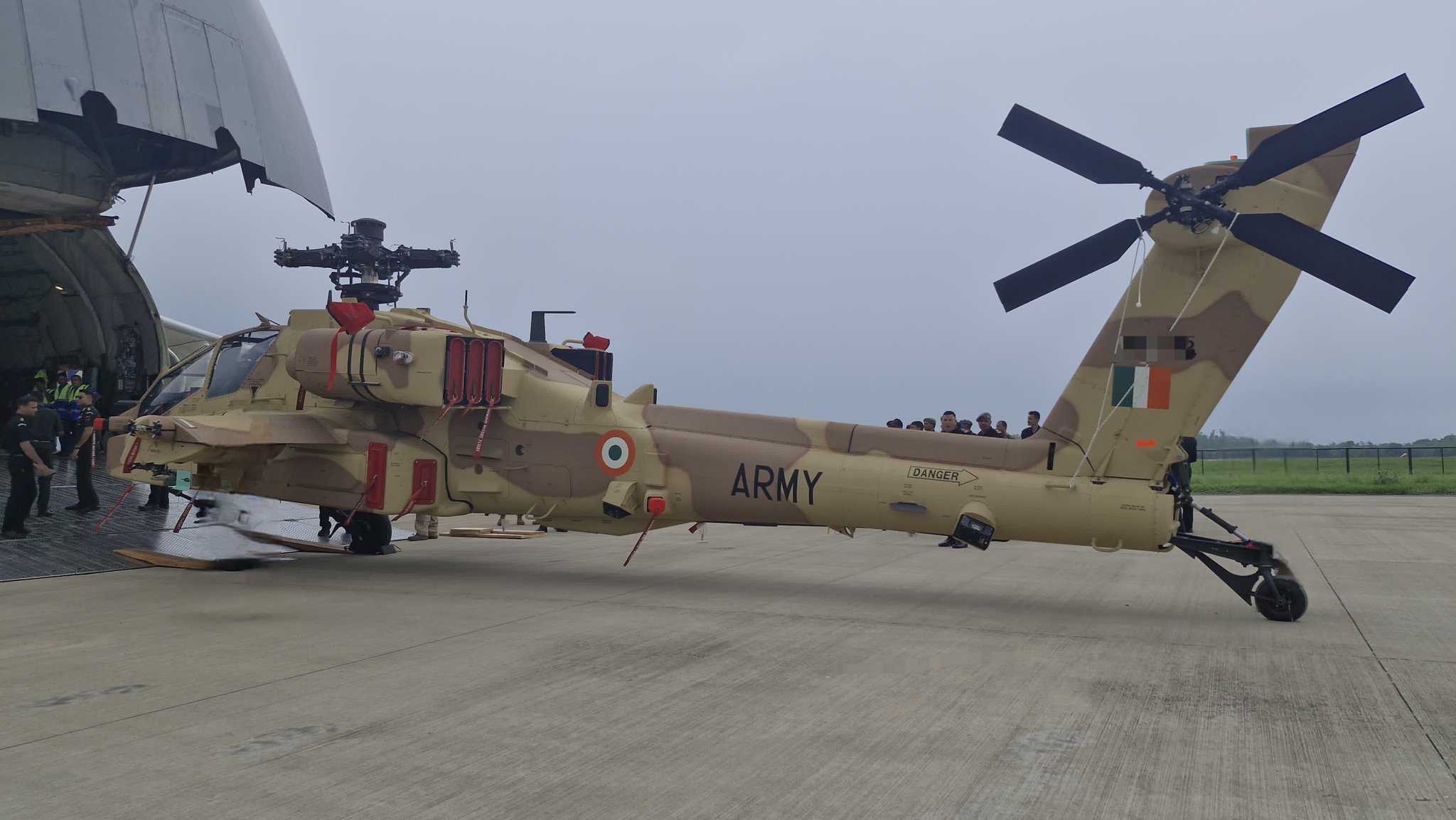
The helicopter is designed to operate in mountainous terrain. It can conduct precision attacks at standoff ranges and operate in hostile airspace amid ground threats—making it ideal for use by the Indian Army and the IAF.
The Apaches are built to be “tank killers,” and in the event of a confrontation, their Hellfire missiles could launch precise attacks against Chinese or Pakistani armoured formations. They would be very effective in scenarios that require a rapid response against PLA ground forces, as they can engage 16 targets at once with their Longbow radar, which can identify and prioritise up to 128 targets in less than a minute.
The AH-64E’s advanced targeting systems and sensors enable day/night and all-weather missions, which are crucial given the unpredictability of India’s borders.
During the 2020 border disputes, the IAF deployed its Apaches to Ladakh, where they flew night sorties and proved their utility in high-altitude regions.
Designed for high-altitude operations, the helicopters are essential for India’s western border with Pakistan and for possible deployments in the Himalayas along the disputed Line of Actual Control (LAC) close to China.
The Apaches bolster India’s defences against armoured attacks and provide close air support, particularly in arid and semi-arid regions.
They also have Manned-Unmanned Teaming (MUM-T) for drone integration, which could be very significant for networked combat in a saturated battlefield. Earlier, the Indian Ministry of Defence (MoD) stated in a press release that these helicopters can transmit and receive battlefield imagery via data networks.
- Contact the author at sakshi.tiwari13 (at) outlook.com
- Follow EurAsian Times on Google News


