During the maddening years of World War II, the Soviet Red Army executed over 150,000 of its own soldiers for desertion.
Fighting an existential battle against Hitler’s onslaught, who viewed the Slavs as racially inferior and called for their physical extermination, ethnic cleansing, and enslavement, the Soviet Red Army came up with notoriously harsh on-the-spot execution orders for deserters.
Each Soviet battalion had “blocking detachments” (barrier troops) that would fire on fleeing, panicked troops at the rear.
The Nazi German Army fared no better. Germany had still not come to terms with its defeat in the First World War.
There was widespread belief that Germany could never be defeated on the battlefront, but for the desertion and sabotage by its own forces.
After the shock of defeat in World War I, German commanders and military jurists concluded that the Imperial German Army had been too lenient in the crisis year of 1918. They vowed that if Germany ever went to war again, they would be pitiless in dealing with deserters.
During the course of the war, the German Army shot anywhere between 15,000 and 20,000 of its own soldiers for desertion.
Even in the US Army, over 20,000 soldiers were convicted of desertion during the Second World War. As many as 49 were given death sentences. However, 48 of those death sentences were commuted.
Only one US soldier was executed, 24-year-old Edward Donald Slovik. He was executed on January 31, 1945, becoming the first US soldier to be executed for desertion since the American Civil War.
Slovik also remains the last US soldier to be executed for desertion.
During the Vietnam War, and recently even in Afghanistan, dozens of US soldiers deserted; however, none received a death sentence.
Ironically, according to World War II veteran Nick Gozik, Slovik, the only US soldier to be executed for desertion in over one-and-a-half centuries, was also the bravest soldier he encountered during his two years of combat in World War II.
His unfortunate story inspired a book in 1954. In the 1960s, Joseph Kennedy forced Frank Sinatra to cancel his plans for making a movie on the subject, fearing that Sinatra’s involvement in such a controversial project would damage JFK’s presidential prospects.
The movie was finally made for TV in 1974. It attracted a record audience and is a sombre, sober work about chance fate, the horrors of war, and people trapped in a bureaucratic war machine.
What makes his story even more melancholy is that Slovik was given not one but several chances to change his mind, which would have saved him from his ignominious end.
Slovik made a series of fatal decisions. He wrote and signed a confession admitting his crime, and he refused five chances to retract his statement and escape punishment. He told his judge advocate he would desert again. And his case reached General Dwight Eisenhower’s desk at the worst possible moment during the Battle of the Bulge.
All these arbitrary circumstances ensured that he died at the hands of the firing squad, while nearly 20,000 other US soldiers, also convicted of the same crime, escaped this ignominious end.
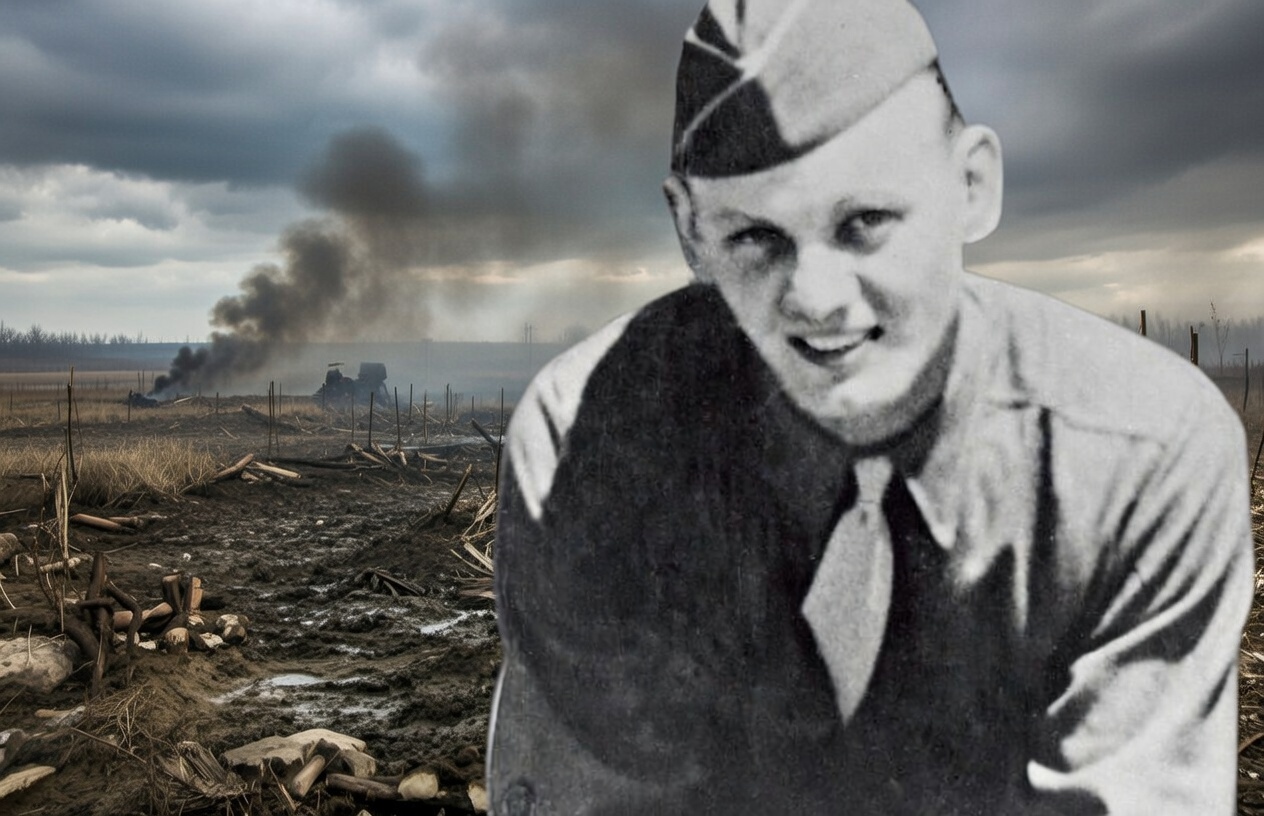
Slovik’s Journey Towards Death By Firing Squad
Slovik was born in Detroit on February 18, 1920, to Polish-American parents Josef Slowikowski and Anna Lutsky.
At 12, Slovik attempted his first theft – entering a foundry with friends to steal brass for resale.
This would become his habit. He was arrested by police five times, each time for petty theft.
He served two different prison sentences.
In November 1942, he married Antoinette Wisniewski and started working as a shipping clerk. His criminal record classified him as 4-F — morally unfit for military service.
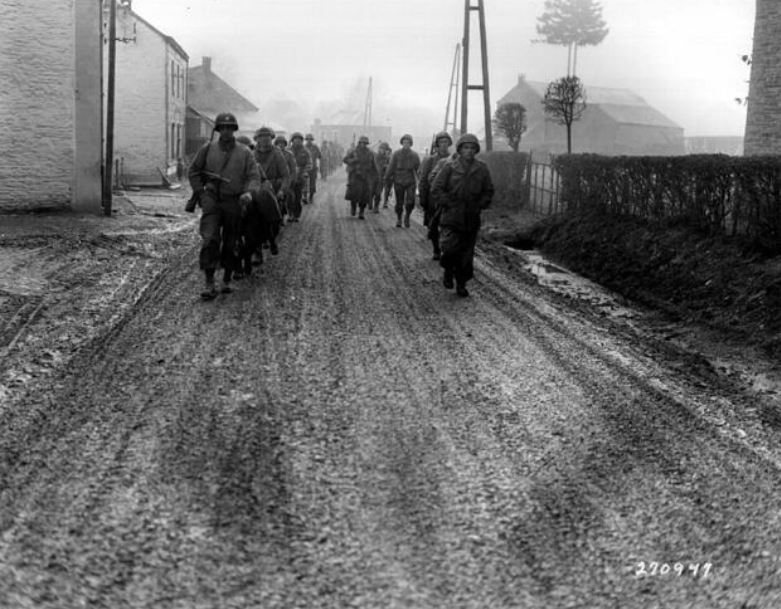
However, as the US military needed more and more men for the war, it lowered its standards.
Slovik was drafted in January 1944, beginning his fateful year with the US military.
After his training, he shipped to France in August and was assigned to Company G, 109th Infantry Regiment, 28th Infantry Division.
Just a few days at the front, Slovik and Private John Tankey got separated from their unit during German artillery shelling. They spent six weeks with a Canadian military police unit and made no effort to join their unit.
When a new Canadian commander took charge, he contacted the US unit and had the men transferred.
They rejoined their unit in October. No charges were pressed, as it was common for soldiers to get left behind.
However, just one day after rejoining his unit, Slovik made his first fateful decision, telling his Captain Ralph Grotte he was “too scared” to serve in a rifle company and asked for reassignment to a rear unit.
When Grotte refused, Slovik asked, “If I leave now, will it be desertion?” When Grotte confirmed it would be, Slovik walked away anyway.
Tankey tried to persuade him, but Slovik’s only comment was that his “mind was made up”. Slovik walked several miles to the rear and approached an enlisted cook at a military government detachment of the 112th Infantry Regiment, presenting him with a note which stated: “I, Pvt. Eddie D. Slovik, 36896415, confess to the desertion of the United States Army.”
The note also added: “I’LL RUN AWAY AGAIN IF I HAVE TO GO OUT THERE (at the front).”
The cook took Slovik to the company commander, who asked him to destroy the note before he was taken into custody. Slovik refused.
He was then brought before Lieutenant Colonel Ross Henbest, who again offered him the opportunity to tear up the note, return to his unit, and face no further charges; Slovik again refused.
Henbest ordered Slovik to write on the back that he understood the confession could be used against him in a court-martial. Slovik wrote the disclaimer and was confined to the division stockade.
Slovik was again asked by Lieutenant Colonel Henry Sommer, the division judge advocate, to return to the front and face no charges, but Slovik again replied that he had made up his mind.
Sommer later wrote that Slovik was convinced that he would face only jail time, which he had experienced before and considered far more tolerable than combat.
Sommer made one last offer, to transfer Slovik to a new unit where no one knew of his past and he could start fresh, but Slovik again refused, saying, “I’ve made up my mind. I’ll take my court-martial.”
On November 11, 1944, Slovik was court-martialed.
Slovik had to be tried by a court-martial composed of staff officers from other U.S. Army divisions, because all combat officers from the 28th Infantry Division were fighting on the front lines.
Even here, Slovik refused to defend himself or give assurance that he would not desert again.
At this time, the US forces in France were taking heavy casualties, and desertions were rising.
Slovik was given a death sentence.
General Cota, one of the judges on the panel, wrote, “Given the situation as I knew it in November 1944, I thought it was my duty to this country to approve that sentence. If I hadn’t approved it – if I had let Slovik accomplish his purpose – I don’t know how I could have gone up to the line and looked a good soldier in the face.”
On December 9, Slovik wrote a letter to the Supreme Allied Commander, General Dwight D. Eisenhower, pleading for clemency.
Unfortunately, just then, the Battle of the Bulge began, which would take a heavy toll on US forces.
Eisenhower confirmed the execution order on December 23, noting that it was necessary to discourage further desertions.
The decision came as a shock to Slovik, who thought that he would only recieve prison sentence, just like thousands of other deserters.
Just before the execution, Slovik spoke his mind: “They’re not shooting me for deserting the United States Army, thousands of guys have done that. They just need to make an example out of somebody and I’m it because I’m an ex-con. I used to steal things when I was a kid, and that’s what they are shooting me for. They’re shooting me for the bread and chewing gum I stole when I was 12 years old.”
He was executed by a firing squad on January 31, 1945. He served in the US military for barely a year, was in France for nearly five months, and spent less than a week on the front lines.
Slovik remains, to this day, the last US soldier to be executed for desertion.
- Sumit Ahlawat has over a decade of experience in news media. He has worked with Press Trust of India, Times Now, Zee News, Economic Times, and Microsoft News. He holds a Master’s Degree in International Media and Modern History from the University of Sheffield, UK.
- VIEWS PERSONAL OF THE AUTHOR.
- He can be reached at ahlawat.sumit85 (at) gmail.com