US President Donald Trump recently ignited fury among NATO allies by claiming that their troops in Afghanistan “stayed a little back, a little off the front lines” during the two-decade-long conflict.
Interestingly, the comments may be true for Turkey, the 2nd biggest contributor to NATO after the USA.
Speaking to Fox News, Trump said that the NATO allies would not come to Washington’s support. “I’m not sure if NATO allies would be there “if we ever needed them, and that’s really the ultimate test,” he stated. “We’ve never needed them; we have never really asked anything of them. You know, they’ll say they sent some troops to Afghanistan, or this or that, and they did, they stayed a little back, a little off the front lines.”
Notably, the only time NATO’s Article 5 for collective security was invoked was following the 9/11 attacks on the US in 2001. At the time, all the NATO members pledged support to the United States and embarked on a protracted and unprecedented NATO involvement in Afghanistan for nearly two decades.
Trump’s comments were lambasted as “disrespectful and appalling” by several NATO allies, including the United Kingdom, France, Italy, Poland, Denmark, and even a non-NATO member like Australia that took part in the campaign. This ultimately forced the American President to retract his comments, as recently reported by the EurAsian Times.
Intriguingly, Turkish President Recep Tayyip Erdogan, who is notorious for frequently locking horns with allies like the US, did not join his NATO counterparts in rebuking Trump. Although Erdogan has had a complicated relationship with Trump since his first term as President, the silence may be more calculated.
It is pertinent to mention here that Turkey lost 15 soldiers in the two-decade-long Afghanistan conflict, which is remarkably less compared to 2,450 soldiers lost by the US, 457 lost by the UK, 159 lost by Canada, and 90 lost by France.
Turkey Had No “Combat Losses” in Afghanistan
Despite being a major NATO contributor to the Afghanistan mission and the second biggest to NATO after the USA, Turkey lost 15 soldiers in the International Security Assistance Force (ISAF) and the Resolute Support Mission in Afghanistan between 2001 and 2021, and none of those were combat losses.
Of the total 15, at least 14 died in two separate crash incidents.
In 2009, two Turkish soldiers died in a car crash.
Meanwhile, about 12 Turkish soldiers died when a NATO helicopter crashed on the outskirts of Kabul in 2012 due to a technical glitch, an incident described as the worst loss of life in Turkey’s 10-year involvement in Afghanistan.
At the time, about 1,800 Turkish soldiers were serving in Afghanistan. Thus, proving that nearly all Turkish fatalities in Afghanistan were surprisingly related to non-combat situations.

Is Donald Trump Right?
For one, Turkey viewed its presence in Afghanistan not only as part of the NATO-led International Security Assistance Force (ISAF) mission, but also as a brotherly effort to help the Afghan people restore peace, and hence asked to be left out of aggressive operations against the Taliban and other militants in the country.
Turkey’s mission was purportedly limited to patrols, and its soldiers did not take part in combat operations, unlike its other NATO counterparts.
In fact, Turkey joined the International Security Assistance Force in 2001 with 300 soldiers, provided that it would not use its forces for overt counterterrorism or counterinsurgency operations.
It served as the ISAF commander twice: from June 2002 to February 2003 (ISAF II) and from February 2005 to August 2005 (ISAF VII). During this period, it also operated the Kabul International Airport and was responsible for its safety.
Turkey’s troops were mostly stationed in calmer areas like Kabul, which was significantly more peaceful and safer than eastern border districts close to Pakistan or southern provinces like Helmand and Kandahar, where US, British, and Canadian soldiers were heavily involved in combat and anti-insurgency operations.
Moreover, Kabul benefited from increased international presence and security infrastructure.
By restricting operations to defensive positions, such as defending bases and convoys in the capital and nearby areas, the Turkish forces were able to reduce their exposure to ambushes, IEDs, and firefights that beset other NATO troops in high-conflict areas.
This strategy was influenced by domestic political factors in Turkey, where people were hesitant to risk their lives in foreign conflicts, particularly in light of their experiences in earlier crises such as Cyprus. Therefore, Ankara presented its contributions as merely supportive rather than confrontational or occupational.
Besides the Regional Command Capital in Kabul, the Turkish troops controlled provinces like Wardak and Jawzjan for PRT (Provincial Reconstruction Teams) operations.
The PRT missions focused on capacity building and initiatives in infrastructure, education, health, and counter-narcotics, often under the direction of civilian diplomats rather than military personnel. These missions were less provocative to insurgents, who targeted combat-focused forces more aggressively.
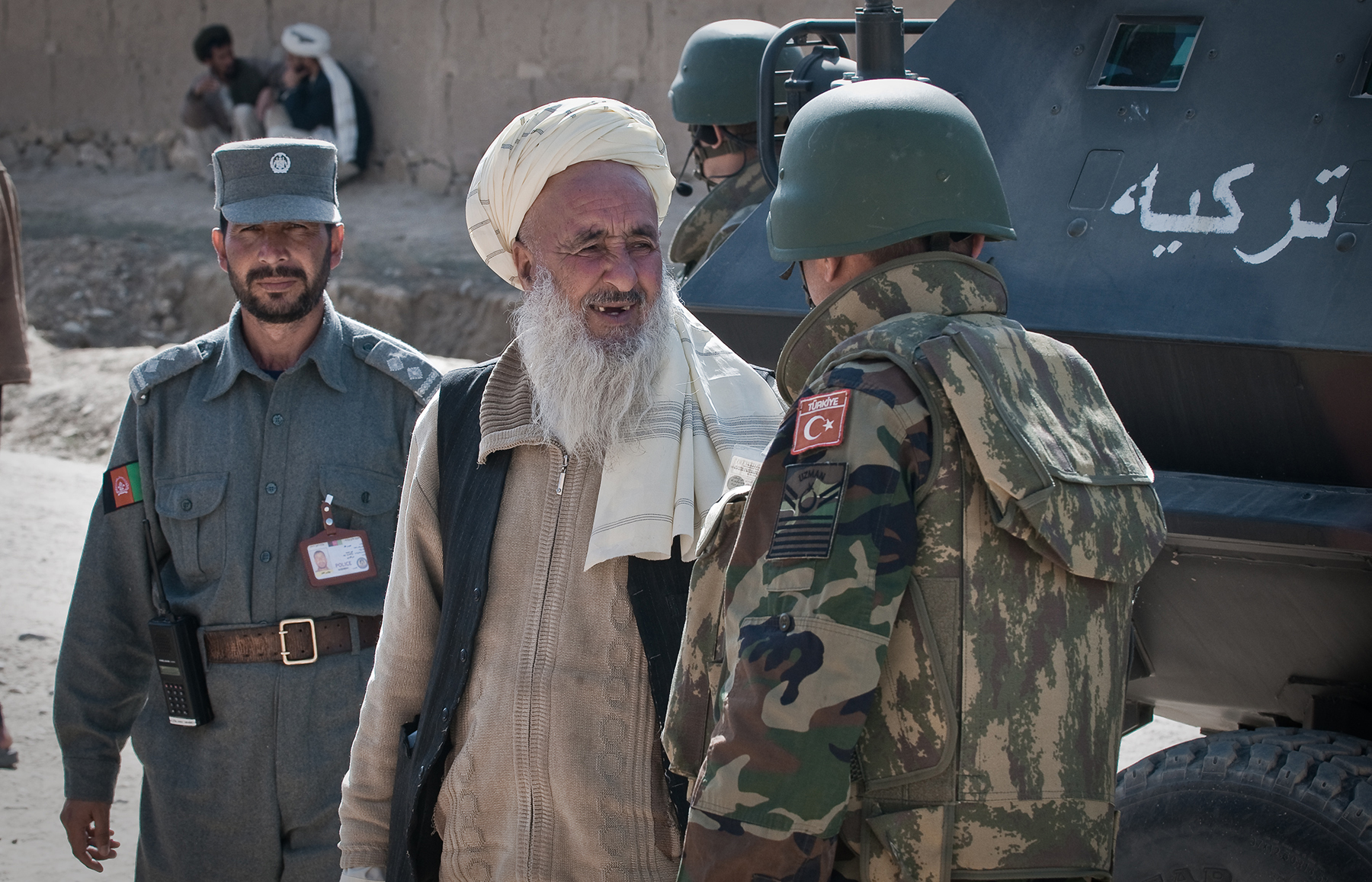
Additionally, as a Muslim-majority country with ties to Central Asia dating back to the Ottoman era, Turkey also shared a special relationship with Afghans, who frequently referred to Turkish soldiers as “brothers” rather than foreign invaders.
This bonhomie was rooted in ethnic ties to Turkic communities such as Uzbeks and Turkmens in northern Afghanistan, as well as their shared Islamic principles.
Analysts have stated that the Taliban may have refrained from attacking Turkish troops in Afghanistan because of these affinities and fear that their killings may run the danger of upsetting the local populace, who had a positive opinion of Turks.
Notably, the Islamic connection between the two states and their long-standing cultural and diplomatic ties were also seen as a reason behind Turkey’s reluctance to participate in combat operations.
Therefore, Turkey reduced its threat profile, as Taliban propaganda often spared Muslim-majority allies perceived as non-aggressive.
The Kabul Provincial Governor, Dr. Zabibullah Mojadid, said in an interview in January 2012, “Contrary to some other international forces here, the Turks don’t march through our streets with their guns and their caravans, ready to fire. When you see other forces with their hands on their triggers, people are very intimidated. Afghans don’t look at the Turkish forces as foreign forces here; they somehow view them as their own.”
Turkey also put its foot down when called upon to increase forces in Afghanistan. In December 2009, for instance, Erdogan said Turkey would not contribute additional troops to Afghanistan and would instead continue training Afghan forces. The decision came just a week after the former US President Barack Obama announced he was dispatching 30,000 more American troops to Afghanistan, and urged other allies to follow suit.
“Turkey has already done what it can do by boosting its contingent of soldiers there to 1,750 from around 700 without being asked,” said Erdogan.
Additionally, through years of hostilities, Turkey maintained strong ties with Pakistan, which was believed to be a key Taliban supporter at the time, further possibly deterring the Taliban from targeting Turkish troops.
Turkey’s reluctance to snap ties with Afghanistan remained constant till the 2021 eviction of NATO troops amid the Taliban takeover. Ahead of the takeover, Turkish security sources offered to remain after NATO’s withdrawal and continue providing security for the Kabul Hamid Karzai International Airport.
However, the Taliban repeatedly rejected any continued Turkish military presence, insisting on full withdrawal, which eventually forced the Turkish troops out, marking the end of Turkey’s nearly 20-year involvement in Afghanistan.
- Contact the author at sakshi.tiwari13 (at) outlook.com
- Follow EurAsian Times on Google News