After it failed to acquire American Tomahawk cruise missiles, Ukraine touted its own domestically developed Flamingo FP-5 as a long-range strike platform with comparable capabilities.
At least on paper, the two missiles had more than passing similarities.
Tomahawk had a claimed range of 1600 miles, slightly less than the 1900 miles claimed range of the Flamingo.
They are both terrain-hugging cruise missiles and fly at subsonic speeds, around 550 miles per hour.
In terms of price and warhead carrying capabilities, the Flamingo reportedly betters the Tomahawks.
While the Tomahawk carries a conventional warhead of 450 kg, Flamingos could carry a massive warhead of 1,150 kg.
In terms of price, Flamingos cost nearly one-fourth of the Tomahawks.
Flamingos’ much heavier warhead and significantly lower cost make it a good option for mass production and saturation strikes.
However, critics highlighted two critical issues where Flamingo’s effectiveness remained untested.
Its larger size (twice as long and wide as the Tomahawks) made it susceptible to interception. Furthermore, the Tomahawk is a combat-tested platform that has been upgraded over the decades and is known for its stealthy, precision-strike capabilities.
Critics argued that unless Flamingos prove their worth in real combat situations, they can not be compared to the Tomahawks.
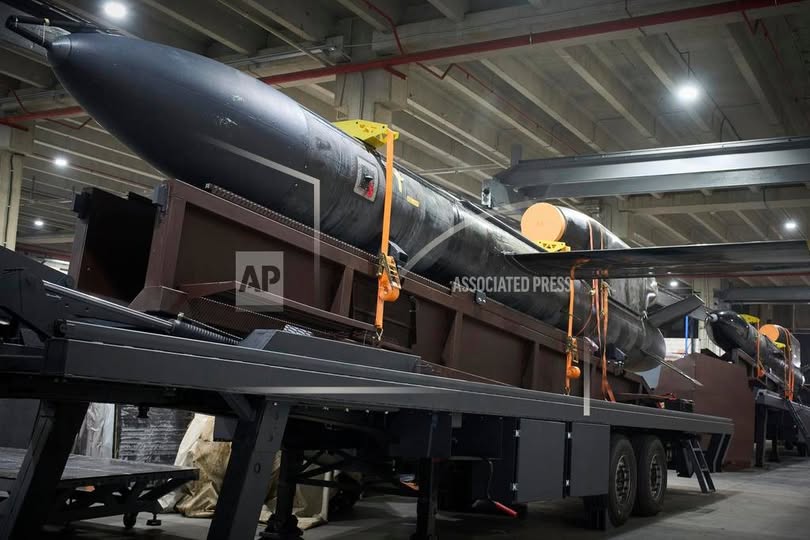
Ukraine first publicly unveiled the Flamingo missile in late August 2025, when international media published images of a production facility in Southern Ukraine. (The EurAsian Times has reported in detail about the missile’s capabilities in August 2025 itself.)
The missile’s first combat use also happened in late August when Ukraine launched a salvo of three Flamingos, targeting a Russian Federal Security Service (FSB) outpost near Armyansk in Crimea.
In September, Ukraine targeted Russia’s Skif-M facility in Belgorod, a specialized tooling factory critical to Russia’s Su-34, Su-35, and Su-57 production, with a salvo of four Flamingo missiles.
At that time, Russia reported shooting down three of these missiles, with one missile causing limited damage at the facility.
However, according to the latest reports in Ukrainian media, not only did all four missiles hit the facility, but they also caused significant damage at the factory.
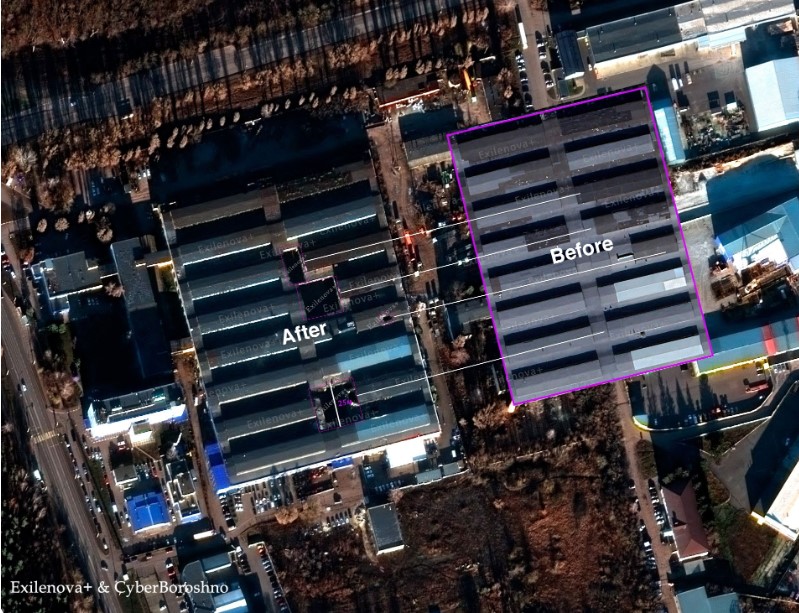
The reports analyzed satellite imagery to claim that all four missiles hit the target and that repairs were still underway at the factory critical to the production of Russia’s combat jets.
If the claims are correct, the long-range cruise missile has proven its precision-strike capabilities and its ability to bypass Russian air defense systems.
Ukraine Claims Flamingo Scored 4/4 Hits At Russia’s Skif-M factory
According to Ukrainian media claims based on satellite imagery, the Flamingo cruise missiles hit the Skif-M facility in Belgorod on 23 September 2025 with 100% accuracy.
Ukrainian Telegram channels Cyberboroshno and Exilenova+ reported that all four missiles hit the specialized tooling factory critical to Russia’s Su-34, Su-35, and Su-57 production.
At the time of the strike, Russia claimed that only one of the four missiles was able to hit the facility.
Satellite imagery, however, tells a different story. The OSINT analysts found all four Flamingo missiles struck within an 80-meter deviation radius of their targets. The 25-meter primary destruction zone is inconsistent with a single impact, suggesting Russian authorities attempted to downplay the strike’s effectiveness.
Skif-M manufactures specialized drills, cutters, and inserts essential for machining titanium, aluminum, and composite components. Seventy percent of its production serves aerospace applications. Russia’s United Aircraft Corporation remains its largest customer.
The factory has long been identified as Russia’s vulnerable spot in the production of its frontline combat aircraft.
In November 2025, the London-based Royal United Services Institute (RUSI) identified Skif-M as a vulnerable point in Sukhoi aircraft production.
Satellite imagery analyzed by Exilenova+ reportedly captured the facility after workers had already removed three of four damaged roof sections. This likely occurred as part of preparations for reconstruction.
Militarnyi noted that a low-resolution Copernicus satellite imagery from early January 2026 shows roof repairs remained incomplete more than three months after the attack.
This suggests that the missile strikes caused significant damage to the facility.
Given the factory’s criticality, it must have been protected by Russian air defense systems.
If, despite their presence, the missiles flew undetected and hit the factory, it means Flamingos could conduct precision strikes deep inside Russian territory against high-value targets.
However, the Ukrainian claims fail to address some crucial gaps in the production and use of Flamingo missiles during the last six months.
Does Flamingo Match Its Hype?
It must be noted that the strikes happened over four months ago. The factory’s location is no secret to Ukraine. Kyiv has sanctioned this factory even before these September strikes.
After the missile’s public unveiling in August 2025, the strike on the Skif-M factory in Belgrode in September was the first high-profile combat use of the missile.
Given the high-stakes involved, Ukraine would have liked to know the performance of its missile, which was critical to its ambitions of having a long-range strike platform capable of hitting targets deep inside Russian territory.
It is curious, to say the least, that Ukraine did not analyze satellite imagery of the factory for nearly four months after the strike.
According to the Centre for European Policy Analysis (CEPA), of the three missiles launched against a relatively undefended target in Northern Crimea in August, only two reached the target.
One missed the target by about 100 to 200 meters (109-218 yards), while the other impacted the target and caused significant damage, though it was likely 15 to 40 meters from its aimpoint.
“This result shows the continued challenge of manufacturing high-quality missile system, especially as Ukraine moves from manufacturing light and relatively unsophisticated long-range drones and mini-cruise missiles, toward heavier and more complex alternatives,” CEPA said.
Furthermore, in August last year, Fire Point claimed it could produce one Flamingo missile per day, and by October, it said it could increase production to seven per day.
So, Fire Point should be capable of producing over 200 Falamingo missiles per month.
However, over the last five months, the missile has been used sparingly.
While there is no official data on how many times Ukraine has launched the missile, media reports say Kyiv has fired fewer than 10 Flamingo missiles over the last five months.
Clearly, either Fire Point is not able to deliver the numbers it promised, or the missile has not achieved the desired results.
Notably, the missile is twice the size of Tamahawks.
Flamingo is over 40 feet in length, compared to Tomahawk’s length of nearly 18 feet. Its wingspan is over 20 feet compared to the wingspan of 8 feet of the Tomahawk. Flamingo’s bigger size means a larger Radar Cross Section (RCS).
Also, Tomahawks feature folding wings, whereas Flamingo has fixed wings, making it easier to detect. Nevertheless, Flamingo adds a critical capability to Ukraine’s arsenal as it provides Kyiv with the ability to strike deep inside Russian territory.
Notably, Flamingo is Europe’s longest-range cruise missile. Germany’s Taurus missile has a range of nearly 550 km. Similarly, the British-French Storm Shadow/SCALP has an effective range of 560 km.
Currently, the longest-range cruise missile in Europe is France’s MdCN (Missile de Croisière Naval), also known as SCALP Naval. The MdCN is a naval cruise missile derived from the SCALP platform. It has an officially declared range of over 1,000–1,400 km, and carries a warhead weighing approximately 300 kg.
Thus, the Flamingo’s range is more than double the range of Europe’s current longest-range cruise missile. A spectacular achievement, given that Ukraine developed it in just three years.
If Ukraine can reduce its size, improve its stealth and precision-strike capabilities, Flamingo would truly become a force to reckon with.
- Sumit Ahlawat has over a decade of experience in news media. He has worked with Press Trust of India, Times Now, Zee News, Economic Times, and Microsoft News. He holds a Master’s Degree in International Media and Modern History from the University of Sheffield, UK.
- VIEWS PERSONAL OF THE AUTHOR.
- He can be reached at ahlawat.sumit85 (at) gmail.com