

Ukraine’s STING interceptor drone has managed to shoot down a “newly unveiled” Shahed-107, the latest entrant to Russia’s notorious Shahed family of kamikaze drones.
On December 30, 2025, Ukraine’s “Wild Hornets” volunteer group announced the first confirmed downing of a rare Iranian-made Shahed-107 kamikaze drone, achieved by pilots from the air defence unit of the 47th Separate Mechanised Brigade “Magura”, as reported by local Ukrainian media.
The drone was intercepted using an STING interceptor equipped with the advanced Hornet Vision thermal camera system.
Footage recorded by the Sting drone has been published on social media, showing the moments of tracking and the ensuing engagement with the hostile Shahed-107.
The Shahed-107 is an Iranian-developed unmanned aerial vehicle (UAV), specifically a kamikaze drone with combined reconnaissance and strike capabilities.
The existence of this drone was first reported by Sky News in January 2024, which described it as an “explosive and reconnaissance” unmanned aerial vehicle (UAV), possibly fitted with technology to seek out high-value battlefield targets.
This was followed by a report in October 2024 that Iran had offered Russia “several units” of Shahed-107 drones.
The first confirmed takedown of the Iranian kamikaze UAV Shahed-107 🔥
Air defense pilots of the 47th Mechanized Brigade “Magura” engaged the enemy target using interceptor STING equipped with the Hornet Vision video system by Wild Hornets. pic.twitter.com/Kg3xTQDnvo
— Wild Hornets (@wilendhornets) December 30, 2025
The drone was officially unveiled by Iran in June 2025 amid sustained hostilities with Israel. At the time, the Iranian state media claimed that the drone boasted the capability to cause significant damage to Israel’s air defence systems.
The use of the drone in Ukraine was first confirmed in November 2025 by Ukrainian electronic warfare expert Serhii “Flash” Beskrestnov.
“Increasingly, the use of a new type of Shahed-107 is being recorded in frontline zones,” Beskrestnov wrote on Telegram at the time. “The UAVs were produced in 2024 in Iran, and it can be assumed that the Russians will continue to produce this UAV on the territory of Russia.”
Several videos attributed to the Shahed-107 were also posted to social media. Some Open Source Intelligence (OSINT) bloggers surmised that the drone was using a 4-element CRPA satellite navigation system and could carry an 8–9 kilogram warhead.
Though details are still emerging, we know that the drone is designed for targeted strikes on high-value assets, such as military equipment or infrastructure. It is capable of real-time live video transmission to identify targets before diving to impact, which may make it suitable for hunting mobile or high-priority targets in Ukraine, such as HIMARS.

Some experts have noted that the Shahed-107 is potentially a more sophisticated version of the Shahed-101, whose use was earlier recorded within Hezbollah ranks.
Unverified reports suggest that the brand-new Shahed-107 may have a range of about 300 kilometres, although some sources estimate the range at 800 kilometres and predict a cruising speed of about 120 kilometres/hour.
Images of the drone in the public domain indicate that it has a cylindrical fuselage with rectangular wings attached on top, roughly halfway between the nose and tail, according to photos shared online. It features a unique X-shaped rear tail fin.
The Shahed-107 has a piston engine instead of the previous model’s electric motor, which probably extends its range, but also makes it easier to detect by increasing its thermal and aural signature. Some sources say that the engine is a Chinese DLE 111 two-stroke gasoline piston engine, but the information could not be independently verified.
A new type of UAV developed in Iran in 2024 called “Shahed-107” is increasingly being used by Russia.
It has a 4-element CRPA satellite navigation system, a range of several hundred kilometers, and an 8–9 kg warhead.
1/ https://t.co/u8KG9g78dK pic.twitter.com/WLH7vmtqXd— Roy🇨🇦 (@GrandpaRoy2) November 17, 2025
According to some reports, the drone is lightweight and sturdy, as its body is composed of lightweight carbon fibre with aluminium structural components.
With its four-stage jamming-resistant antenna and protective block, Shahed-107 employs an inertial navigation system (IMU) that may reduce, but not fully block, the effects of some electronic warfare tactics.
Notably, the deployment of Shahed-107 builds upon the combat success of Shahed-136, which is locally produced under the name Geran-2.
A propeller-driven drone with a range of up to 2,500 kilometres, speed of 180 kilometres/hour, and a warhead of 40–90 kilograms, the Shahed-136 has been extensively deployed by Russia to attack Ukraine’s energy grid, power plants, and critical infrastructure. These low-cost drones are launched in swarms to overwhelm Ukrainian air defences, making them a constant source of trouble for Kyiv.
In fact, the Ukrainian battlefield has been somewhat of a live lab for Iran-origin Shahed-class drones. For instance, Russia has experimented with the use of Shahed-131, a smaller variant of the Shahed-136, and the Shahed-238, a jet-powered variant of the drone that is harder to intercept and can reach targets at a longer range.
The most commonly used Shahed-136 has been upgraded multiple times to bolster its capability to launch devastating attacks. In fact, Russia has started to equip these drones with Soviet-era R-60 air-to-air missiles, as reported by the EurAsian Times earlier this month. One of these AAM-equipped Shahed was downed by the Sting interceptor drone.
The use of Shahed-107 once again emphasises the growing utility of cheap, expendable unmanned systems in modern warfare with contested airspace.
Nonetheless, it is noteworthy how Ukraine is now relying on interceptor drones to down these suicide machines, instead of bleeding out its expensive air defence missiles.

Drone vs Drone
Kyiv has been compelled to revise the air defence regulations and create low-cost drone killers that can cost as little as $1,000 due to nightly attacks on Ukrainian cities and electrical infrastructure. In just a few months in 2025, interceptors—the most recent innovation in modern warfare—went from prototype to mass manufacturing.
Instead of relying on a small number of costly, slow-to-replace weapons, effective defensive systems in Ukraine prioritize mass production, rapid adaptability, and layering inexpensive systems into existing fortifications.
The Sting Interceptor is a shining example of this approach.
The Sting is a Ukrainian-developed FPV (first-person view) interceptor drone developed by Wild Hornets, a volunteer-driven non-profit charitable fund and UAV manufacturer. It is specifically designed as a low-cost loitering munition to counter the Shahed-136 kamikaze drones and other UAV threats.
The Sting’s primary role is to intercept slow-flying, long-range threats such as Shaheds, decoys, reconnaissance drones, and even faster jet-powered variants. It is operated manually via VR goggles, with some models featuring AI-assisted targeting. It entered combat use in 2025.
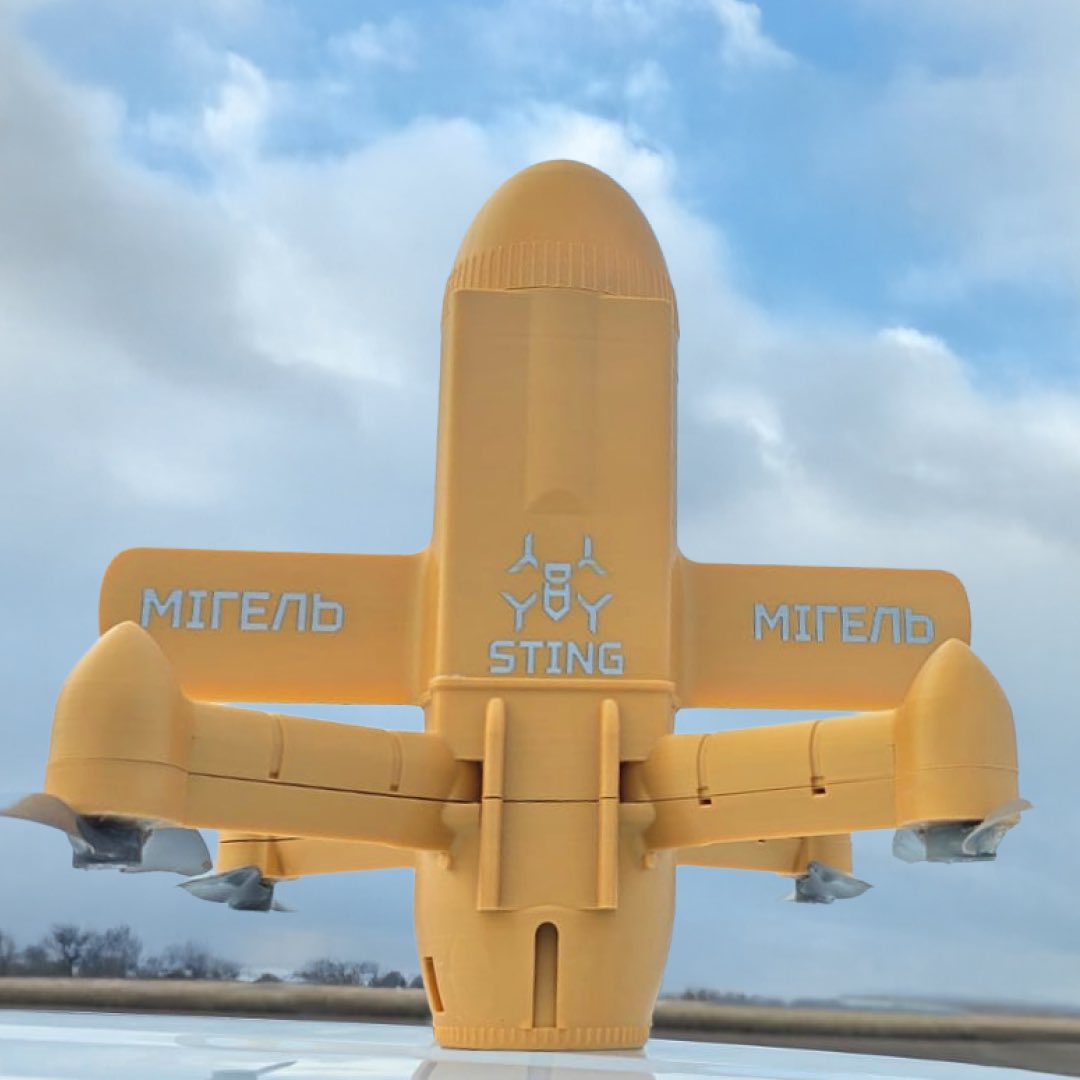
These drones can accelerate quickly before colliding with adversary drones. Pilots either wear first-person vision goggles or watch monitors while flying them. The success of these drones depends on sensors, fast command and control, and skilled operators.
Serhii Sternenko, a Ukrainian activist, said earlier this month that Ukrainian troops used Sting interceptor drones to shoot down multiple Shahed jet-powered drones for the first time during an overnight aerial raid. This is quite a milestone, given that Shahed-238 jet-powered drones are difficult to intercept.
- Contact the author at sakshi.tiwari13 (at) outlook.com
- Follow EurAsian Times on Google News


