

The U.S. Navy is arming its carrier-based F-35C Lightning II stealth fighters with Leonardo’s BriteCloud active expendable decoys, enabling bolder strikes deep into contested airspace while enhancing aircraft survivability against sophisticated threats.
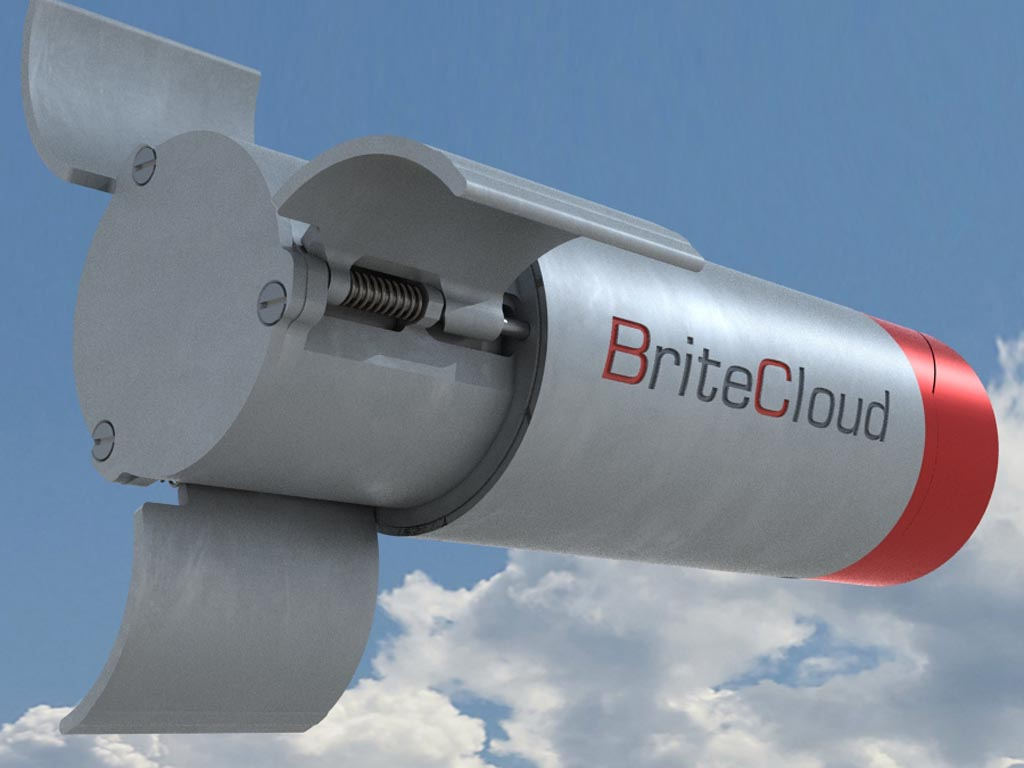
As the manufacturer, Leonardo UK, puts it: “The BriteCloud Expendable Active Decoy (EAD) is a small active self-contained Digital RF Memory (DRFM) countermeasure for fast jet aircraft that can defeat the majority of modern and legacy Surface-to-Air and Air-to-Air threat systems. BriteCloud is designed to be dispensed from standard chaff and flare dispensers and requires minimal platform integration.”
Naval Air Systems Command (NAVAIR) awarded Leonardo UK an undisclosed quantity of these decoys, along with spare impulse cartridges and support gear. The award was announced through a Department of Defense (DoD) notice on December 23, 2025.
The US Navy first disclosed plans to acquire the Britecloud decoys in June last year, followed by an announcement that it was ready to negotiate a fixed-price contract covering an estimated 1,000–2,000 EADs annually.
Although the announcement did not mention the decoy’s name, experts inferred that the contract being awarded to Leonardo’s UK division indicated that BriteCloud had been selected.
Additionally, key details outlined by NAVAIR, most notably the required 2×1×8-inch form factor, strongly indicated interest in the BriteCloud 218 variant, a compact rectangular adaptation of the original 55 mm cylindrical BriteCloud round.
This smaller design is specifically engineered to fit seamlessly into U.S.-standard chaff/flare dispensers, including the widely used AN/ALE-47 system. By July 2025, NAVAIR escalated its ambitions in a pre-solicitation notice, targeting an annual procurement of 3,000–6,000 units for the F-35 and F/A-18 fleets.
The latest award has been categorised as non-competitive and sole-source, reflecting Leonardo’s unique qualifications, which include prior testing, hardware-in-the-loop validation, safe separation trials, and effectiveness demonstrations on the F-35.
The contract includes procurement of the EAD, as well as initial spare impulse cartridges and support equipment to provide the required radio frequency countermeasure capability. The duration consists of a base year and up to one option.
The US Navy specifically uses the F-35C Lightning II, a dedicated carrier-variant of the fifth-generation stealth aircraft.
The F-35C made its combat debut in November 2024 during a campaign against Houthis, but the F-35C squadron deployed aboard the USS Abraham Lincoln was a US Marine Corps unit called “Black Knights.”
However, the US Navy F-35Cs from VFA-97 on USS Carl Vinson followed up on this earlier this year with drone shootdowns using AIM-9X missiles and strikes on Houthi sites inside Yemen.
It is pertinent to note that while stealth fighters, such as the F-35, have a low radar cross-section, they are not fully invisible to radar.
China has repeatedly claimed to have detected F-35s and F-22s. Meanwhile, systems like Russia’s S-400 use multi-band radars (including low-frequency Nebo-M arrays in VHF and L bands) to detect stealth aircraft at longer ranges for cueing, even if precise targeting is more challenging, as previously explained by EurAsian Times.
This is where the BriteCloud AED comes into play: an off-board, autonomous RF jammer with broadband coverage that blinds or misdirects networked integrated air defenses (IADS) on ships, planes, or ground sites.
The Navy’s current go-to expendable is the GEN-X (RT-1489/ALE), which is considered good for end-game missile jamming. However, the NAVAIR needs more as it prepares for a future conflict, potentially with China.
The incoming BriteCloud would create a highly realistic false target by leveraging advanced DRFM technology to deliver precise Doppler shifts and range obscuration, manipulating velocity and distance gates in ways that defeat even sophisticated electronic counter-countermeasures (ECCM) and home-on-jam seekers. This creates an effective electronic phantom that draws missiles away, forcing them to detonate harmlessly at a safe standoff distance.
BriteCloud would significantly strengthen the F-35’s electronic warfare (EW) capability, delivering a critical additional layer of protection in high-threat environments where stealth alone may prove insufficient.
By providing off-board, expendable RF countermeasures that complement the AN/ASQ-239 suite and limited ALE-70 towed decoys, it markedly increases the aircraft’s odds of executing successful strikes and returning safely, making it a vital enabler for operations against advanced, integrated air defenses.
What Do We Know About The Britecloud AED?
The BriteCloud is an advanced expendable active decoy (EAD) developed by Leonardo to protect aircraft against radio-frequency (RF)-guided threats, such as surface-to-air missiles (SAMs), air-to-air missiles (AAMs), and fire-control radars. It is widely recognized as the “gold standard” for protecting against radar-guided surface-to-air and air-to-air missiles.
Britecloud is a battery-operated, self-contained device that creates a very realistic fake target using Digital Radio Frequency Memory (DRFM) jamming technology, diverting threats from the host aircraft and creating a very large miss distance.
The self-contained, battery-operated BriteCloud cartridge has an off-board jamming capability, which accounts for its “active” name. It can be dropped like traditional chaff and flares, which accounts for its “expendable” nature, to create a wide gap between the aircraft and the decoy, ensuring that the missile and its shrapnel miss the aircraft entirely.
Leonardo has developed a version of the BriteCloud, code-named BriteCloud 218 (AN/ALQ-260(V)1 in the US designation system), with the express purpose of being installed in standardized 2-inch x 1-inch x 8-inch countermeasure dispensers, like the commonly used AN/ALE-47 and the countermeasure dispenser system of the F-35.

According to Leonardo, BriteCloud can eliminate the majority of Radio Frequency (RF)-guided surface-to-air and air-to-air threat systems, including those that employ risky “home-on-jam” guidance, in which the missile targets the jamming signal—especially for aircraft that have only an internal or podded jammer.
BriteCloud can detect incoming radar pulses from hostile platforms such as ships, aircraft, and ground-based air defense systems.
The decoy’s onboard sensors scan for incoming RF signals from priority threats. This is followed by the collection of radar pulses and cross-referencing them against a pre-programmed threat library. Once the threat is identified, it employs Digital Radio Frequency Memory (DRFM) to replicate and manipulate the signals, generating a false target signature with precise Doppler (velocity) and range obscuration.
This deceives the threat’s electronic counter-countermeasures (ECCM), making the decoy appear more convincing as a target than the actual aircraft. Therefore, forcing the missile or radar locks onto the decoy instead, which then explodes harmlessly away from the plane.
Several air defense systems today use Electronic Counter-Countermeasures (ECCM) to subdue countermeasures an aircraft uses, such as flares, chaff, and jammers. Using a decoy like BriteCloud would subdue that glaring threat, especially in a near-peer combat situation.
- Contact the author at sakshi.tiwari13 (at) outlook.com
- Follow EurAsian Times on Google News


