

Turkey and France are pushing ahead with new aircraft carriers despite ongoing debate over their relevance in modern combat. While France just announced the new PANG carrier development program, Turkey has revealed new details about MUGEM.
Speaking at a shipyard in Istanbul, Turkish President Recep Tayyip Erdogan claimed that construction had already begun on the aircraft carrier MUGEM.
Describing the carrier as the “older brother” of the Turkish navy’s 261-foot-long amphibious attack ship, the TCG Anadolu, the Turkish President said that the length of its upcoming first-ever aircraft carrier is now anticipated to be 300 meters, up from previously anticipated 285 meters.
The carrier’s length could be instrumental in determining the space on its flight deck, which can have a big impact on the number of aircraft it can accommodate, the length of its runway, and the launch mechanism.
For instance, the US Navy’s USS Gerald R. Ford, currently the largest aircraft carrier in the world, measures about 337 meters in length. At the same time, though, it must be remembered that the real size of a warship is more precisely determined by its displacement than by its length.
MUGEM is expected to displace approximately 60,000–70,000 tons, making it comparable to the UK’s Queen Elizabeth-class (65,000 tons) and significantly larger than France’s existing carrier, the Charles de Gaulle (42,000 tons). Nonetheless, it is smaller than Ford (100,000 tons) or China’s newly commissioned Fujian (80,000 tons).
The length of the MUGEM national aircraft carrier (under construction) has been increased from 285 meters to 300 meters ☄️ https://t.co/US7pnrvDmh pic.twitter.com/nAWTlfVPmu
— TR_tech (@T_Nblty) December 20, 2025
The MUGEM design activity began in October 2023, but the carrier program was officially unveiled when President Recep Tayyip Erdoğan visited the Istanbul Naval Shipyard’s Design Project Office in February 2024.
This was followed by Turkish naval authorities providing updates on the project in April 2024, including specifics of the ship’s capabilities and design during a behind-the-scenes tour of the shipyard.
While the details of the carrier are still emerging, previous reports suggest that the carrier’s optimised hull form, created with the aid of a multi-dimensional optimisation tool, guarantees superior seakeeping, stability, and great manoeuvrability. These capabilities have been demonstrated by internal modelling tools.
Furthermore, the carrier design’s bow enhances underwater noise propagation and reduces fuel consumption by 1.5%, thereby increasing its operational stealth and efficiency.
The MUGEM carrier has been envisioned to feature three runways, two for takeoff and one for landing. While it was originally intended to have a ski-jump ramp for aircraft takeoff, the new carrier is now planned to incorporate a domestically developed catapult.
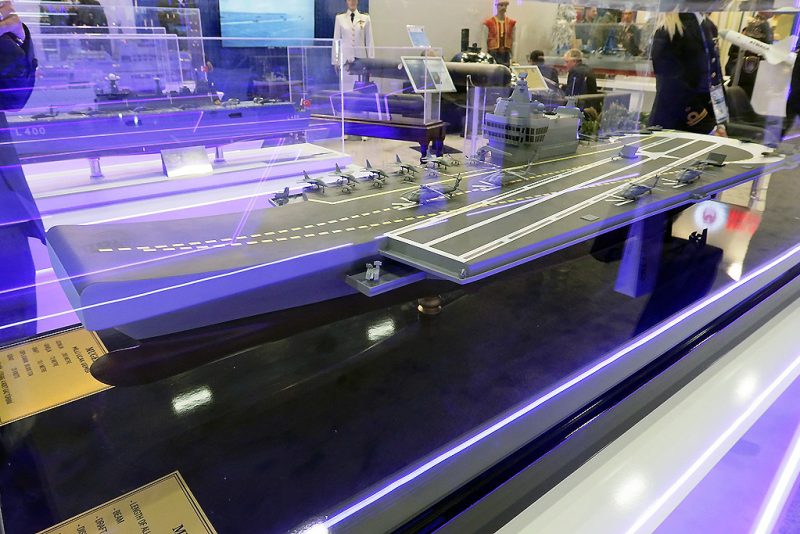
However, this also means that Turkey has a long road ahead. Developing a domestic catapult is extremely difficult and costly, and even China struggled with it for the Fujian project.
Turkey, for one, has no prior experience in developing a catapult or an aircraft carrier. Moreover, it is an extremely expensive program that could strain defense spending.
MUGEM will be equipped with four Gökdeniz Close-in Weapon Systems (CIWS) and a 32-cell (8×4) MIDLAS Vertical Launching System (VLS) for self-defense. Additionally, it will feature six Aselsan 25mm STOP Remote Weapon Systems for close-range defense, primarily against asymmetric threats
As per the previous plan, the carrier was expected to host about 50 aircraft, including both manned and unmanned systems—20 on deck and 30 in the hangar.
The aircraft scheduled for deployment aboard Turkey’s first aircraft carrier include the naval variant of TAI’s Hurjet light attack aircraft, TAI’s ANKA-III unmanned jet fighter, Baykar’s Bayraktar KIZILELMA unmanned jet fighter, and the TB-3 UCAV.
However, it is pertinent to note that many of these aircraft are in different phases of development and testing.
Turkey has long sought to host the F-35B, the short-takeoff and vertical-landing (STOVL) variant operated by US allies, on its own aircraft carrier. However, that dream was dashed when it was expelled from the F-35 program in 2019 for purchasing the Russian S-400 air defence system.
The Erdogan government is currently in talks with the US to secure clearance for the F-35, but a decision has yet to be made by the White House.
Designed as a fully dedicated supercarrier, MUGEM will shift Turkey’s naval posture from coastal defence to blue-water force projection. The carrier provides a platform for diplomatic signaling, amphibious operations, and air superiority in contested waters in the Mediterranean and Black Sea, where Turkey faces disputes with Greece, Cyprus, and others over energy resources and maritime boundaries.
The project positions Turkey among a select group of nations, such as the US, China, Russia, France, and the UK, capable of constructing large aircraft carriers. In fact, it aligns with Turkey’s long quest for military autonomy within the larger NATO alliance.
If all goes well, Ankara could hold the distinction of being the second NATO country to build its own fifth-generation stealth fighter (KAAN) and its own aircraft carrier.
France Will Get A Brand New Carrier
French President Emmanuel Macron has approved the proposal to replace the nuclear-powered Charles de Gaulle (CDG) aircraft carrier. “In line with the last two military programming laws, and after a thorough and comprehensive review, I have decided to equip France with a new aircraft carrier,” Macron said, speaking during a visit to French troops in the United Arab Emirates.
Known as Porte-Avions Nouvelle Génération (PA-NG), it is envisioned as a 78,000-ton nuclear carrier measuring around 310 metres, making it Europe’s largest warship.
The PA-NG will accommodate 30 fighter jets. The carrier will enter service in 2038 and replace the Charles de Gaulle inducted in 2001, as recently noted by the EurAsian Times.
The flight deck will feature two or three electromagnetic catapults (EMALS), enabling rapid and flexible aircraft launches. The air wing is planned to include around 30–40 next-generation fighters (likely Rafale-M or future FCAS aircraft), three E-2D Advanced Hawkeye AWACS aircraft, and a complement of unmanned systems.

Notably, the new carrier will be powered by two advanced K22 nuclear reactors developed by TechnicAtome, each producing 220–230 megawatts and driving three shafts. This will allow the carrier to stay at sea longer and operate at high sustained speeds.
The new carrier will help project force across regions like the Indo-Pacific and the Middle East amid rising tensions with powers like China and Russia. This aligns with France’s NATO commitments and its interests in overseas territories, where a carrier enables rapid response without fixed bases.
The project, greenlit for design and production phases, reflects a strategic push for autonomy in defense technology.
Carriers Still Worth Investing In
In recent years, several analysts and naval strategists have argued against the development of mammoth platforms like aircraft carriers, stating that they are just heavy platforms that can be “destroyed in a few minutes with modern weapons, making them an expensive and inefficient naval weapon in contested environments.
Critics draw attention to modern anti-access/area-denial (A2/AD) systems, such as hypersonic glide vehicles, anti-ship ballistic missiles, and long-range ISR (Intelligence, Surveillance, and Reconnaissance), in high-end conflicts that have the potential to strike carriers from ranges of more than 1,000 kilometers.
In fact, a large section of experts and strategists believe that the future of warfare is robotic and unmanned systems, emphasizing that these carrier-killer missiles make aircraft carriers high-risk and low-return assets.
A leaked Pentagon document appeared to suggest to the US military that it must invest in unmanned platforms and hypersonic missiles instead of complex and expensive platforms like aircraft carriers. Chinese hypersonic missiles could sink carriers “within minutes.”
However, a dominant group of experts still believes that aircraft carriers are indispensable and far from obsolescence.
The Russian Navy’s former Vice Admiral Vladimir Pepelyaev discussed the strategic importance of these mammoth vessels in his book “Aircraft Carrier.” Citing historical precedents and modern strategic imperatives, he said that for a nation like Russia, which aspires to be a major maritime power, a fully-equipped aircraft carrier fleet is indispensable.
Similarly, Admiral S. J. Paparo, the former Commander of the United States Indo-Pacific Command (USINDOPACOM), said: “Aircraft carriers are indispensable combat platforms. With their air wings, these mighty, mobile, maritime air bases offer a unique combination of versatility and force, enabling the nation to project air power across the globe without the constraints of basing rights and geopolitical borders. Naval aviation and aircraft carriers are critical capabilities within a system of joint, combined, all-domain warfighting. They can generate high sortie rates for strike warfare and air superiority.”
While carriers are vulnerable in some high-intensity combat situations, they can be very useful in other potential military missions. They don’t need help from the host nation to react swiftly to various operational needs or threats because they can be deployed anywhere in international waters.
That is perhaps why countries like the United States and China continue to invest in developing new and advanced carriers. While Washington continues to churn out new Ford-class carriers, Beijing has reportedly started work on its nuclear-powered Type 004 aircraft carrier.
- Contact the author at sakshi.tiwari13 (at) outlook.com
- Follow EurAsian Times on Google News


