China is bolstering Pakistan’s naval power with advanced weaponry and platforms, including AIP-equipped submarines, multi-role frigates, and long-range missiles, which analysts have characterised as a calculated move to keep India distracted and to split its military resources.
While Chinese-supplied J-10C fighters and PL-15 missiles grabbed headlines during the intense aerial clashes during the Indo-Pakistan conflict of May 2025, Beijing has been quietly transforming Pakistan’s naval power with cutting-edge platforms poised to challenge Indian dominance in the strategic Indian Ocean Region (IOR).
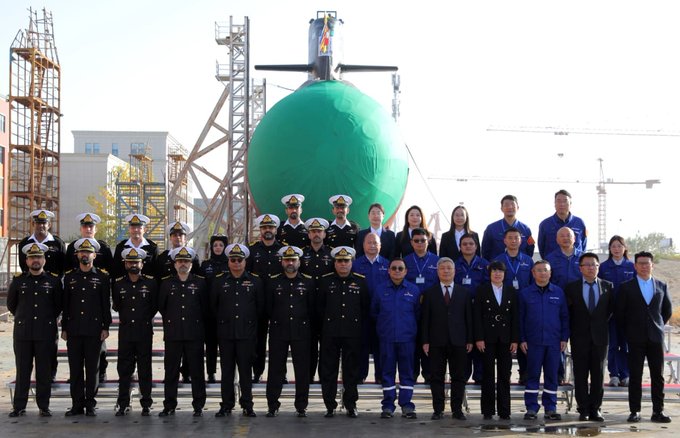
On December 17, 2025, mere weeks after India observed Navy Day commemorating the 1971 sinking of Pakistan’s original PNS Ghazi, China launched the fourth and final Chinese-built Hangor-class submarine, boldly rechristened PNS Ghazi, at Wuchang Shipbuilding in Wuhan.
“With the launching of GHAZI, Pakistan Navy has achieved another significant milestone where all four submarines under construction in China are now undergoing rigorous sea trials and are in the final stages of being handed over to Pakistan,” the Pakistani Navy stated in the press statement.
Notably, this air-independent propulsion (AIP)-equipped diesel-electric attack submarine—an export variant of the People’s Liberation Army Navy’s advanced Type 039B Yuan-class—completes the set of four China-built Hangor-class subs, all of which are now undergoing rigorous sea trials ahead of handover to Pakistan.
Pakistan inked a deal with China to acquire eight Hangor-class conventional submarines in 2015. Of these, four are being constructed in Wuhan, China, and the remaining four will be constructed in Pakistan at Karachi Shipyard and Engineering Works Ltd (KS&EW) with Transfer of Technology (ToT).
The first batch of Pakistan’s Hangor-class submarines is expected to enter service with the Pakistani Navy by 2026, as recently disclosed by Admiral Naveed Ashraf, chief of the Naval Staff of the Pakistan Navy, in an interview with the Chinese state-owned Global Times.
While a lot has changed since 1971, when the two South Asian neighbours went to war, the animosity between India and Pakistan has remained constant.
For instance, when the Indian Air Force engaged Pakistan in the skies during Operation Sindoor in May 2025, the Indian Navy quietly stood guard in the Arabian Sea, waiting for orders to strike Pakistan from the sea, as also highlighted by the Indian PM Narendra Modi himself.
The order never came, and the conflict ended in a ceasefire after four days.
China-Pakistan Naval Cooperation
The Hangor-class submarine tops the list of all naval cooperation between China and Pakistan. These submarines are expected to enhance Pakistan’s naval capabilities through improved stealth, maneuverability, and firepower, enabling the Pakistani Navy to execute a wide range of operations effectively, as Admiral Naveed Ashraf, the chief of the Naval Staff of the Pakistan Navy, has highlighted.
Named after the original PNS Hangor, a French-built Daphné-class submarine that sank the Indian Navy frigate INS Khukri during the 1971 Indo-Pakistani War, the Hangor-class is an export derivative of China’s Yuan-class (Type 039A/B) submarines, which form a cornerstone of the People’s Liberation Army Navy’s conventional submarine fleet.
These are world-class subs that come with advanced sensors and modern armaments. Their acquisition is part of Pakistan’s offensive sea denial strategy, which prioritizes the use of subs and maritime patrol aircraft equipped with lethal missiles in naval warfare.
The submarine is expected to be equipped with exceptional weaponry, including anti-ship cruise missiles (ASCMs) and heavyweight anti-submarine warfare (ASW) torpedoes. It will also carry a version of the Babur land-attack cruise missiles (LACM) for long-range strikes and possibly for nuclear deterrent, according to some reports in Pakistani media that EurAsian Times is currently unable to verify at this moment.
More importantly, though, the Hangor-class submarines are equipped with AIP technology, which allows a submarine to stay hidden in the ocean’s depths for longer periods and, if necessary, reach its target quickly without disclosing its position. This is because the smoke emitted by a submarine’s diesel engines as it climbs from the ocean’s depths to the surface increases its chances of being detected by the enemy.
As of now, all three of Pakistan’s French Agosta-90B —PNS Khalid, Saad, and Hamza—are powered by AIPs. The addition of Hangor-class submarines will take the number of AIP-equipped submarines in the Pakistan Navy to eleven.
India, on the other hand, is finalising a submarine design with AIP. However, the project is still in the negotiation phase 10 months after selection, which means it could be a while before construction can begin.
This essentially puts India at a competitive disadvantage vis-à-vis its adversaries, China and Pakistan, as previously explained in a detailed EurAsian Times report.
By bolstering Pakistan’s navy, China compels India to allocate significant forces to the west, thereby diluting its ability to project power eastward or challenge Chinese interests in the Indo-Pacific. This “two-front” pressure has intensified amid Sino-Indian border tensions.
Boosting Pakistan, Challenging India
The Pakistan Navy (PN) has undergone a significant modernization drive over the past decade, shifting from a primarily littoral force focused on defending its shoreline and nearby waters to one with growing regional power-projection capabilities in the Indian Ocean Region (IOR), particularly in the northern Arabian Sea.
This evolution is supported by Chinese arms transfers and is in line with Pakistan’s focus on longer-range operations, advanced strike options, and sustained patrols beyond coastal zones.
In addition to strengthening Pakistan Navy’s undersea capability, China is also helping ramp up its surface capability with some of the most advanced warships operated by the Chinese People’s Liberation Army Navy (PLAN).
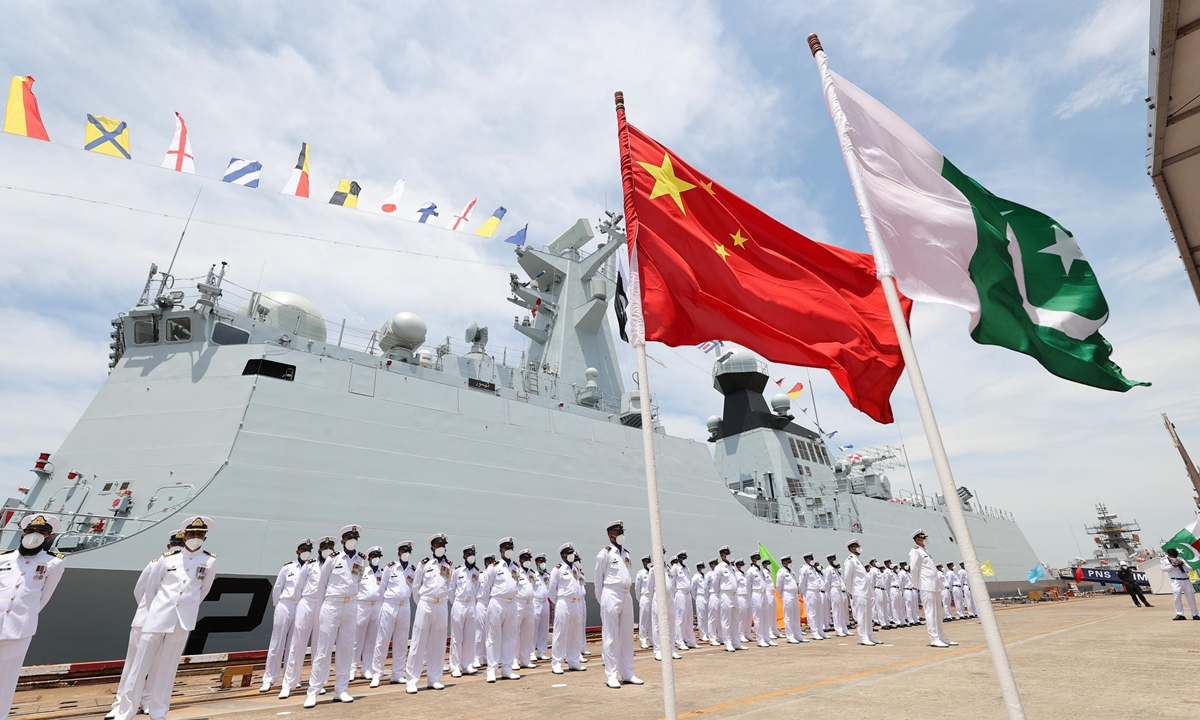
This includes the Type 054A/P multi-role frigates, which are essentially the backbone of PLAN’s surface fleet.
Known by the name of Tughril-class, the frigate builds on the capabilities of Pakistan’s Zulfiquar-class frigates (based on China’s Type 053H3 frigates), which were commissioned in 2009.
Four Zulfiquar-class ships are in service with the Pakistan Navy. These are multi-mission guided missile frigates that can be used for both anti-surface warfare (ASUW) and anti-submarine warfare (ASW), and are not intended for any particular duty; they can also be employed for air defense.

The Tughril-class, or the Type 054A/P, takes that capability to the next level. It is a stealth frigate with multi-mission capabilities and enhanced air defense.
These 4,000-ton vessels represent Pakistan’s most capable surface combatants, equipped with vertical launch systems for CM-302 supersonic anti-ship missiles, LY-80 (HQ-16) surface-to-air missiles, advanced anti-submarine warfare suites, and modern sensors for multi-threat operations, among other things.
Earlier, the Pakistani Navy chief noted that the Type 054A/P frigates have greatly strengthened the Pakistan Navy’s multi-mission capability, particularly in air defense, anti-submarine warfare, and maritime surveillance.
“These platforms are playing a key role in ensuring maritime security in the North Arabian Sea and the broader Indian Ocean region, which is critical for the global economy,” he was quoted as saying by Chinese media.
Notably, Pakistani war strategists believe that these warships would revolutionize the Pakistan Navy when used alongside MILGEM/Jinnah-class corvettes, offshore patrol vessels (OPV 1900), and CH-4 medium-altitude long-endurance (MALE) drones.
In addition to world-class submarines and surface vessels, China has also helped ramp up the Pakistani Navy’s firepower.
At the heart of this effort is the transfer of the CM-302, a variant of the popular YJ-12 supersonic anti-ship missiles. Pakistan has integrated the missile onto its Type 054A/P frigates.
The CM‑302 is an export variant of China’s YJ-12 ramjet-powered coastal anti-ship missile. It is widely described as a supersonic, sea‑skimming, anti‑ship cruise missile intended to strike surface warships with high speed and a heavy warhead. In fact, it is considered to be an analog of the Indo-Russian BrahMos missile.
The missile had earlier been deployed to mainland China’s shoreline and artificial islands in the South China Sea, posing a direct threat to Taiwan and American aircraft carrier strike groups.

And, in service with the Pakistani Navy, they potentially pose a threat to the Indian warships and carriers. They can be deployed as dispersed coastal batteries or on small ships to threaten larger warships. They are cheaper than large cruise missiles and could be used in salvos to overwhelm hostile air defense systems in combat.
Lyu Xiaoge, spokesman for China Aerospace Science and Industry Corp, told China Daily in 2016 that CM-302 is the best anti-ship missile available on the world’s arms market and “it’s not an exaggeration.”
China has also enhanced Pakistan’s airborne anti-submarine warfare (ASW) capabilities by transferring Harbin Z-9EC helicopters. A navalized variant of the Z-9 series (itself a licensed derivative of the French AS365 Dauphin), the Z-9EC was specifically customized for the Pakistan Navy as part of the 2006 deal that accompanied the Zulfiquar-class (Type 053H3/F-22P) frigates.
Approximately six Z-9EC helicopters were delivered between 2009 and 2010, providing embarked rotary-wing support for ASW operations in the Arabian Sea. Equipped with advanced sensors, the Z-9EC serves as a force multiplier for Pakistan’s frigates.
It can deploy lightweight anti-submarine torpedoes and has been integrated for over-the-horizon targeting. While primarily focused on submarine hunting, these helicopters also support secondary roles, including search-and-rescue, maritime surveillance, and limited anti-surface warfare.
China’s arming of the Pakistani Navy is still a work in progress and is expected to see a significant jump in the future.
As Pakistan eyes 11 modern AIP submarines by 2030, complemented by Type 054A/P frigates and supersonic missiles, India can no longer dominate the IOR region, unchallenged.
- Contact the author at sakshi.tiwari13 (at) outlook.com
- Follow EurAsian Times on Google News