Europe is no longer just talking about war — it is quietly preparing for one. Conscription is returning, bunkers are being rebuilt, budgets are exploding, and plans now exist to rush thousands of NATO troops to the Russian border.
Last week, Russian President Vladimir Putin warned that Russia does not want war with Europe, but if Europe starts one, Moscow is ready.
“We’re not going to war with Europe; I’ve said that a hundred times. But if Europe suddenly wants to fight us and starts, we’re ready right now,” Putin told journalists earlier this month.
At that time, Putin’s statement sounded overtly aggressive. However, subsequent statements by European and NATO leaders may make Putin’s statement look mild.
On December 11, the Secretary General of NATO, Mark Rutte, warned allies that they’re Russia’s next target, and that they should prepare to fight a war on the scale of the two World Wars.
“Russia is already escalating its covert campaign against our societies,” Mark Rutte said in a speech in Germany. “We must be prepared for the scale of war our grandparents or great-grandparents endured.”
Meanwhile, the UK is “rapidly developing” plans to prepare the whole country for the possible outbreak of war, the country’s armed forces minister has said.
“The shadow of war is knocking on Europe’s door once more. That’s the reality. We’ve got to be prepared to deter it,” Al Carns said.
Underlining the role civilians would have to play in a major conflict, Al Carns told Sky News that armies, navies, and air forces respond to crises, but “societies, industries, and economies win wars.”
The UK also revealed that the level of hostile intelligence activity – such as spying, hacking, and physical threats – against its armed forces and the Ministry of Defence has jumped by more than 50% over the past year.
To tackle these rising threats, the UK is launching a new defence counter-intelligence unit to bolster its ability to detect and disrupt intelligence operations by hostile states.
To further streamline the counter-intelligence operations, the UK is also moving to combine the various military intelligence branches across the army, navy, and air force, as well as Defence Intelligence, into a new organisation called the ‘Military Intelligence Services’.
Furthermore, Al Carns said: “There’s a whole load of work going on now between us [Ministry of Defence], the Cabinet Office, and the whole of society approach, and what conflict means, and what everybody’s role in society means if we were to go to war and the build up to war.”
“Collectively, everybody – what is their role if we get caught in an existential crisis, and what do they need to be aware they need to do, and what they can’t do, and how do we mobilise the nation to support a military endeavour?
“Not just about deploying the military, but actually about protecting every inch of our own territory. That work is ongoing now, it’s rapidly developing. We’ve got to move as fast as we can to make sure that’s shored up.”
Al Carns’s comments suggest that the UK is developing a comprehensive plan for the transition from peace to war.
Notably, for decades, the UK had a Government War Book that had detailed instructions for every part of society, from the army and the police to schools, hospitals, and even art galleries.
However, the Government War Book fell into disuse after the end of the Cold War.
Carns’s comments suggest that a modern version of the doctrine could make a comeback.
Carn also warned the British people not to underestimate the threat of war with Russia.
“We’ve got to bring that home to make sure people understand, not to scare them, but to be realistic and understand where those threats are emanating from, and why defence and a whole society approach is so important,” he said.
The UK is by no means the only country preparing for an imminent war at a frantic pace.
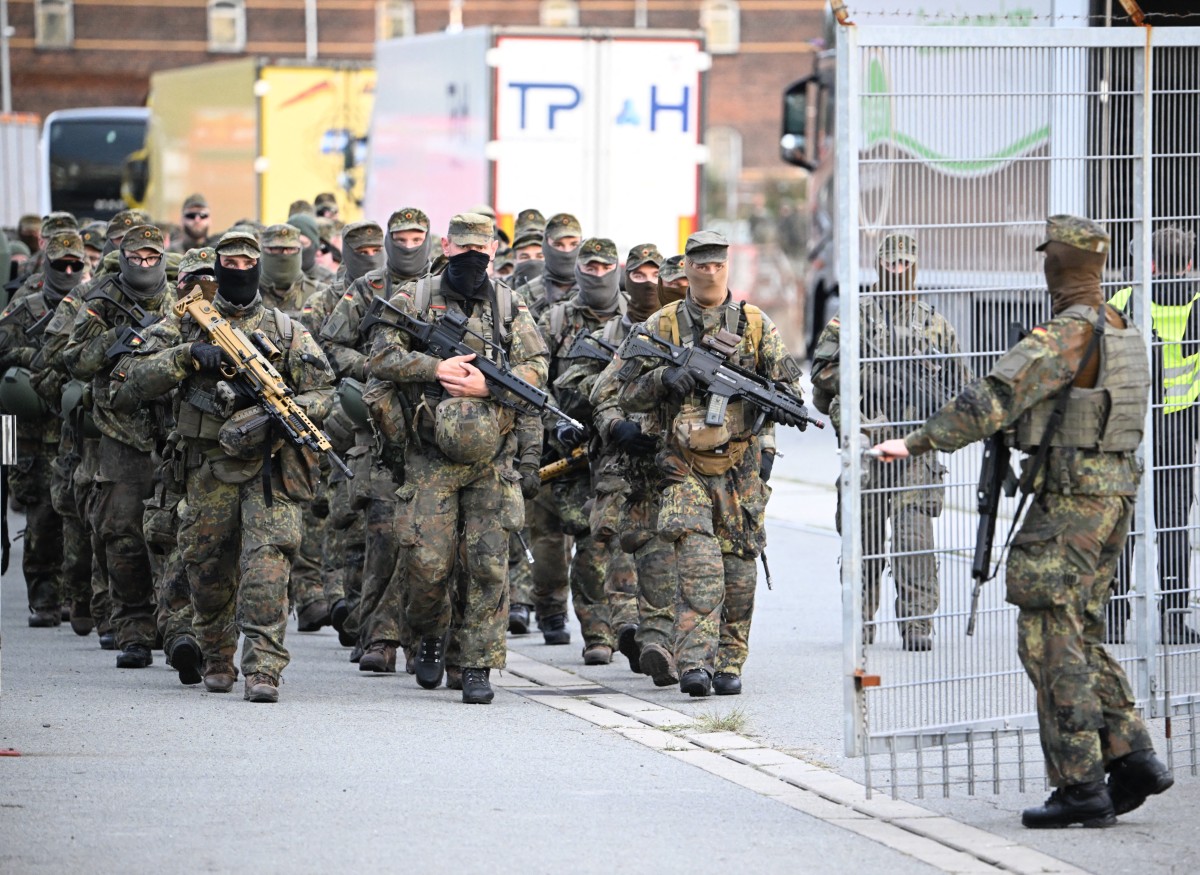
France And Germany Bringing Back Compulsory Military Service
Ten European countries, including France and Germany, have recently moved to reinstate compulsory military service for 18-year-olds.
Announcing a new national service for over-18s, the French President Emmanuel Macron said: “If the French want to protect ourselves, we must show that we are not weak in the face of one power that threatens us the most.”
“The only way to avoid danger is to prepare for it,” Macron said while announcing the plan at an infantry base near Grenoble in south-east France. “We need to mobilise, mobilising the nation to defend itself, to be ready and remain respected.”
France abolished compulsory military service in 1996, transitioning to a professional army. However, 29 years after abolishing compulsory military service, France is bringing it back in the face of the threat of war with Russia.
The new “national service” will be introduced gradually from next summer, mainly for 18- and 19-year-olds, who will receive at least €800 (USD 939.5) per month.
Meanwhile, earlier this month, Germany’s parliament, the Bundestag, voted to introduce voluntary military service, in a move aimed at boosting national defences.
The change means that all 18-year-olds in Germany will be sent a questionnaire from January 2026 asking if they are interested and willing to join the armed forces. The form will be mandatory for men and voluntary for women.
For now, Germany has approved voluntary military service; however, if the security situation worsens or too few volunteers come forward, the Bundestag could consider a form of compulsory military service.
Compulsory military service in Germany ended in 2011 under former Chancellor Angela Merkel.
Similarly, Belgium and the Netherlands have introduced a voluntary military service.
Last month, the Belgian defense ministry sent letters to 17-year-olds inviting them to volunteer for about €2,000 (USD 2,348) a month.
Poland is training every adult male for potential combat and expanding its army to 500,000 troops.
Besides, Lithuania and Latvia have compulsory schemes. Sweden, which recently joined Nato, has started a nine- to 15-month military service with selection on merit.
Some European countries, such as Finland, Austria, and Greece, have never abolished compulsory military service.
Boosting Defense Spending And Rearmament
Many European countries are increasing military budgets to meet or exceed NATO’s 2% GDP target, with some aiming for 3-5% to fund weapons production, troop expansions, and infrastructure upgrades.
Germany has allocated a €100 billion (USD 117 billion) special fund for rearmament.
Poland plans to spend 4.7% of GDP on defense; Estonia, Latvia, and Lithuania are targeting 5%; Sweden and France are aiming for 3.5%; and Finland for 3% by 2029.
The EU has also launched a “ReArm Europe Plan/Readiness 2030,” to boost defense spending by leveraging up to €800 billion (USD 939 billion) through national fiscal flexibility, a €150 billion (USD 176 billion) Security Action for Europe (SAFE) loan instrument for joint procurement (drones, missiles), and private capital mobilization.
Building Infrastructure & Logistical Preparedness
The European countries are also building military infrastructure on a war footing.
For instance, Germany is implementing “Operation Plan Germany” (OPLAN DEU), a 1,200-page classified blueprint detailing how as many as 800,000 German, U.S., and other NATO troops would be ferried eastward toward the front line in the event of a war.
The plan is intended to ensure that political decisions during a crisis or conflict can be made quickly, in line with the constitution, and in a coordinated manner that enables rapid action.
According to the Bundeswehr document, OPLAN DEU is designed to align Germany’s “cold-start capability, warfighting readiness, and resilience” with today’s security challenges.
Norway is restoring Cold War-era military bunkers and mandating bomb shelters in new large buildings.
Similarly, many Eastern European countries, such as Poland, Lithuania, Latvia, and Estonia, are restarting the stockpiling of landmines and munitions for eastern-flank defense.
These steps by European states clearly establish that European leaders think that war with Russia is a very real possibility. Multiple reports suggest that Russia could initiate a war with a NATO country by 2028.
However, a lot will depend on how the Ukraine War progresses. If a mutually acceptable peace deal could be reached, a war in Europe could still be avoided; however, if the situation worsens, the war could expand to include other European and NATO countries.