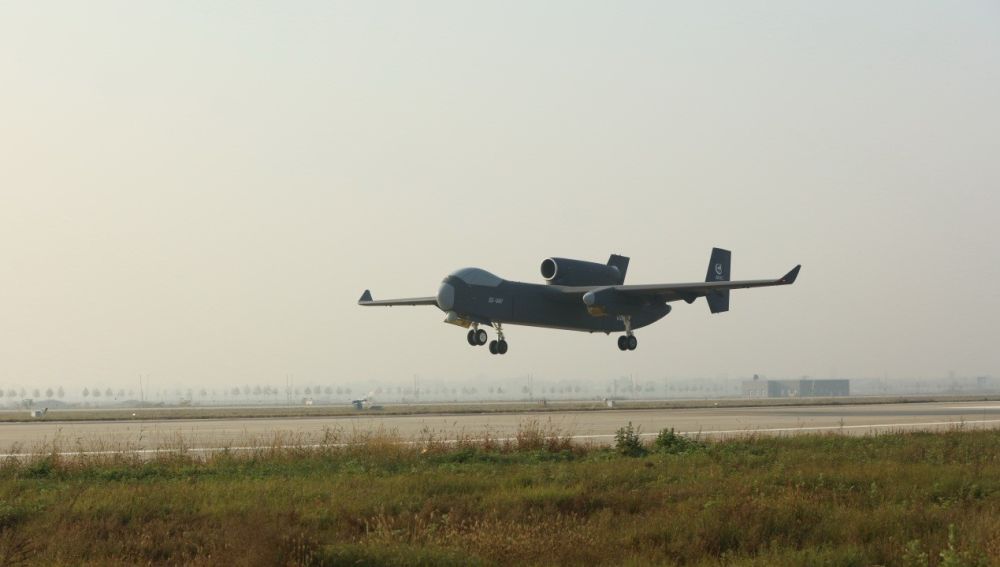
China just brought to life a sci-fi-like concept that sounds too good to be true: a massive, high-flying unmanned aircraft capable of unleashing a swarm of unmanned aerial vehicles (UAVs) mid-air. The long-awaited ‘Jiutian’ or ‘Jetank’, as it is known by the Chinese state media, has finally taken its maiden flight.
Dubbed the world’s first “drone mothership,” the Jiutian completed its first flight on December 11, 2025, in Northwest China’s Shaanxi Province. The photos and videos of the aircraft in flight were published online by the official X account of China’s armed forces, China Military Bugle.
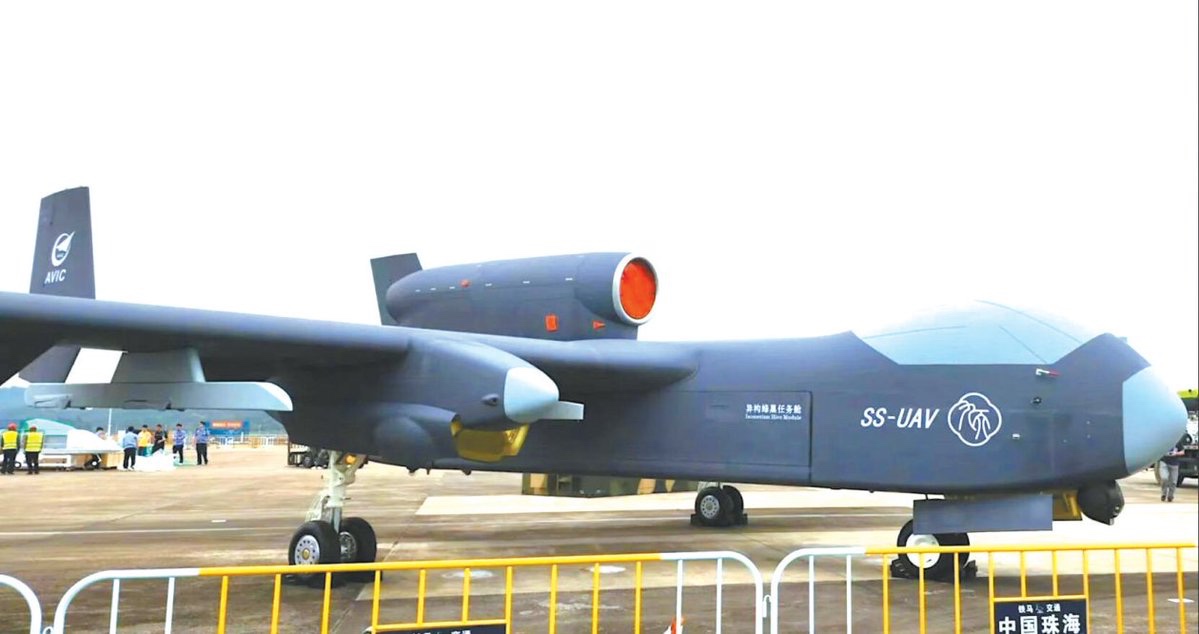
First unveiled at the Zhuhai Air Show in November 2024, the Jiutian is referred to as SS-UAV, with no clarity on what the designation means.
The successful flight marks a breakthrough in China’s large unmanned aerial vehicle (UAV) technology, said the Aviation Industry Corporation of China (AVIC), the aircraft’s manufacturer.
Meanwhile, experts noted that the aircraft’s colossal size could allow it to carry a swarm of small drones to cause significant damage.
The Jiutian uses a “universal platform with modular mission payload” design philosophy and is based on independently developed, integrated technological breakthroughs, as per a report in the Chinese state-owned media Global Times. It has a large cargo capacity, a high service ceiling, a broad speed range, and a short takeoff and landing capacity.
A large unmanned aerial vehicle (#UAV), named "Jiutian," completed its maiden flight on December 11, 2025, according to the Aviation Industry Corporation of China (#AVIC).
The domestically developed general-purpose drone, measuring 16.35 meters in length and 25 meters in… pic.twitter.com/LwUHyNaEp6
— China Military Bugle (@ChinaMilBugle) December 11, 2025
The drone carrier has a length of about 16.35 meters, a wingspan of 25 meters, a maximum takeoff weight of more than 16 tons, a cargo capacity of about 6,000 kilograms, an endurance of about 12 hours, and a ferry range of nearly 7,000 kilometres.
It can fly at speeds ranging from 108 to 378 knots, with a stated maximum operational ceiling of 49,212.5 feet (15,000 meters).
This aircraft has been designed to carry up to 100 smaller drones, including kamikaze UAVs, and a mix of air-to-air, air-to-ground, and anti-ship missiles, and can perform different roles, including airborne signal relay and logistics.
This essentially means that the Jiutian is positioned to become a crucial force multiplier for the People’s Liberation Army (PLA), particularly in a high-stakes conflict in the Indo-Pacific.
Notably, Jiutian’s maiden flight comes amid a rise in the prominence of drone combat in modern warfare, driven by affordability, scalability, and integration with Artificial Intelligence (AI) for complete autonomy.
The use of drones enables an asymmetric advantage by allowing outnumbered forces to disrupt superior armies while challenging traditional air defenses and manned aviation, as demonstrated in the Ukraine War.
In fact, a recently leaked Pentagon assessment implores the US military to adopt affordable, scalable technology, such as drones, rather than spending billions of dollars on complex systems like aircraft carriers.
The report made a case for a shift from high-cost platforms to low-cost disruptors, in line with evolving threats, emphasizing that while adversaries like China use low-cost, scalable technology such as drones, hypersonic weapons, and cyber tools, the US military clings to costly, slow-to-produce, and vulnerable equipment.
The report warned that the US risks losing an armed conflict to China unless it carries out a military overhaul based on the recommendations.
China’s Drone Mothership
Operationally, the Jiutian shifts warfare toward “swarm-centric” tactics, enabling the People’s Liberation Army (PLA) to project force deep into areas such as the Taiwan Strait or the contested South China Sea without risking its expensive manned jets.
Jiutian’s overall structure consists of an H-shaped tail and a high-mounted wing with very little sweep and tiny winglets at the tips. It has a single jet engine installed above the rear fuselage in a nacelle.
Its primary units retract into sponsons beneath the wings as part of its tricycle landing gear. The platform has dual-use applications, according to the Global Times. It can carry loitering munitions, anti-ship missiles, air-to-air missiles, air-to-ground missiles, and 1,000-kilogram-class guided bombs.
The platform can switch mission types within two hours by switching modular mission payloads to fulfil operational needs, including airdrop and airlift, information support and countermeasures, and strike-and-support missions. Additionally, it can be employed for emergency rescue, transportation support, and systematic operations in both military and civilian contexts, states the report.
A unique and noteworthy feature of the platform is an advanced isomerism-hive module in its fuselage that can store hundreds of small drones or loitering munitions.
China claims that a highly adaptable platform that can operate at altitudes of up to 15 kilometres, where it can remain undetected by a variety of low-altitude defences.
The Jiutian is a top-tier airborne UAV carrier, said Wang Ya’nan, chief editor of the Beijing-based Aerospace Knowledge magazine, who spoke to the Global Times.
He pointed out that the platform’s enormous capacity and maximum takeoff weight allow it to launch a swarm of smaller drones. The size of the platform was also emphasized by Fu Qianshao, a Chinese military affairs specialist who saw it firsthand at Airshow China 2024. He said the massive drone’s payload capacity is on par with fighter bombers or even crewed jets.
Jiutian is the largest unmanned aircraft in the world.
For perspective, the popular Wing Loong-10 has a maximum takeoff weight of about 3.5 tons. Meanwhile, the Wing Loong 3, a pusher-propeller-driven armed drone considered the largest in the Chinese inventory, has a maximum take-off weight of 6 tons.
This drone carrier would support trans-theater operations. It could be launched from mainland China to saturate Taiwanese air defenses 150-200 kilometres offshore. Similarly, it would enable heavy-lift from forward bases, which is comparable to an unmanned C-130 for airlift.
In contrast to single drones, such as the Shahed-136 used by Russia, the Jiutian would enable “intelligent swarming” through AI integration, helping distribute targets dynamically and achieve a higher kill rate.
In the event of a Taiwan invasion, the PLA could deploy multiple Jiutian unmanned drone carriers to produce drone swarms and overwhelm the enemy.
With a range of 7,000 kilometres, it would operate beyond most enemy fighter radii and use its payload for loitering munitions to “hunt” high-value targets, such as American destroyers in the Indo-Pacific, while creating a massive cost differential. The enemy would have to use millions of dollars’ worth of air defense missiles to hunt down cheap drones launched from the Jiutian.
As a High Altitude Long Endurance (HALE) platform, it would provide persistent overwatch and fuse data from swarms into the PLA’s Joint All-Domain Command & Control (JADC2) for real-time battle space awareness.
That said, suspicions about the aircraft’s capabilities persist, particularly regarding its survivability in contested environments. Tom Shugart, an adjunct senior fellow at the Center for a New American Security, earlier told Newsweek that the Jiutian “doesn’t appear to be particularly stealthy” and could be “subject to destruction by enemy aircraft or air defenses” before it gets close enough to release its drones.
“The Jiutian is a massive platform with an 82-foot wingspan and a 16-tonne frame. That’s not exactly a needle in a haystack. Its radar cross-section (RCS) is likely significant, making it a juicy target for advanced radar systems like those on the U.S. F-35, India’s Rafale, or even Taiwan’s upgraded F-16s,” said Group Captain MJ Augustine Vinod (retd) in a previous article for the EurAsian Times.
“Even if it flies at 15,000 meters, it’s not out of reach. High-altitude SAMs and interceptors are designed for exactly this kind of threat. And let’s not forget electronic warfare,” he added.
Additionally, Group Captain Vinod was apprehensive about the capabilities of the small drones that would be unleashed in a swarm, stating that they would have limited range and endurance, making them more suited for a flashy drone show than a serious military operation.
“Moreover, swarm tactics rely on numbers and coordination, but quantity doesn’t always trump quality. Modern air defenses are designed to counter exactly this kind of threat,” he argued in the article.
While these arguments hold substance and warrant closer examination, the EurAsian Times understands that several advanced militaries are pursuing similar capabilities to enhance survivability in highly contested airspace.
The US is working to transform the MQ-9A Reaper into a drone mothership. In fact, General Atomics Aeronautical Systems, Inc. (GA-ASI) and AeroVironment completed the first air launch of a Switchblade 600 from a Reaper earlier this year.
- Contact the author at sakshi.tiwari13 (at) outlook.com
- Follow EurAsian Times on Google News