Two big things happened last week that will reverberate for years, perhaps decades to come, and will define US military priorities in an era of multipolarity and rising geopolitical upheaval.
First, the Trump administration released the new US National Security Strategy (NSS), which presidents typically release once each term, offering a formal statement of the U.S.’s global priorities under the second Trump presidency.
This was followed by Defense Secretary Pete Hegseth’s speech at the Reagan Defense Forum, in which he outlined the US’s defense priorities for the foreseeable future.
Though every US President issues a National Security Strategy (Trump did so in 2017 during his first term, and Biden did so in 2022), the document released last week radically redefines the US’s global priorities, geopolitical commitments, and military strategy.
When the 33-page NSS document was released last week, EurAsian Times, in a detailed article, elaborated on how the report stands out for its realist (rather than idealist) analysis of the global geopolitical situation and the US’s position/role in it.
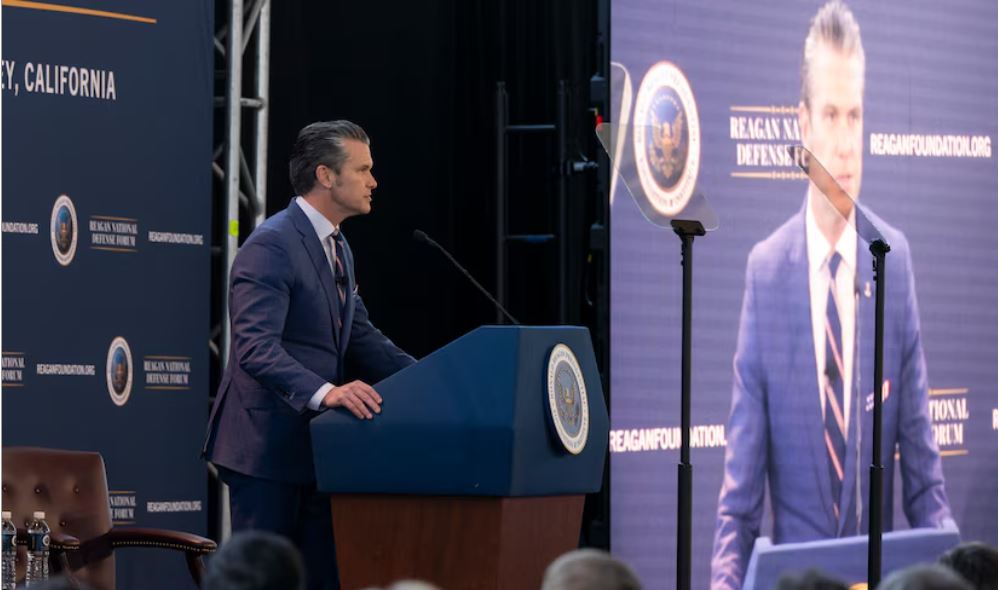
Defense Secretary Pete Hegseth speaking at the Ronald Reagan National Library’s annual defense forum in Simi Valley, California. Credits DoW.
The report acknowledged China’s rise, and hinted that the US could no longer maintain a hegemonic position globally; rather, Washington should instead focus on strengthening its dominance over the Western Hemisphere, a Trump corollary of the famous 19th-century ‘Monroe Doctrine’.
Now, Hegseth’s speech at the Ronald Reagan National Library’s annual defense forum in Simi Valley, California, has further formalised that position, offering an even more explicit elaboration of that view.
In essence, Hegseth’s speech can be summed up in three broad policy goals of the Trump administration:
(a) Avoid confrontation with China in the Asia Pacific, i.e., deal with Beijing with strength but not confrontation;
(b) Europe must step up and fend for its own security,
(c) A renewed focus on maintaining US supremacy in the Western Hemisphere, which includes a more aggressive posture not only in Central and Latin America, but also vis-à-vis Canada and Greenland.
In Hegseth’s own words, the new US defense policy prioritizes “four key lines of effort” at the War Department: defending the U.S. homeland and its hemisphere; deterring China through strength rather than force; increasing burden sharing between the U.S. and its allies and partners; and supercharging America’s defense industrial base.
In other words, the policy marks a radical departure from the stated US foreign policy goals of the last four decades.
Hegseth Declares End Of American “Utopian Idealism”
During his speech, Hegseth launched a scathing attack on U.S. foreign policy goals in the post-Cold War era, an era also known as the ‘Unipolar World’ or, as American political scientist Francis Fukuyama mistakenly described in his controversial thesis, ‘The End of History‘.
The post-Cold War era was marked by a spirit of American triumphalism, where it was believed that U.S. global hegemony could no longer be challenged.
The controversial essay, “The End of History?” was initially published in 1989 in the right-leaning international relations magazine The National Interest. It was later expanded into a book, The End of History and the Last Man, in 1992.
In it, Fukuyama argued that the dissolution of the Soviet Union and the victory of the US and Western World in the over four-decades-long Cold War marked “not just … the passing of a particular period of post-war history, but the end of history as such: That is, the end-point of mankind’s ideological evolution and the universalization of Western liberal democracy as the final form of human government.”
In his view, the Western liberal democracy tied to the market economy (or in other words the US-style parliamentary democracy) was the end-point of mankind’s ideological evolution, it represented though not the ideal, but the least worst form of government, and with the disolution of the Soviet Union, the spread of the Western liberal democracies throughout the world was inevitable.
Past week, first the US National Security Strategy (NSS), followed by Hegseth’s speech, declared that this era of American “utopian idealism” was over.
“Out with idealistic utopianism,” Hegseth said. “In with hard-nosed realism.”
Further elaborating on it, Hegseth said that the U.S. should not be “distracted by democracy building, interventionism, undefined wars, regime change, climate change, woke moralizing and feckless nation-building. We will instead put our nation’s practical, concrete interests first.”
Earlier, the US National Security Strategy report said that “after the end of the Cold War, American foreign policy elites convinced themselves that permanent American domination of the entire world was in the best interests of our country.”
“Yet the affairs of other countries are our concern only if their activities directly threaten our interests,” the report said.
“They placed hugely misguided and destructive bets on globalism and so-called “free trade” that hollowed out the very middle class and industrial base on which American economic and military preeminence depend.”
“In sum, not only did our elites pursue a fundamentally undesirable and impossible goal, in doing so they undermined the very means necessary to achieve that goal: the character of our nation upon which its power, wealth, and decency were built.”
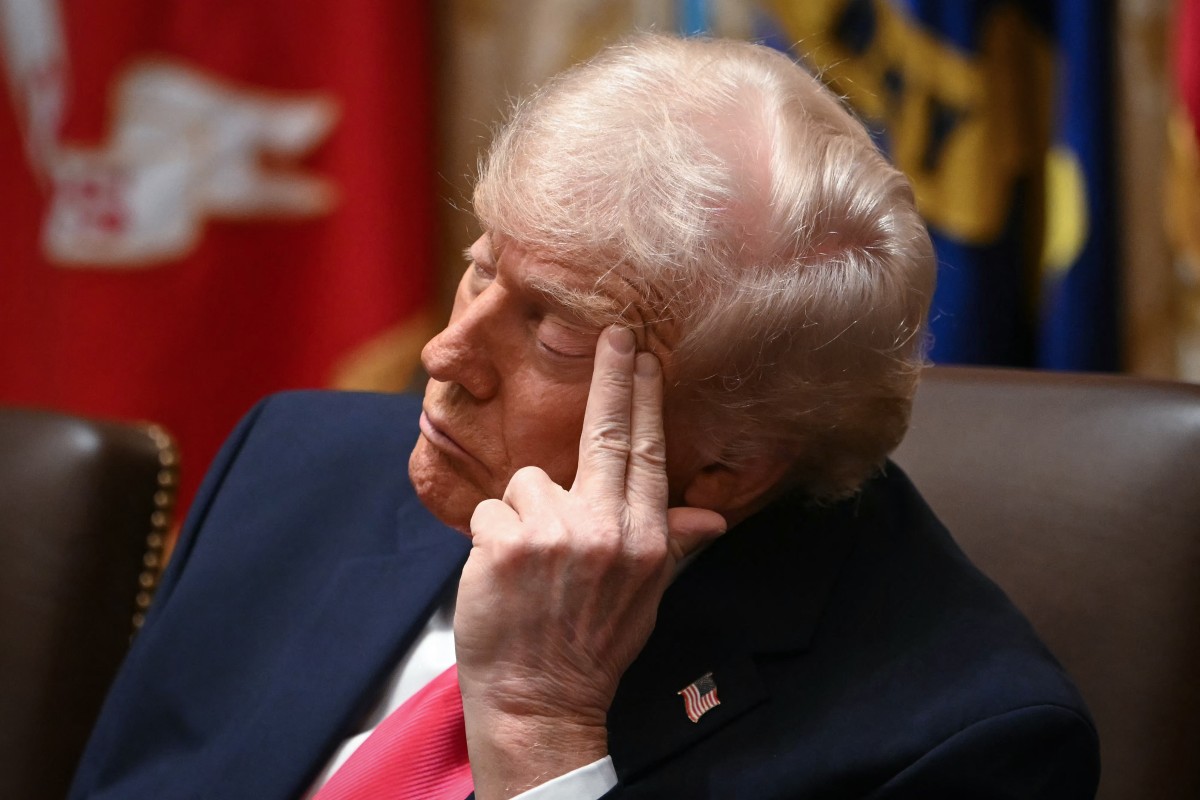
US President Donald Trump looks on as members of his cabinet speak during a Cabinet Meeting in the Cabinet Room of the White House in Washington, DC on December 2, 2025. (Photo by ANDREW CABALLERO-REYNOLDS / AFP)
Spheres Of Influence: China In Asia, Europe For Itself, U.S. Supremacy In ‘Western Hemisphere’
Hegseth’s speech also suggested that the Trump administration is moving towards a policy which recognizes ‘spheres of influence’ led by great powers; China in Asia, Europe in Europe, and the US in the Western Hemisphere and in Europe more broadly.
On the issue of China, Hegseth said that relations between the U.S. and China are stronger than they have been in many years.
“President Trump and this administration seek a stable peace, fair trade and respectful relations,” Hegseth said, adding that the War Department is committed to opening a wider range of military-to-military communications with China’s People’s Liberation Army aimed at deconfliction and de-escalation.
“This line of effort is based on flexible realism … an approach aimed not at domination, but rather a balance of power … that will enable all of us, all countries, to enjoy a decent peace in the Indo-Pacific, where trade flows openly and fairly, where we can all prosper and all interests are respected,” Hegseth said.
“That’s the world that we see in the Indo-Pacific, and that is what our approach is designed to produce,” he added.
Acknowledging China’s rising military capabilities, Hegseth said that the U.S. will follow a policy of “respecting the historic military buildup (China is) undertaking,” and the Pentagon “maintains a clear-eyed appreciation of how rapid, formidable and holistic their military buildup has been.”
With Europe, Hegseth stressed on ‘increasing burden sharing’.
He said that many who have shaped U.S. foreign policy have “lost the plot” when it comes to treating our allies as if they are incapable of helping themselves.
“That is, of course, patently ridiculous — not to mention insulting to our allies,” Hegseth said, adding that it’s important for America’s allies and partners to step up to do their part for our collective defense.
“Allies are not children,” he said. “We can and should expect them to do their part.”
On Trump administration’s focus on maintaining U.S. superimacy in the Western Hemisphere, Hegseth said that the U.S. will “rightly prioritize our homeland and hemisphere…Threats persist in other regions, and our allies need to step up, and step up for real.”
In other words, Europe should fend for itself, as the U.S. will remain focused on the Western Hemisphere.
This policy illustration by Hegseth explains a lot of Trump administration’s actions during the last 10 months, including rising military buildup in the Carribean, threats against Venezuela and Panama, more agressive patrolling near Mexico, and agressive posturing towrads Canada and Greenland.
He suggested the military would become more involved in patrolling the southern border with Mexico. “We’ll secure the border in part by organizing training and equipping units specifically for border defense missions, including operations in the land, maritime and air.”
Along the fourth line of effort — defense industrial buildup — Hegseth said that “supercharging” America’s defense industrial base underwrites all other lines of effort.
“Our objective is simple, if monumental: transform the entire acquisition system to rapidly accelerate the fielding of capabilities and focus on results,” he said.
This focus on reviving U.S. defense industrial base involves investments in ships, drones and air defense systems such as the ambitious Golden Dome project.
There can hardly be a more concise acknowledgement of the fact that slowly but certainly, the US is coming to a realization that it can no longer dominate the entire world, or play the role of global cop.
Instead the Trump administration is moving towards a policy that recognizes ‘spheres of influence’ led by great powers, China in Asia, and the US in Western Hemisphere and Europe in General.
What this policy will entail for Taiwan, or the future of Quad, only time will tell.
Sumit Ahlawat has over a decade of experience in news media. He has worked with Press Trust of India, Times Now, Zee News, Economic Times, and Microsoft News. He holds a Master’s Degree in International Media and Modern History from the University of Sheffield, UK.
VIEWS PERSONAL OF THE AUTHOR.
He can be reached at ahlawat.sumit85 (at) gmail.com