The United States Air Force (USAF) has achieved a big milestone in its aerial target program with the delivery of the final QF-16 full-scale aerial target (FSAT) on December 5, 2025.
Boeing made this announcement on its LinkedIn page.
Converted from retired F-16 jets, the QF-16 has served as a critical asset for live-fire weapons testing and pilot training over the past decade.
As the program concludes after 15 years and 127 conversions, it highlights the US push for advanced simulation of peer adversaries like Russia and China. However, with emerging threats from stealth fighters such as the J-20 and Su-57, the USAF is already eyeing next-generation targets to stay ahead.
The QF-16 program traces its roots to the early 2000s, when the USAF sought a replacement for the aging QF-4 Phantom targets, based on Vietnam-era F-4 jets.
Boeing won the contract in 2010 to convert surplus F-16A/C models into unmanned aerial targets, with the first flight occurring in 2012 at Tyndall Air Force Base, Florida. The initial operational capability was achieved in 2015, and the first live-fire test followed in 2017, where a QF-16 was successfully engaged by an AIM-120 AMRAAM missile.
By repurposing F-16 airframes, the QF-16 provided realistic radar signatures, maneuverability, and performance to mimic fourth-generation fighter jets.
The transformation process at Boeing’s facility in Cecil Field, Florida, includes the installation of autonomous flight systems, ground control interfaces, and safety features such as self-destruct mechanisms.
The program faced early challenges, including integrating the F-16’s complex avionics and ensuring reliable unmanned operations. However, it has since proven invaluable, with over 100 QF-16s expended in tests, allowing the USAF to validate weapons like the AIM-9X Sidewinder missile and advanced radar systems without risking manned aircraft.
The QF-16 retains much of the F-16’s capabilities, making it an ideal platform for USAF training. Powered by a single General Electric F110-GE-100, it can reach speeds of Mach 2 and has a combat radius exceeding 500 nautical miles.
The QF-16 is no ordinary drone – it’s a battle-tested F-16 reborn as a “zombie” target. It can fly completely autonomously on pre-programmed routes or be flown in real time by a ground controller sitting up to 300 miles away.
Loaded with active electronic attack pods, AN/ALQ-series jammers, chaff/flare dispensers, and advanced scoring systems, the jet can perfectly mimic the jamming, ducking, and weaving of a Russian Su-35 or Chinese J-11/J-16 in an intense dogfight.
U.S. ‘Flips The Script’ In Drone War! Deploys “Cloned” Shahed-136 Aka LUCAS Drones Against Iran
It is armed with sophisticated threat emitters that replicate the radar and infrared signatures of enemy surface-to-air missile batteries or fifth-generation fighters, forcing American missiles and pilots to prove themselves against these realistic targets.
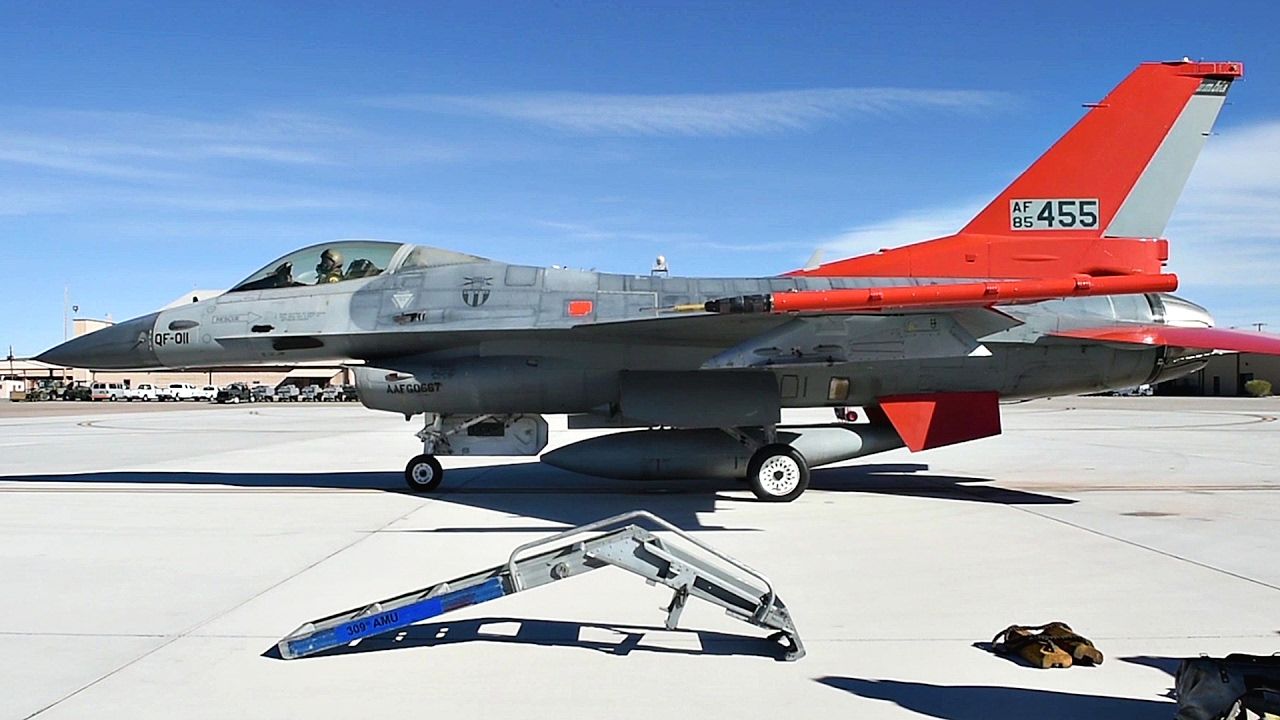
And while the QF-16 is deliberately built to be shot out of the sky (hundreds already have been), a surprising number survive the barrage, execute a flawless automatic recovery, and glide back to the runway for another mission.
While the QF-16 leads in sophistication, Russia and China have pursued similar programs to bolster their training. Russia’s MiG-21 and Su-25 conversions serve as targets, but they lack the QF-16’s advanced autonomy and recoverability. China, meanwhile, has aggressively converted Cold War-era jets like the J-6 into unmanned targets and combat drones.
In September 2025, the People’s Liberation Army Air Force (PLAAF) unveiled a J-6 drone variant for live-fire exercises, emphasizing its use of swarm tactics. Unlike the QF-16’s focus on high-end simulation, Chinese drones prioritize quantity and integration with AI-driven networks, potentially outpacing the US in massed operations.
An argument here is that while the QF-16 excels in replicating kinetic performance, Beijing’s approach leverages cheaper, expendable platforms for rapid iteration. As one RAND report notes, the US must evolve beyond the QF-16 to counter stealthy adversaries effectively.
Looking ahead, the USAF is soliciting proposals for stealthy, fifth-generation aerial targets (5GAT) to mimic J-20 and Su-57 threats, with prototypes like those from the Air Force Academy showing promise.
Via: ET Online Desk