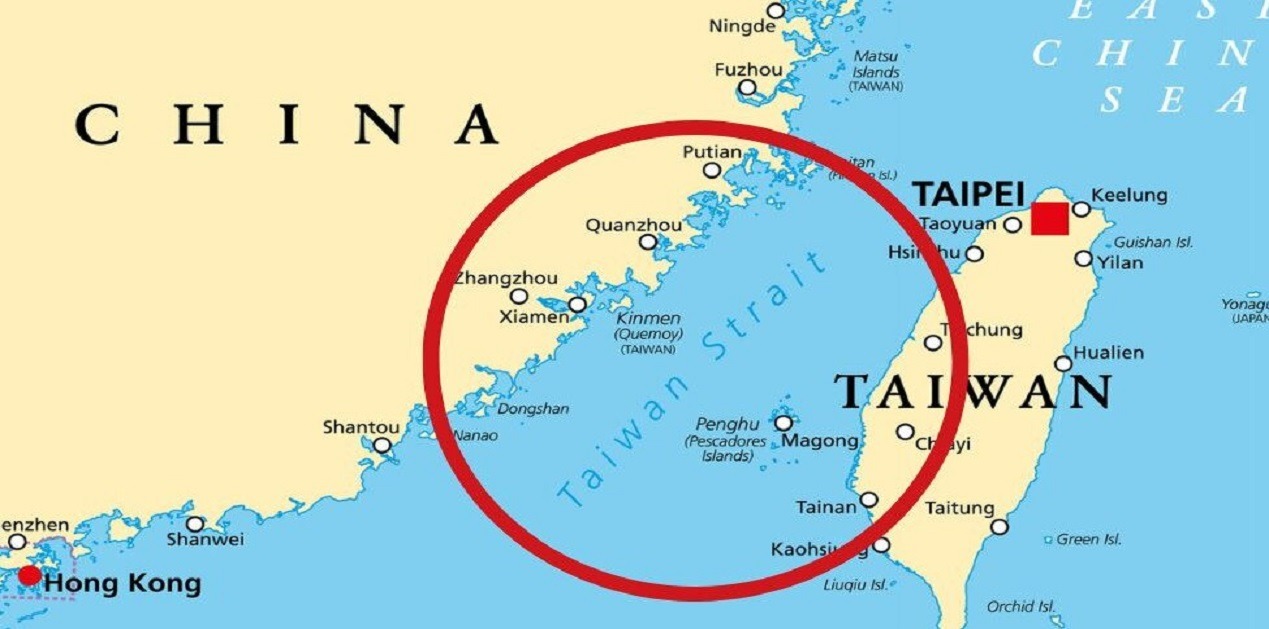
Tensions appear to be escalating in the Indo-Pacific region, with Taiwan accusing China of deploying a large number of warships for “military operations” stretching hundreds of kilometres from the Yellow Sea to the South China Sea.
Taiwan’s defence ministry and other security agencies were monitoring China’s activities and had a “complete grasp of the situation”, presidential office spokeswoman Karen Kuo told reporters.
The operations were not limited to the Taiwan Strait, but extended from the southern Yellow Sea to the East China Sea near the Japanese-controlled Senkaku/Diaoyu Islands and on into the South China Sea and even the Western Pacific, Kuo said.”
This indeed poses a threat and impact on the Indo-Pacific and the entire region,” she said.
Taiwan urged China to “exercise restraint”, Kuo said, adding: “We are also confident that we can handle this matter well.”
Beijing’s foreign ministry did not answer directly when asked if the military was amassing a large number of naval vessels in those waters.
“I want to emphasise that China has consistently followed a defensive policy,” spokesman Lin Jian told a regular press briefing. “The Chinese navy and coast guard strictly operate in relevant waters according to Chinese domestic law and international law,” Lin said.
He urged “relevant parties” not to “overreact or… engage in groundless hype”.
Taiwan’s intelligence chief Tsai Ming-yen said that October to December was the “peak season” for China’s “annual evaluation exercises”. There was a possibility that Beijing could turn routine drills into an invasion, Tsai warned.
Last December, Taiwan said about 90 Chinese warships and coast guard vessels took part in vast exercises, including simulating attacks on foreign ships and practising blockading sea routes. China did not confirm the drills at that time.
In Tokyo, Defence Minister Shinjiro Koizumi, asked about Chinese activity in the East China Sea, said Japan was aware of the reports and was watching Chinese military movements “with great attention”, while declining to comment on the specific deployment.
“China has been expanding and stepping up its military activities in the areas surrounding Japan, and we make a constant effort to gather and analyse information on Chinese military movements with great attention,” he told reporters.
“In any event, the government will continue to monitor developments around Japan with deep concern and will make every effort to ensure thorough information gathering and surveillance,” he said.
Taiwan to Spend an Extra $40 Billion on Defense
Taiwan’s President Lai Ching-te announced a massive new defence plan late last month: an extra $40 billion over the next eight years to deter China from invading Taiwan.
Taiwan has ramped up defence spending in the past decade as Chinese military pressure intensified, but US President Donald Trump’s administration has pushed the island to do more to protect itself.
Lai said the military aimed to achieve a “high level” of joint combat readiness against China by 2027, a timeline US officials believe is when China could invade Taiwan.
“The ultimate goal is to establish defence capabilities that can permanently safeguard democratic Taiwan,” Lai said at a news conference, after announcing the $40 billion spending plan in a Washington Post opinion piece.
China’s foreign ministry quickly hit back, saying: “Attempts to resist unification and seek independence through military means will never succeed.”
Lai’s announcement came as Tokyo and Beijing were locked in a weeks-long diplomatic spat after Japanese Prime Minister Sanae Takaichi hinted that Tokyo could intervene militarily if Taiwan were attacked.
The United States’ top envoy in Taiwan said he “welcomes” the government’s spending plan and urged the island’s rival political parties to “find common ground” on boosting its defences.
“Whether your priority is preserving Taiwan’s democracy and market economy, fostering conditions for cross-Strait dialogue, or maintaining support from the international community, increasing Taiwan’s defence capabilities is a necessary precondition,” said Raymond Greene, director of the American Institute in Taiwan, Washington’s de facto embassy.
- By Agence France-Presse
- Edited by ET Online Desk