

In a major milestone, a Gripen-E combat aircraft belonging to the Brazilian Air Force (Força Aérea Brasileira or FAB) fired the Meteor air-to-air missile for the first time, validating the integration of the missile on the most advanced variant of the Gripen aircraft. Incidentally, the test coincides with escalating tensions in South America.
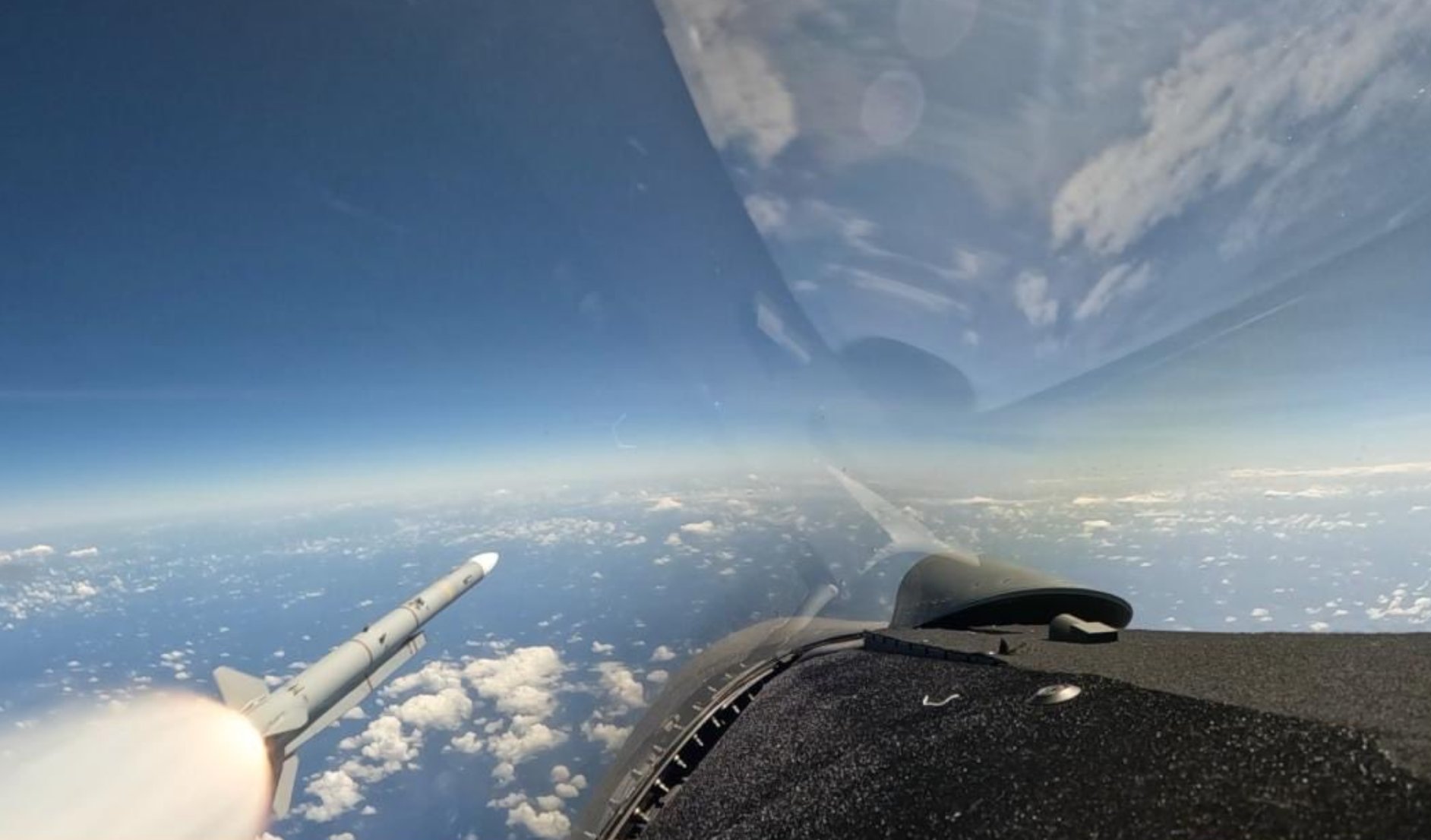
An FAB Gripen-E, officially designated as the F-39E, announced the live firing test of the Meteor BVRAAM (beyond visual range air-to-air missile) on November 28 against a target drone.
The test has been described by the Brazilian Air Force as a milestone, which is also the first buyer of the jet. It placed an order for 36 Gripen-E/F aircraft in 2014 and has also opened a domestic production line for the aircraft.
The test was conducted on November 28 in the Natal region during Operation BVR-X, which is part of the process to achieve full operational capability by 2026.
“BVR-X Technical Exercise (EXTEC) test campaign, believed to have taken place earlier this month in the Natal region, involved four Gripen Es, which conducted two live-firings against Leonardo’s maneuverable Mirach 100/5 aerial targets,” the FAB said in a press release.
Why U.S. Defeat In Vietnam Was Inevitable Despite Massive Military Superiority, A Boardgame Explains
It further noted that “The targets simulated flight profiles of fighters at high speed and altitude, ensuring a challenging scenario to evaluate the accuracy of the missile. The success of EXTEC confirmed that the F-39 Gripen and Meteor binomial is the fundamental pillar for the FAB to fulfil its mission of defending the homeland.”
The test confirmed full end-to-end integration of the Meteor with Gripen E’s avionics, sensors, and data-link systems. This was the first operational live firing of the Meteor missile from a Gripen E outside Sweden and the first ever in the Southern Hemisphere.
📍Natal, #Brazil (🇧🇷)
The @fab_oficial held the first @MBDAGroup Meteor BVRAAM live-fire tests from a Gripen F-39E against a Mirach 100/5 Aerial Target System.
This was a very important trial to test the operability of the Meteor on a Brazilian Air Force platform. pic.twitter.com/rrK9yklmjc
— SA Defensa (@SA_Defensa) November 29, 2025
The Gripen-E/F aircraft is equipped with the AESA (Active Electronically Scanned Array) radar, advanced infrared search and track (IRST) systems, and cutting-edge electronic warfare (EW) capabilities, which allow it to detect, track, and engage multiple targets at long ranges, even in contested environments.
Saab promises that the Gripen-E redefines the rules of the game by providing the first missile-launch opportunity and the first kill. The integration of Meteor on the Gripen-E significantly enhances the lethality of these jets because the missile is known for its large no-escape zone, which enables a “first-shot, first-kill” advantage.
Meteor is counted among the best air-to-air long-range missiles in the world. It can engage a broad spectrum of targets at unrivalled ranges, from fighter planes to small drones and cruise missiles, at about 200 kilometres.
The missile uses a ramjet engine, which enables it to sustain high speeds throughout its flight, including during the terminal phase of engaging a target aircraft. Its data link has two-way capability, so the pilot can re-target the missile while it is already in flight. Additionally, the pilot can view the missile’s fuel and tracking status in real time.
While this specific test was conducted by Brazil, it could directly advance Saab’s overall export program. This is particularly important because the Saab Gripen-E has had a rough stint in the export market–it went through a decade after Brazil’s purchase in 2014, which ended only in 2024 when Thailand announced that it would acquire four new Gripen E/F to replace its aging F-16s. An order for four Gripen-E/F fighters was placed in August 2025.
This was followed by Ukraine signing a Letter of Intent (LoI) for about 100 to 150 Gripen-E/F fighter jets with Saab in October 2025. Colombia, on the other hand, announced the purchase of 15 Gripen E one-seater and 2 Gripen F two-seater fighter aircraft, along with associated equipment, weapons, training, and services, in November 2025.
Both new buyers, Thailand and Colombia, stand to benefit from the latest Meteor firing. While the Thai government has already placed an order for the Meteor as part of the aircraft package, Colombia is also poised to order the missile, according to some reports.
Saab highlights the Gripen’s ability to carry up to 7 Meteors per sortie, enabling long-range intercepts without entering hostile surface-to-air (SAM) envelopes. In fact, experts have described this as a “game-changer” for Ukraine’s air force, meaning Kyiv would likely opt for the lethal BVRAAM if it proceeds with a purchase.

Canada’s $50B F-35 Stealth Fighter Deal In Danger As Ottawa Joins EU’s €150 Billion SAFE Initiative?
The latest test could thus be considered a major marketing win, reinforcing Gripen E’s appeal in competitive bids by demonstrating real-world performance.
Incidentally, the test was conducted in South America at a time of spiralling tensions between the United States and Brazil’s neighbour, Venezuela.
President Lula da Silva has publicly criticized the US military build-up in the region as a “source of tension” that could “inflame South America,” while emphasizing diplomacy with Venezuelan President Nicolas Maduro’s government.
The US has carried out a large-scale military buildup in the South Caribbean off Venezuela’s coast. This includes the world’s largest aircraft carrier, USS Gerard R. Ford, several warships, F-35 stealth fighter jets, MQ-9 Reaper drones, and thousands of troops, to name a few.
The US has conducted at least 21 strikes on unknown ships and killed over 80 people, on suspicion that the vessels were carrying drugs, without providing evidence.
It is pertinent to note here that while this aggression is projected as a war against drugs by the Trump administration, Venezuelan President Nicolas Maduro says it is an eyewash, alleging that the real objective is to oust him from power.
The tensions reached a tipping point when the US President unilaterally announced the closure of Venezuela’s airspace. “To all Airlines, Pilots, Drug Dealers, and Human Traffickers, please consider THE AIRSPACE ABOVE AND SURROUNDING VENEZUELA TO BE CLOSED IN ITS ENTIRETY,” the President wrote on Truth Social on November 29.
Trump’s remarks came after the US Federal Aviation Administration’s (FAA) warning of “heightened military activity in and around Venezuela” a few days ago, which prompted many major airlines to halt operations there.
In a statement released on November 30, Venezuela’s foreign ministry called on “the international community, the sovereign governments of the world, the United Nations, and the relevant multilateral organizations to firmly reject this immoral act of aggression.” The same day, Venezuela’s military conducted exercises in coastal areas, with state TV showing anti-aircraft weaponry and other artillery being moved around.
The US has branded Cartel de los Soles, or Cartel of the Suns — a group it believes is directed by Maduro – as a foreign terrorist organization.
Labelling an organization as a terrorist group offers US law enforcement and military agencies additional authority to seek and dismantle it.
In addition, Donald Trump reportedly handed Nicolás Maduro an ultimatum to cede power immediately during their recent conversation. However, the Venezuelan leader has resisted, and tensions continue to rise in what is considered by the US as its backyard.
- Contact the author at sakshi.tiwari13 (at) outlook.com
- Follow EurAsian Times on Google News


