The United States Navy has announced it is pulling the plug on the troubled Constellation-class frigate program due to delays and significant cost overruns. The program for the Constellation-class frigates (FFG-62) was originally planned for up to 20 ships, with an estimated total program cost reported at around $22 billion.
The Secretary of the US Navy, John Phelan, announced on November 24 that the service was officially ending the Constellation-class program as part of a “strategic shift.”
The cancellation is part of the Pentagon’s effort to make expenditures more efficient, enabling greater resources per dollar, as well as a force-wide reallocation of resources with an emphasis on faster procurement.
“From day one, I made it clear: I won’t spend a dollar if it doesn’t strengthen readiness or our ability to win,” said US Navy Secretary John Phelan. “To keep that promise, we’re reshaping how we build and field the Fleet—working with industry to deliver warfighting advantage, beginning with a strategic shift away from the Constellation class program.”
“The Navy and our industry partners have reached a comprehensive framework that terminates for the Navy’s convenience the last four ships of the class, which have not begun construction,” Phelan said in a video address that was posted on X. “We greatly value the shipbuilders of Wisconsin and Michigan. While work continues on the first two ships, those ships remain under review as we work through this strategic shift.”
Fincantieri Marinette Marine, the Wisconsin shipyard, will continue to build Constellation (FFG-62) and Congress (FFG-63), but will cancel the remaining four.
From day one I made it clear: I won’t spend a dollar if it doesn’t strengthen readiness or our ability to win.
To keep that promise, we’re reshaping how we build and field the Fleet—working with industry to deliver warfighting advantage, beginning with a strategic shift away… pic.twitter.com/pbTpIPDfR8
— Secretary of the Navy John C. Phelan (@SECNAV) November 25, 2025
Based on the Fregata Europea Multi-Missione (FREMM) of the Italian Navy, the Constellation-class frigates were to replace the troubled Littoral Combat Ship vessels.
However, to comply with more stringent US survivability criteria, the Navy and Marinette had to make significant design modifications. The program became a headache, with the lead ship (USS Constellation, FFG-62) now delayed by over 3 years. It was originally planned for delivery in 2026, but it cannot be delivered before 2029.
Shockingly, the first vessel is currently only about 10-12% complete.
“Sometimes, you’re just better off designing a new ship,” Navy’s former top acquisition executive Nickolas Guertin said in February, describing the complexity of reconfiguring an existing design. “Turns out modifying someone else’s design is a lot harder than it seems.”
Moreover, in what can only be described as a bizarre development, as of April 2025, the frigate’s design had yet to be finalised, even though construction of the vessel had already started and was about 10% complete.
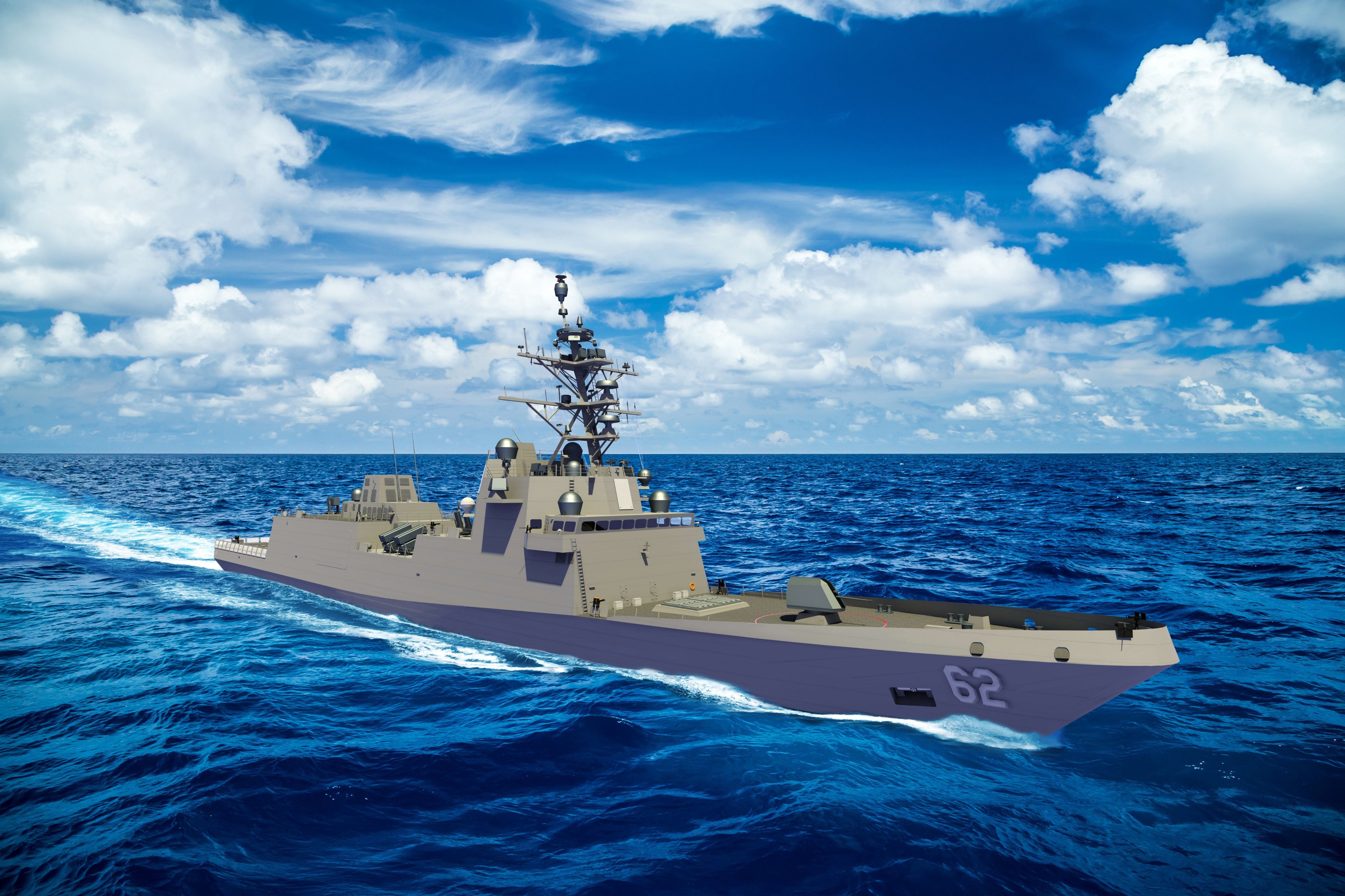
Earlier this year, an assessment published by the Congress watchdog, the Government Accountability Office (GAO), stated that the Constellation-class frigates for the US Navy would be at least 759 metric tons heavier, a 13% increase over previous projections.
Describing the perils of this, it said, “We previously reported that unplanned weight growth during ship construction can compromise ship capabilities, as the fleet seeks to alter and improve initial capabilities over the planned decades-long service life of the ship. Such alterations may leave frigates less combat capable, limit the ability to add capabilities to address evolving threats, and reduce planned service lives.”
“Navy personnel are working with the shipbuilder to reduce the ship’s weight, but weight growth has only become more pronounced over the last year as the program further developed the frigate design,” the report added.
Separately, as compared to the initial target of 85%, there is only about 15% similarity between the Constellation-class frigates and the FREMM designs.
The future of the Constellation-class came under a scanner this year when the US Defense Secretary Pete Hegseth ordered the military to devise plans for major defense spending cuts over the next five years. At the time, a US-based nonpartisan watchdog group, the ‘Project on Government Oversight,’ suggested that the frigate program be cancelled.
That said, the latest decision has drawn a mixed response from experts, with some calling it a long-overdue gutsy move that will free up money for other alternatives.
Some even contemplated what alternatives the US Navy could consider.
Navy Lookout said on X: “Canadian River-class variant of T26 would be ideal alternative to Constellation, but doubt the US will look overseas again – too much hubris and pork barrelling surrounds US defence procurement. The USN’s failure to design a successful new surface combatant in 30 years is a very serious concern for the free world…”
Meanwhile, others cited Zumwalt and LCS as examples to suggest that design evolution may not have been responsible for the delays and cost overruns.
Interestingly, this comes as China is rapidly expanding its shipbuilding capacity and has now surpassed the US Navy by fleet size.
The Threat From China’s Naval Expansion
The United States has on multiple occasions expressed mounting alarm over the rapid expansion and modernization of the Chinese People’s Liberation Army Navy (PLAN), viewing it as the most significant long-term challenge to American maritime dominance since the end of the Cold War.
According to a previous Pentagon estimate, the People’s Liberation Army Navy is expected to have roughly 400 hulls in service.
Similarly, the US-based think tank, Center for Strategic and International Studies (CSIS), said in a March 2025 report, “Ship Wars – Confronting China’s Dual-Use Shipbuilding Empires,” that China would have a 425-ship strong fleet by 2030, compared to the US Navy’s 300 vessels.
On its part, the US has been alarmed by the rate at which these ships are being built rather than their sophistication. While the US Navy retains qualitative superiority—better-trained crews, more advanced systems—leaders are alarmed by the scale of China’s shipbuilding output.
“I have no doubt about our ships or how we train and use them. But quantity? That’s a concern,” said Adm. James W. Kilby, acting Chief of Naval Operations, during a panel. “Virtually every shipbuilding class we have is behind schedule.”
China’s People’s Liberation Army Navy (PLAN) operates approximately 50 frigates. This figure primarily encompasses modern guided-missile frigates, such as the Type 054A class, which forms the backbone of the fleet, supplemented by the newer Type 054B class.
The Type 054A is a multi-role platform optimized for anti-submarine warfare, air defense, and surface strikes, while the Type 054B introduces enhanced stealth features and improved sensors.
Both are considered crucial for securing its expansive maritime claims, particularly in the South China Sea. And, in a potential Taiwan contingency, frigates would form surface action groups for blockade enforcement or amphibious support, shifting from “near-seas defense” to “far-seas protection.”
In contrast, the US has no frigates in operational service.
When it comes to guided missile cruisers and destroyers, the United States still has an advantage. Destroyers, for one, are considered the backbone of any Navy because of their speed, cruising range, and multi-mission capabilities.
However, frigates typically displacing 4,000–8,000 tons offer a cost-effective way to achieve numerical superiority, enhance distributed operations, and sustain high-tempo warfare.
The Chinese advantage in frigates and corvettes may potentially be obscured by the US dominance in cruisers and destroyers, states a CSIS report titled “Unpacking China’s Naval Build Up.”
During World War II, these smaller ships were crucial as radar picket ships, fleet protection vessels, and convoy escorts, the report stated, adding that they may play comparable roles in a future conflict.
“In a modern conflict, they might serve similar roles, fight enemy ships in the Indo-Pacific’s littoral waters, or perform other missions that naval strategists have not yet foreseen. The US Navy appears to recognize that it might be overinvested in larger cruisers and destroyers,” the report posited.
This appears to be true, particularly as USNI reported that the sea service is currently undergoing a fleet design review, which will influence how the military develops new systems. It, however, added that the Navy requires 73 small surface combatants.
- Contact the author at sakshi.tiwari13 (at) outlook.com
- Follow EurAsian Times on Google News