Six years after Brazil took delivery of the Gripen E fighter jet, the Swedish Air Force has finally received its first domestically produced 4.5-generation Gripen E aircraft.
This perhaps marks the first instance in global aviation history when a client nation acquired aircraft well ahead of the country that developed it.
The first Gripen E of the Swedish Air Force has been delivered to the Skaraborg Wing (F 7) at Satenas air base, near Lidköping, on October 20.
This is the first of the 60 new jets the Swedish Air Force has ordered, marking a significant step in modernizing the country’s air force amid rising tensions in Europe, which is facing a resurgent and increasingly belligerent Russia.
“This is a big day that marks the beginning of a new chapter in Swedish aviation history,” said Skaraborg’s Wing Commander Mattias Ottis. “F 7 Skaraborg Wing is the center of Swedish fighter aircraft development; we are paving the way for the future. We are ready, we are excited, and now we are going for it.”
“This marks an important milestone in the development of the Swedish defense… Gripen E strengthens our national defense capability to meet future threats together with our allies,” added Michael Claesson, commander-in-chief of the Swedish Armed Forces.
Brazil Got Gripen-E Ahead Of Sweden
Notably, the aircraft is joining the Swedish Air Force fleet nearly 5-6 years after joining the Brazilian Air Force.
Brazil received its first Saab JAS 39E Gripen (locally designated F-39E) on September 10, 2019, during a handover ceremony in Linköping, Sweden.
This marked the initial delivery under the 2014 contract for 36 Gripen E/F fighters, with the aircraft initially retained in Sweden for testing before it arrived in Brazil in September 2020.
As of October 2025, Brazil has received eight European-built units, with the first locally assembled Gripen E scheduled for delivery in November 2025.
Brazil was the first export customer of the Gripen E aircraft and has also opened a domestic production line for the fighter jet.
Under the 2014 agreement, Brazil will import 21 Gripen E from Sweden in fly-away condition and will locally produce the remaining 15 aircraft. Unlike Sweden, Brazil is also receiving the two-seat variant of the jet, the Gripen F.
However, following the initial success in Brazil, the Gripen E struggled to secure its next export order for nearly a decade, losing many close contests to the American F-35 Lightning II and the French Rafale.
Earlier this year, in June, Thailand announced plans to buy four Gripen E fighter jets in a US$500 million deal, choosing the Swedish-made planes over American F-16s.
Thailand officially approved the acquisition in August this year, following the Gripen-C/D’s combat deployment against Cambodia. The event also marked the combat debut of JAS-39 Gripens.
Earlier in April, Colombia also selected the Gripen E/F as its next fighter jet.
The back-to-back export orders to Thailand and Colombia, over a decade after Brazil first ordered them, have once again revived interest in Gripen E/F fighter jets.
Notably, according to the Swedish Defense Minister Pål Jonson, the Gripen E/F is an entirely new fighter jet, and not just an upgrade of the older Gripen C/D variants.
Gripen E: Entirely New Fighter Jet
Writing on the social media platform X, Sweden’s Defense Minister, Pål Jonson, said: “Gripen E is an example of Swedish technological forefront and is a modern fighter aircraft that is essentially completely new in all respects.”
“The aircraft contains advanced electronic warfare equipment and can update new software in the aircraft within hours. This enables rapid innovation & flexibility. Gripen E is also being tested with AI capabilities that have attracted international attention.”
In outward appearance, the Gripen E looks quite similar to the Gripen C/D variants; however, in terms of capabilities and firepower, it’s an entirely new beast, so much so that many defense analysts believe that SAAB should have given it an entirely new name.
På plats vid F7 Såtenäs där Försvarsmakten idag tar emot den första av 60 JAS Gripen E. Det är en viktig dag för flygvapnet och det svenska försvaret. Gripen E är ett exempel på svensk teknologisk framkant och är ett modernt stridsflyg som i allt väsentligt är helt nytt. (1/3) pic.twitter.com/Bse70Hb5DX
— Pål Jonson (@PlJonson) October 20, 2025
In terms of size, the Gripen E is slightly bigger than the Gripen C variants. The Gripen E is 15.2 meters in length, as compared to the Gripen C, which is 14.9 meters in length. The Gripen E features a beefed-up fuselage that accommodates approximately 30% more fuel, extending its range.
The new aircraft can also carry a heavier load than its predecessor. The Gripen E’s maximum take-off weight is 16,500 kg, as compared to Gripen C’s 14,000 kg.
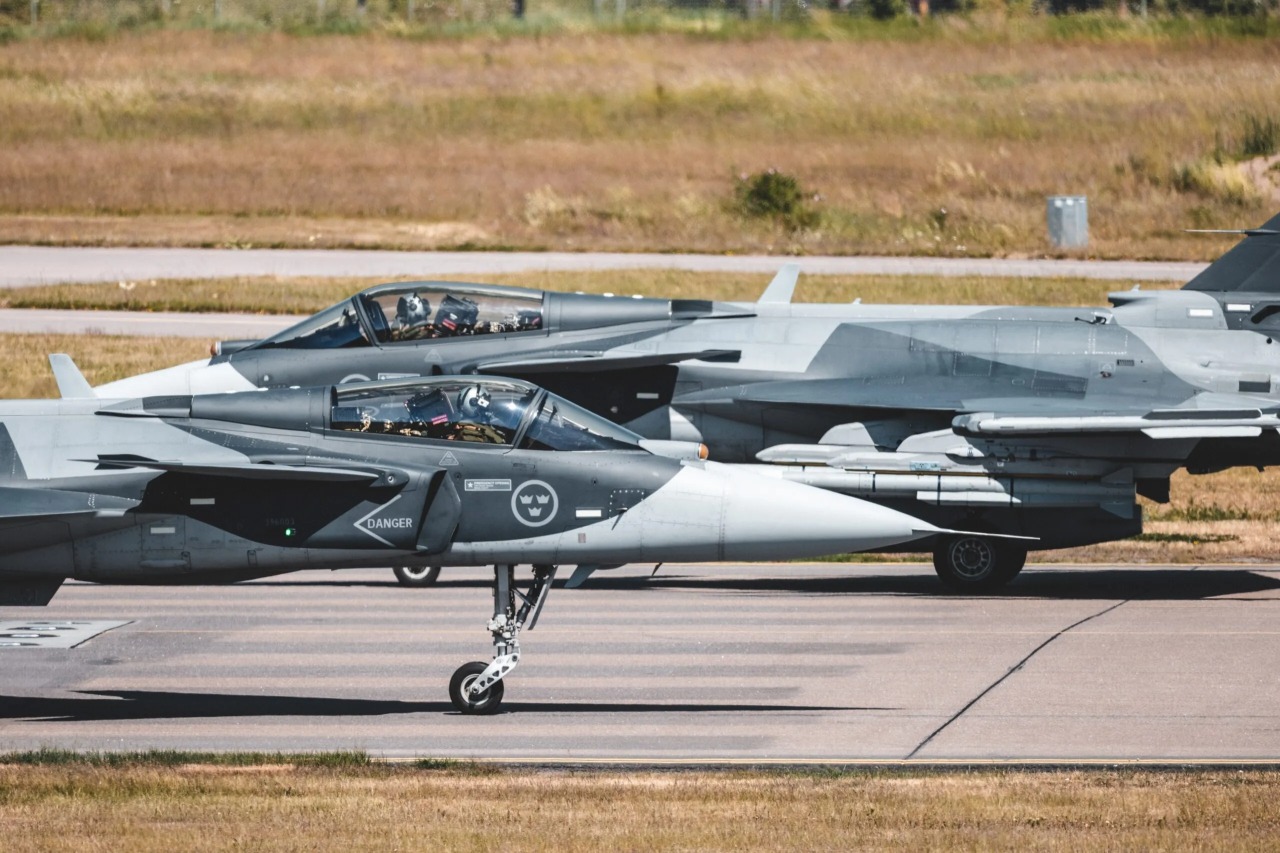
The Gripen E features the more advanced and powerful GE F414G engine, which produces 98 kN of thrust. In contrast, the Gripen C was powered by the Volvo RM12 engine, based on the GE F404, producing 80.5 kN of thrust.
In terms of armaments, the Gripen E features 10 hardpoints against Gripen C’s eight hardpoints.
On those 10 hardpoints, the Gripen E can carry four Saab RBS 15 anti-ship missiles, up to nine air-to-air missiles, or 16 Small Diameter Bombs.
“It’s a completely new system — built to meet future requirements for survivability, range, sensors, and interoperability. It’s the result of Swedish engineering and innovation with a clear focus on operational effectiveness,” said Ottis.
The Gripen E also features an AESA radar, Infrared Search and Track System (IRTS), and highly advanced electronic warfare and communication systems.
According to SAAB, the Gripen E’s “embedded AI capability and its future-oriented cockpit design that features the Wide Area Display (WAD), facilitate the pilot’s decision-making process and provide crucial assistance in the midst of a complex mission.”
“The WAD presents the information in a user-friendly way, which supports the pilot’s ability to select, launch, and guide weapons in perfect coordination with other members of a tactical air unit.”
Due to advanced radar, IRST, and highly advanced electronic warfare and communications systems, the Gripen E can operate in a different threat environment than the Gripen C/D.
“The Armed Forces have had to find a way to operate in an environment that is called a ‘contested environment’, i.e., an area where you do not have your own control. In the past, you could take off and land in a controlled environment,” the Swedish Air Force said in a statement.
“Today, even when the aircraft takes off, we find ourselves in an environment that is uncertain, hence the need to develop a new and more capable combat aircraft system.”
At the same time, the Swedish Air Force claims that the Gripen E is as maneuverable and easy to operate as the Gripen C/D variants.
“What is good about the JAS 39 Gripen C/D remains in the E. The aircraft is just as easy to fly and maneuver. Pilots who have flown the JAS 39 Gripen C/D will recognize themselves in the E. The difference lies in how the pilot makes decisions in the new E. There is much more information to deal with, more sensors and other weapons.”
Meanwhile, even as the Swedish Air Force receives deliveries of the Gripen E fighter jets, Sweden is already planning for what might come next.
The Swedish Defense Materiel Administration (FMV) recently awarded Saab a US$276 million contract for conceptual studies for the next-generation fighter aircraft, scheduled to take place from 2025 to 2027.
The contract includes conceptual studies of manned and unmanned solutions in a system-of-systems perspective, as well as technology development and demonstrators, according to an official press statement published by Saab.
For this, the company will collaborate closely with FMV, the Swedish Armed Forces, the Swedish Defence Research Agency, GKN Aerospace, and other industry partners.
This is the continuation of the contract awarded to SAAB in March 2024 for conceptual studies for crewed and uncrewed fighters, as previously reported by the EurAsian Times.
As Sweden plans to gradually replace its older Gripen C/D variants with the new Gripen E models, reports indicate that some of the older C/D variants could be transferred to Ukraine to support its fight against Russia.