Lockheed Martin’s F-35 is arguably the most popular aircraft. The fifth-generation fighter jet has already delivered over 1,200 units, and total program commitments exceed 3,000 aircraft across 20 nations.
There are currently more F-35s in the world than all other fifth-generation fighter jets (F-22s, Su-57s, J-20s, and J-35s) combined.
Not just that, at least eight countries, among them Turkey, Egypt, Saudi Arabia, the UAE, Taiwan, and Qatar, have requested or expressed interest in purchasing the jet, only to be turned down by the United States.
The F-35’s popularity is soaring despite concerns about the US maintaining strict control over its source code, spare parts supply, and its terms of use.
The United States is highly protective of the F-35 and its technology. All F-35 export sales come loaded with demanding conditions, terms of use, and restrictions on buying other countries’ defense equipment.
For instance, Turkey was kicked out of the F-35 program in 2018 only because it decided to buy the Russian S-400 air defense system.
The US has forbidden Israeli pilots with dual nationality from flying the F-35. The US also does not allow countries to fly F-35 in joint exercises with countries that operate the Russian S-400 air defense system.
This strict control over the sale and use of F-35s might give the wrong impression that the F-35 is solely a US program. However, contrary to popular belief, the F-35 Joint Strike Fighter (JSF) program has been a joint-development effort with eight other countries since its inception.
In fact, according to Lockheed Martin, nearly 30 to 42 per cent of the jet is manufactured outside the US across three continents before final assembly in Texas.
The Founding Members Of The F-35 Program
Unlike the F-22 Raptor, which was designed exclusively for the US Air Force, the F-35 was conceived as a multirole fighter for the US Air Force, Navy, and Marine Corps, as well as key allies.
All international partners were organized into investment tiers when the program began in the 1990s.
The UK remains the sole Tier 1 partner, with an initial investment of USD 2.5 billion in the JSF program. The UK also has the greatest access to F-35 technology and data outside the US.
Italy and the Netherlands are Tier 2 partners, with initial investments of USD 1 billion and USD 800 million, respectively.
Australia, Canada, Denmark, and Norway are Tier 3 partners. Turkey was one of the founding participants in the JSF program; however, Turkey was kicked out in 2018 due to the controversial purchase of the Russian S-400 AD system.
Besides, other nations, including Japan and Israel, participate through Foreign Military Sales (FMS) or special cooperative agreements.
This sourcing of parts from multiple suppliers around the globe makes the F-35 JSF program one of the most globally distributed fighter jet development programs ever.
The Global Supply Line Of F-35
Each F-35 takes about 18 months or nearly 42,000 labour hours to complete. At the beginning of the assembly line, each jet starts with just a wing.
Being the sole Tier 1 partner in the F-35 program, the UK also has a significant share in the F-35 parts manufacturing.
While Lockheed Martin is the primary contractor, the UK’s BAE Systems is a principal partner. BAE is supplying much of the software code, the rear fuselage for the F-35, tails, the AN/ASQ-239 Barracuda electronic warfare system, the antenna, various avionics, and much more.
Another British contractor, Martin Baker, is providing the ejection seats.
The LiftSystem found in the F-35B variant is made by the UK’s Rolls-Royce (the only company building that type of STOVL lift fan).
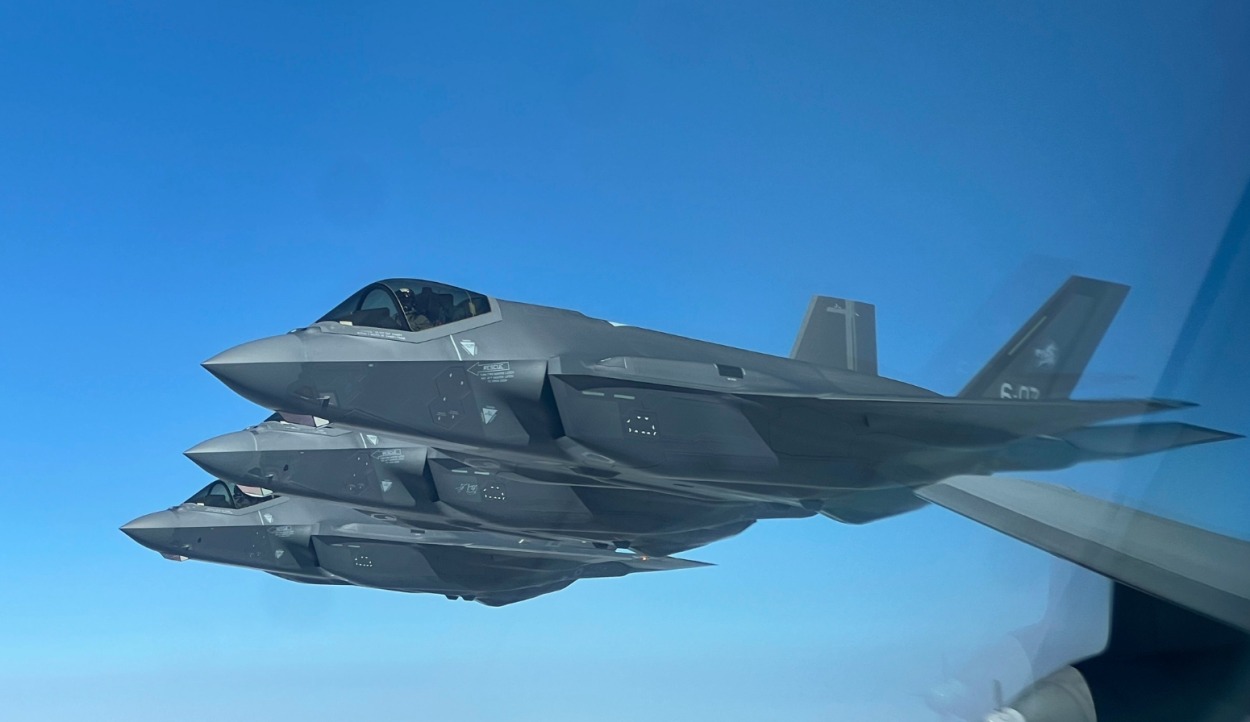
In fact, around 15% of the parts in the F-35 are built in the United Kingdom, including some critical components such as ejection seats, source code, rear fuselage, empennages, and the LiftSystem for the STOVL variant.
According to the BAE, “the rear fuselage of every F-35 in the global fleet is built at our state-of-the-art advanced manufacturing and assembly facilities in Lancashire, UK. We manufactured our first rear fuselage in 2005, and in 2023, we marked the delivery of the 1000th component to Lockheed Martin.”
“We also manufacture vertical and horizontal tails for the F-35 in the UK, with some of this work also done by our industrial partners in Canada and Australia.”
“We also deliver key systems and electronics onboard the jets. We are world leaders in electronic warfare capability, and our engineers in New Hampshire and Texas in the US provide the electronic warfare suite for the F-35, which includes fully integrated radar warning, targeting support, and self-protection, to detect and defeat surface and airborne threats,” it said.
Other notable British contractors include SELEX, Cobham, Ultra Electronics, and UTC Actuation Systems.
Next come the Tier II partners: Italy and the Netherlands.
Leonardo is the leading Italian contractor, with a workshare of around 4.1%. Italy produces various components, including electro-optical targeting systems, radios, engine components, and more.
Cameri in Italy also has a final assembly and check-out facility for the F-35 in Europe.
From the Netherlands, GKN Fokker is a key contractor on the F-35 program, manufacturing critical components including doors, hatches, the drag parachute system, radar systems, and other components. It also manages spare parts for over 500 European F-35s.
Australia makes vertical tails and uplock actuator systems.
Over 700 critical pieces of the aircraft are built in the Australian state of Victoria alone, and over 70 companies across Australia have contracts, Aerospace Global News reported. ASDAM Group (formerly RUAG Australia) is Australia’s largest supplier to the F-35 program.
Lockheed Martin says about 30 companies in Canada are currently involved in the F-35 program, employing about 2,000 Canadians. Canadian companies supply parts for all three variants of the jet: F-35A, F-35B, and F-35C.
Canadian companies make foldable wings for jets that land on aircraft carriers, and composite panels that are structural, lightweight, and stealthy.
Christie Digital, a projector and LED display company located in Kitchener, Ontario, won a contract with Lockheed Martin just last year to help build the next generation of F-35 flight simulators.
Christie supplies the micro LED tiles for Lockheed Martin’s Amorphic Appearance Zero-Projector (AMAZE) visual display system.
Overall, Canadian companies have a workshare of over 3% in the F-35 Program.
Norway contributes air-to-air pylons, vertical leading edges, and more, while Finland supplies front fuselage sections and other components.
Rheinmetall in Germany is also producing fuselage sections for nearly 400 F-35s.
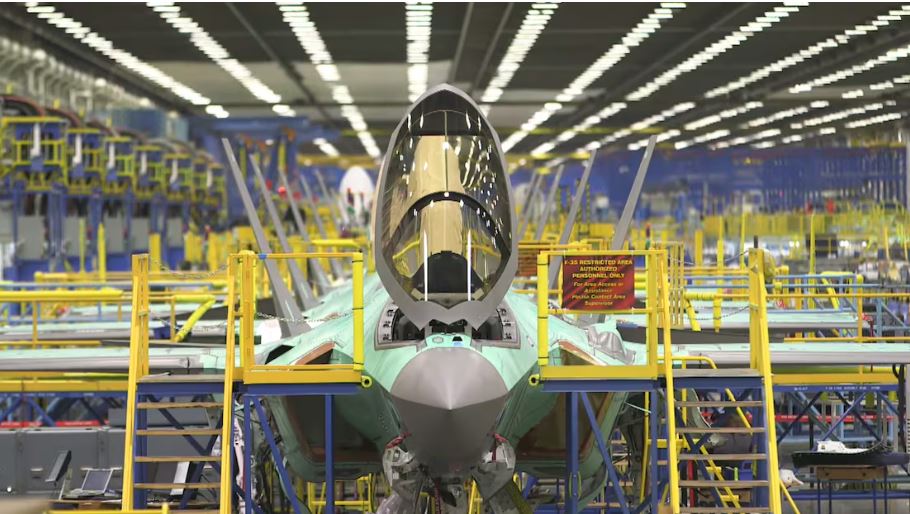
Japan assembles its own F-35As and produces some components domestically.
Israel contributes outer wings, helmet-mounted displays, EW systems, and fuel tanks.
Even within the US, while Lockheed Martin is the prime contractor, many other companies participate in the program, such as Northrop Grumman, Pratt & Whitney (which makes the engines), Raytheon, Honeywell, Curtiss-Wright Corporation, L3Harris Technologies, and Collins Aerospace.
However, notwithstanding its global supply chain, the U.S. retains 100% control over the F-35 due to its ownership of the program’s intellectual property (IP), software source code, and production oversight.
The Department of Defense and Lockheed Martin tightly guard sensitive technologies, such as the jet’s stealth capabilities and ALIS logistics system, imposing strict export conditions and usage restrictions.