

Russia has transformed Iran’s infamous Shahed-136 “kamikaze” drone into a flying missile trap — arming the loitering munition with Soviet-era R-60 air-to-air missiles to hunt down Ukrainian interceptors, drones, and even helicopters.
On December 1, 2025, the drone war entered a new phase: a Ukrainian Sting interceptor drone shot down a Russian Shahed-136 that was carrying a live Soviet-era R-60 air-to-air missile — the first confirmed kill of this Frankenstein hybrid.
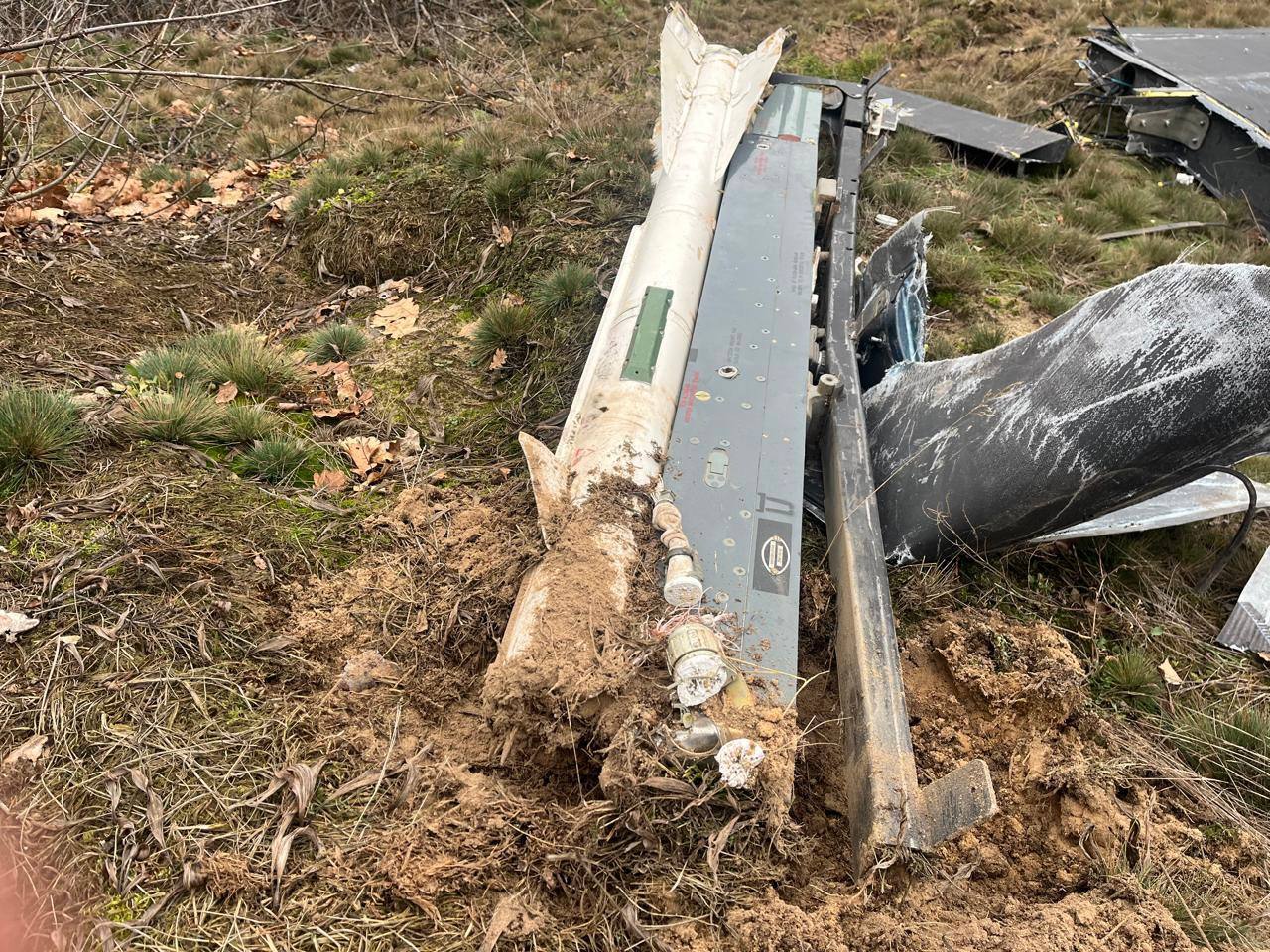
Wreckage photos exploded across Telegram within hours, posted by Ukraine’s most-followed military channel, Serhii “Flash,” who wrote: “Today we saw it for the first time — a Shahed armed with an R-60 missile. The Russians are now trying to kill the very aircraft and drones that hunt their drones.”
The drone was intercepted over Ukrainian territory by the Darknode Battalion of the 412th Nemesis Brigade, which is part of Ukraine’s Special Operations Forces. Additionally, the Sternenko Community Foundation, a Ukrainian non-governmental group that helps supply the country’s armed forces with unmanned aerial vehicles, also published a video of the interception.
The Shahed-136 drone was successfully downed before it could fire the R-60 missile. Video footage from the Sting drone’s onboard camera captured the approach, clearly showing the R-60 mounted on an improvised rail atop the drone’s nose.
🔥🤩 Darknode Battalion of the 412th Nemesis Brigade shot down a Shahed carrying an R-60 aircraft missile. pic.twitter.com/YG8Xm24K5h
— MAKS 25 🇺🇦👀 (@Maks_NAFO_FELLA) December 1, 2025
Introduced on the battlefield in Ukraine in September 2022, the Shahed-136 is a long-range, high-flying, expendable unmanned aerial vehicle. It has been extensively deployed by the Russian Armed Forces to attack Ukraine’s energy grid, power plants, and other critical infrastructure. Russia has been launching these low-cost drones in swarms to overwhelm Ukrainian air defenses.
Kyiv quickly realised it could not burn million-dollar Patriot or NASAMS missiles on every $30,000 drone. Enter the Sting — a fast, reusable interceptor drone built by the volunteer Wild Hornets group and crowdfunded largely through Serhiy Sternenko’s community.
Flying at 200 km/h with a fraction of the cost of a traditional SAM, Sting teams have already shredded thousands of Shaheds and turned the night sky into a hunter’s playground.
Russia is upgrading its Shaheds. Ukrainian channels report that the Russians have used, for the first time, a Shahed equipped with an R-60 air-to-air missile. It is reported that this combination is intended to target helicopters that shoot down the Shaheds. pic.twitter.com/qBhQDfbVcR
— WarTranslated (@wartranslated) December 1, 2025
In fact, Ukrainian sources released a video compilation showing 100 of these interceptions earlier this month. However, this is the first time a Shahed-136 has been spotted armed with the R-60, a heat-seeking missile that entered Soviet service in the early 1970s and is currently used by both Russia and Ukraine.
Weighing about 44 kilograms and being just 2.1 meters long, it is lighter than most anti-tank missiles and can be carried by almost anything that flies, potentially making its integration with Shahed-136 easier. Ukraine has also equipped its Ukrainian Unmanned Surface (USV) with R-60 AAM.
This modification likely counters Ukraine’s success in downing Shaheds using Mi-8 and Mi-24 helicopter gunships, missiles launched by fixed-wing aircraft, and interceptor drones. This means that integrating these missiles onto the Shahed-136 is intended to enhance the drones’ survivability.
The modification may aim to create a defensive “escort” capability for Shahed swarms, deterring or neutralizing air threats. The R-60’s 7–8 kilometre range and 3.5 kilogram warhead allow the drone to engage approaching threats before they close in, turning the Shahed into a semi-autonomous “escort fighter” for swarms.
Operators can point the drone’s nose at targets via optical/thermal guidance in man-in-the-loop (MITL) mode, achieving lock-on before launch. This would help them leverage Shahed’s existing video feed for real-time targeting.
By deploying Shahed-136 armed with an air-to-air missile, Russia would directly threaten high-value, slow-moving targets such as Mi-8 and Mi-24 helicopters and potentially even fixed-wing aircraft, which have allegedly been forced to fly at lower altitudes due to the threat of long-range attacks from Russian Su-35s.
Russia could potentially deploy a swarm of Shahed-136 armed with R-60 air-to-air missiles, creating a “missile truck” wall against targets.
The R-60 is a legacy, mass-produced missile with vast stockpiles in Russian arsenals, costing about $50,000–$100,000 per unit, which is far cheaper than modern air-to-air missiles like the R-73. When paired with Shahed, which costs somewhere between $20,000 and $50,000, the total would still be under $150,000—significantly cheaper than millions of dollars’ worth of manned aircraft.
This would have a deterrent effect on Ukraine’s air operations. Even if not every Shahed is armed, the uncertainty would essentially force Ukrainian pilots to adopt more cautious tactics, such as maintaining greater distances or relying more on ground-based or drone interceptors, like the Sting UAV.
This could reduce the efficiency of manned intercepts in contested airspace—a desirable outcome for Russia in current circumstances.
The concept of equipping drones with AAM goes back decades. In 2002, a US Air Force MQ-1 Predator drone fired a Stinger heat-seeking anti-air missile at an Iraqi MiG-25 Foxbat fighter that was trying to shoot it down—marking what was perhaps the first such incident in modern American aviation history. Later, in 2017, a Reaper successfully downed a target drone using an AIM-9X Sidewinder air-to-air missile.
In the modern combat environment dominated by drones, several air forces are now working to make their drones air-to-air combat machines. For instance, Turkey recently test-fired a Gökdoğan from its Kizilelma jet drone, and Boeing Australia is gearing up to conduct a live-fire test with its MQ-29 Ghost Bat, firing an air-to-air missile.
Shahed Drones Continue To Haunt Ukraine
Designed by Iran and mass-produced under license by Russia with substantial modifications, the Shahed-136 drones have emerged as Moscow’s weapon of choice in the Ukraine War. Notably, Russia also fires dozens of decoys with these drones to confuse and overwhelm Ukrainian air defense systems.
Though the drone was initially purchased from Iran, Russia has been known to manufacture these drones locally for quite some time. Russia is already producing 4,000 to 5,000 long-range Shahed-136 drones every month.
The Yelabuga factory alone is believed to have produced over 18,000 drones in the first six months of 2025. Analysts warn that Russia can further scale its drone production in the coming months.
The kamikaze drones provide Russia with an expendable and cost-effective alternative to its expensive cruise and ballistic missiles. The idea behind deploying them in large numbers is that even if these drones are shot down, they would still deplete Ukraine’s stockpile of expensive surface-to-air missiles (SAMs).

The Shahed-136 drone operates autonomously, meaning it does not require real-time human control after launch. It relies on basic waypoint navigation but remains vulnerable to electronic warfare (EW) techniques such as GPS spoofing or jamming.
Russia has also given six upgrades to newly produced Shahed drones and has been relentlessly working to enhance the targeting and navigation modules.
The Ukrainian engineers claimed earlier this year that since the latest Shahed variants no longer rely on GPS, they have become impervious to Ukraine’s electronic warfare capabilities. Instead, they have found a way to leverage AI and Ukraine’s mobile internet networks. Some reports stated that these drones were now being guided by Telegram bots that provide human operators with real-time flight data and video feed.
Last year, the drone was reportedly upgraded and equipped with electro-optical sensors. At the time, analysts said the Russians were equipping the kamikaze drones with cameras for visual reconnaissance.
Typically, EO sensors can provide visual imagery that enables operators to identify targets accurately. These sensors can effectively identify targets so long as visibility is excellent.
EO sensors combine optical and infrared detection capabilities. The height at which the sensor is mounted and its sensitivity determine the detection range. UAV-based optical sensors not only command height but are also mobile, facilitating surveillance.
A historic first for Ukraine as the country has reportedly used one of its homegrown „Sting” drones to shoot down a new Russian jet-propelled Shahed „Geran-3.” pic.twitter.com/Hrl2qak93P
— TVP World (@TVPWorld_com) December 2, 2025
Moreover, it has reportedly fielded a jet-powered variant of the Shahed-136 or Geran-2, known as the Shahed-236. It is also commonly known as the Geran-3. In fact, a video of the Sting interceptor drone downing the Geran-3 was recently published on social media, marking the first time this variant had been taken down by the Sting.
The appeal of the Shahed drones has reached the United States. The US Air Force (USAF) has asked the industry to produce identical copies of the Shahed-136 drone to develop and test defenses against the Iranian-designed system.
- Contact the author at sakshi.tiwari13 (at) outlook.com
- Follow EurAsian Times on Google News


